Loading...
Pulp & Paper in Burnaby, British Columbia
Industrial Wastewater Canada sizes and supplies pulp & paper for plants in Burnaby, British Columbia. Local demand is driven by food & beverage, metal fabrication, biotech, electronics, discharging under Burnaby's sewer-use rules toward Fraser River / Burrard Inlet. Quote requests with flow rate and effluent type get a sized proposal.
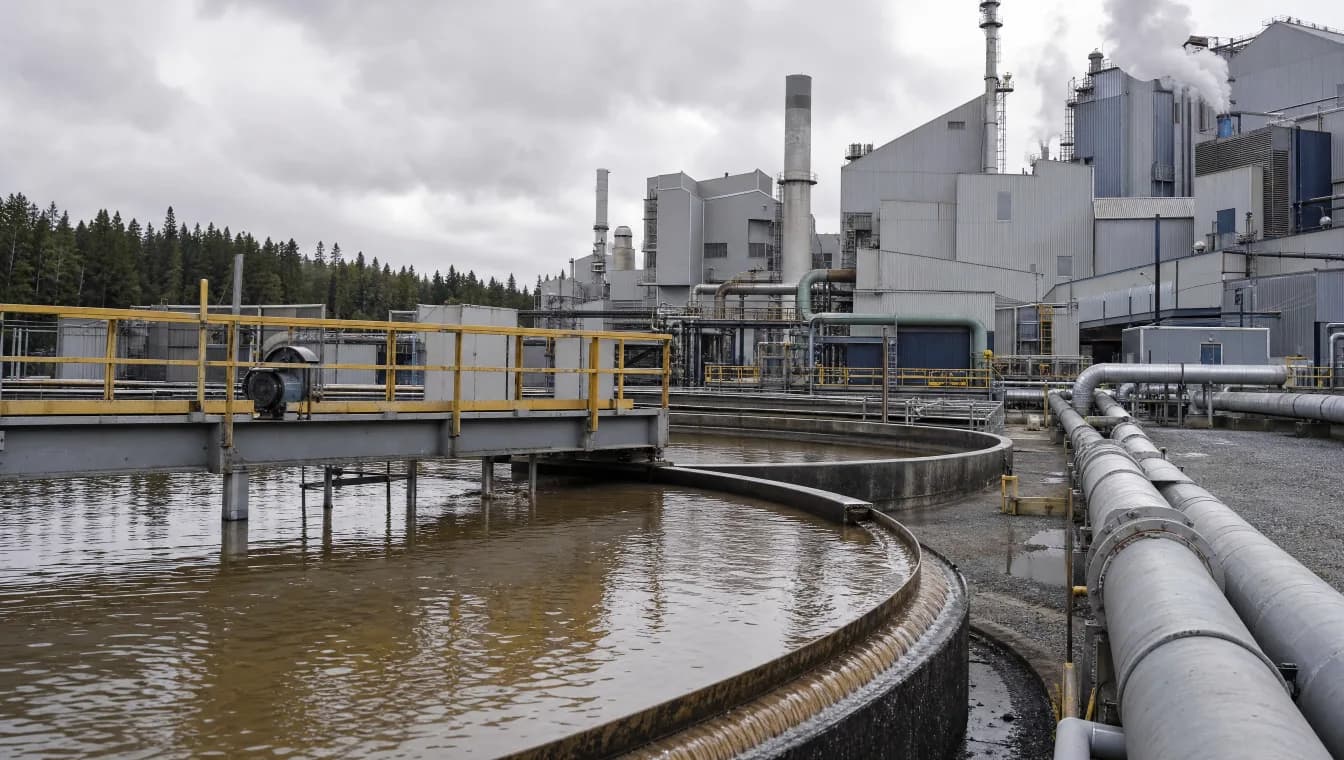
Pulp and paper is the most water-intensive manufacturing sector in Canada, and it operates under the most specific federal effluent rules of any industry we serve. The Pulp and Paper Effluent Regulations under the Fisheries Act set limits on BOD and total suspended solids and require environmental effects monitoring on the receiving water. Mills have lived with these rules for decades, which means pulp and paper wastewater treatment projects are rarely about building a first system. They are about debottlenecking, upgrading or replacing stages inside an existing treatment plant while the mill keeps running.
Effluent varies with the process
The effluent itself varies with the process. Kraft mills contribute black liquor losses, foul condensates and bleach plant filtrates. Mechanical pulping releases fine fibre and dissolved wood extractives that carry both BOD and toxicity to fish. Paper machines add white water rich in fibre and filler. What the streams share is volume: even a mid-size mill moves more effluent in a day than a small city.
Primary clarification, our main lever
Primary clarification is where we most often help. A lamella clarifier can add settling capacity inside a fraction of the footprint a conventional circular unit needs, which matters when the upgrade has to fit between existing structures. Fibre recovered at this stage often goes straight back into the process, so a better clarifier pays twice. Secondary treatment at most mills is an aerated basin or activated sludge plant; where nutrient dosing, foam or bulking are limiting performance, targeted equipment changes cost far less than a rebuild. On the sludge line, screw presses and belt filter presses cut the dewatering and haulage bill, and dewatered sludge feeds hog fuel boilers at many kraft sites.
Equipment for Canadian mills
We supply clarifiers, DAF units for white water recovery, dewatering equipment and spare capacity for mills across Ontario, Quebec, and the western provinces. Send us the bottleneck, the flow numbers and the outfall limits, and we will propose the narrowest change that fixes it. Timing matters more than technology in this sector: treatment upgrades compete for the same maintenance shutdown windows as everything else in the mill, so we build delivery and installation schedules around your planned outage rather than asking the mill to schedule around us.
Burnaby's industry concentrates in the Big Bend flats along the Fraser and the Still Creek corridor, some of the last close-in industrial land in Metro Vancouver. Food and beverage plants, metal fabricators, biotech firms and electronics manufacturers share those zones in a city of 249,000, and every significant discharger holds a waste discharge permit under GVS&DD Bylaw 299. Still Creek runs through the middle of it Still Creek is the detail that changes behaviour here. Still Creek—Big Bend industrial zone; GVS&DD Bylaw 299 permits. That is the regulatory backdrop for pulp & Paper in Burnaby: equipment gets sized against the local limits on the route to Fraser River / Burrard Inlet, not against a national average.
Location
Burnaby, British Columbia
Population 249K
Receiving Water
Fraser River / Burrard Inlet
Pricing
Sized & quoted per project
What's Included in Burnaby
Sizing against Burnaby's sewer-use and surcharge regime (still Creek—Big Bend industrial zone; GVS&DD Bylaw 299 permits)
Support for direct-discharge projects requiring a waste discharge authorization under British Columbia's Environmental Management Act
Effluent characterization matched to Burnaby's dominant dischargers: food & beverage, metal fabrication, biotech, electronics
Discharge route review for systems releasing toward Fraser River / Burrard Inlet
Pulp & Paper on the ground in Burnaby
With salmon-bearing Still Creek running straight through Burnaby's industrial corridor, wastewater diligence here goes beyond the Bylaw 299 permit, because a creek incident is public within hours. In Burnaby, the plants asking about pulp & Paper are mostly in food & beverage, metal fabrication, biotech and electronics, and each of those sectors puts a different load on a treatment train. Still Creek—Big Bend industrial zone; GVS&DD Bylaw 299 permits. Direct discharge toward Fraser River / Burrard Inlet instead requires a waste discharge authorization under British Columbia's Environmental Management Act. In a city of Burnaby's size the industrial dischargers are few enough that the utility knows each one by name, which cuts both ways at permit renewal. Projects in Burnaby tend to be one-of-a-kind rather than repeat configurations, which is exactly the case where sizing from measured effluent data matters most.
FAQ
Frequently Asked Questions
Everything you need to know about our services.
Do you supply pulp & Paper in Burnaby?
Yes. Industrial Wastewater Canada sizes and supplies pulp & Paper for plants across Burnaby and the surrounding region. Most local demand comes from food & beverage, metal fabrication, biotech, electronics. Send a quote request with your flow rate and effluent type and a sized proposal follows.
What discharge rules apply to industrial wastewater in Burnaby?
Still Creek—Big Bend industrial zone; GVS&DD Bylaw 299 permits. A salmon-bearing urban stream flowing directly through the industrial corridor means a spill or a cross-connection is visible within hours, in a region where stream stewardship groups are organized and vocal. Plants in the corridor invest in secondary containment, drain mapping and stormwater segregation beyond the letter of their permits because the reputational cost of a creek incident dwarfs the capital saved. Plants discharging to the municipal sewer answer to that regime; anything released directly toward Fraser River / Burrard Inlet needs a waste discharge authorization under British Columbia's Environmental Management Act. We size equipment against whichever limit governs your outfall.
How is pulp & Paper sized for a plant in Burnaby?
From your numbers, not from the city's. We start with measured flow and effluent characterization, then check the result against Burnaby's local limits. A processor in a city of 249K with food & beverage as the dominant sector rarely has the same loading profile as its neighbours, so treatability data drives the selection.
What does pulp & Paper cost in Burnaby?
There is no list price; every system is sized and quoted per project. The economics are local, though. On the process side the work is standard Metro Vancouver fare, DAF for food plants, oil-water separation and metals treatment for fabricators, batch neutralization for biotech, delivered into buildings where floor space is the scarcest input. Payback in Burnaby is usually calculated against those surcharge and compliance costs, and the quote spells that comparison out.
Send the flow rate. Get the system.
Flow, contaminants, discharge limit. An engineer replies with a sized treatment train and a quote — no obligation.
In this city
Equipment available here.
Industrial Wastewater Treatment Systems→Oil Water Separators→Dissolved Air Flotation (DAF) Systems→Membrane Bioreactor (MBR) Systems→MBBR Systems (Moving Bed Biofilm Reactors)→Lamella Clarifiers→Sludge Dewatering Screw Presses→Dewatering Centrifuges→Industrial Reverse Osmosis Systems→Wastewater Evaporators & ZLD Systems→Belt Filter Presses→Coalescing Filters→Industrial Bag & Cartridge Filtration→Food & Beverage Processing→Dairy Processing→Breweries & Distilleries→Meat & Poultry Processing→Pulp & Paper→Pharmaceutical & Biotech→Textile & Dyeing→Mining & Mineral Processing→Oil & Gas / Produced Water→Metal Finishing & Plating→Chemical Manufacturing→Power, Boilers & Cooling Towers→
Nearby cities