Loading...
Membrane Bioreactor (MBR) Systems in Surrey, British Columbia
Industrial Wastewater Canada sizes and supplies membrane bioreactor (mbr) systems for plants in Surrey, British Columbia. Local demand is driven by food processing, wood products, metal fabrication, agritech, discharging under Surrey's sewer-use rules toward Fraser River. Quote requests with flow rate and effluent type get a sized proposal.
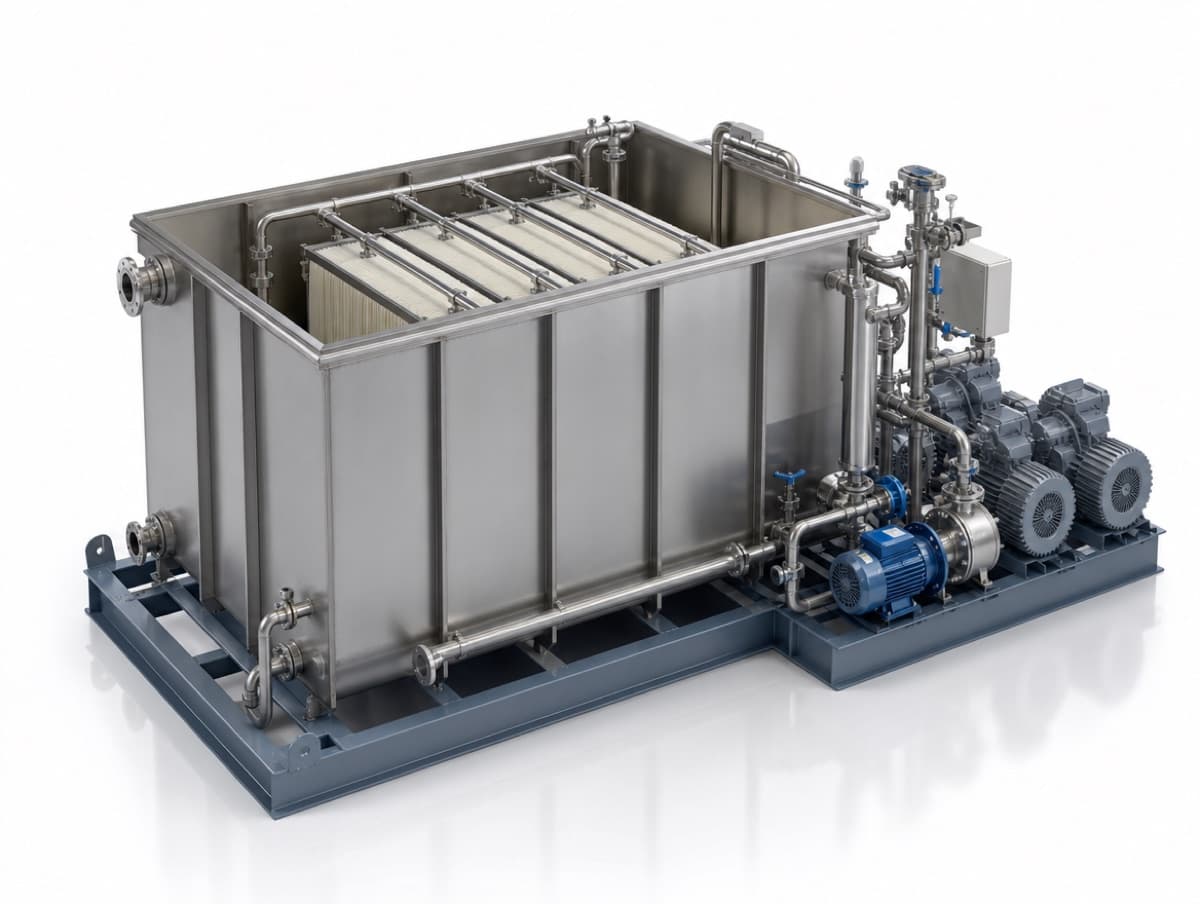
A membrane bioreactor combines two unit processes in one tank: biological treatment that consumes dissolved organics, and ultrafiltration membranes that physically retain the biomass instead of relying on a clarifier to settle it. The result is effluent that is essentially free of suspended solids and most bacteria, clean enough for reuse in washdown or cooling service, or for discharge to sensitive receiving waters.
Higher biomass, smaller footprint
Because the membranes decouple solids retention from settling, an MBR runs at much higher biomass concentrations than conventional activated sludge. That is where the footprint advantage comes from: 50 to 70 percent smaller than a conventional plant treating the same load, which matters when the only available space is inside an existing building. It also explains the stability. High biomass inventory absorbs the load swings that industrial production schedules create, so performance holds through washdown peaks and weekend shutdowns. The strongest fits are food and beverage plants, landfill leachate and high-BOD process water, and any site where reuse or a strict discharge limit justifies the premium.
What our MBR packages include
We supply MBR packages with submerged flat-sheet or hollow-fibre membranes, automated CIP cleaning systems, and the instrumentation to run unattended between operator rounds. The Canadian search interest is real; the membrane bioreactor cluster draws about 1,000 searches a month, the highest of any equipment family we track. But interest is not a specification, so here is the honest trade-off we walk every buyer through. Capital cost is higher than MBBR or conventional treatment because of the membrane modules. Energy use is higher too, since air scouring to keep membranes clean is a significant load. Membranes foul, need routine relaxation and periodic chemical cleaning, and are replaced roughly once a decade, a cost that belongs in your budget from day one. Fats, oils and abrasive solids shorten membrane life, so pre-treatment with fine screening at 1 to 3 mm and FOG removal ahead of the tank is not optional.
When an MBR is the right call
Where footprint is tight, limits are strict, or reuse pays back the premium, an MBR is the right call. Where none of those apply, we will usually recommend MBBR or conventional treatment instead. Send your flow rate, a recent lab analysis and your discharge destination, and a process engineer returns a sized configuration, budget price and delivery timeline for your site, anywhere in Canada. Where the effluent analysis is incomplete, we will specify the sampling program first, because an MBR sized on guesswork wastes exactly the capital premium that makes the technology worth buying.
Surrey holds the fastest-growing industrial land base in British Columbia. As Vancouver's older districts run out of room, food processors, wood-products plants, metal fabricators and agritech operations keep landing in Campbell Heights, Port Kells and Newton, bringing the city past 568,000 residents. Every significant discharger connects to Metro Vancouver's system under GVS&DD Bylaw 299 and its waste discharge permits, with the Fraser River as the ultimate receiving water. Fastest-growing BC industrial land base; GVS&DD Bylaw 299 permits. That is the regulatory backdrop for membrane Bioreactor (MBR) Systems in Surrey: equipment gets sized against the local limits on the route to Fraser River, not against a national average.
Location
Surrey, British Columbia
Population 568K
Receiving Water
Fraser River
Pricing
Sized & quoted per project
What's Included in Surrey
Sizing against Surrey's sewer-use and surcharge regime (fastest-growing BC industrial land base; GVS&DD Bylaw 299 permits)
Support for direct-discharge projects requiring a waste discharge authorization under British Columbia's Environmental Management Act
Effluent characterization matched to Surrey's dominant dischargers: food processing, wood products, metal fabrication, agritech
Discharge route review for systems releasing toward Fraser River
Membrane Bioreactor (MBR) Systems on the ground in Surrey
Surrey's new industrial parks mean most plants are getting their first Metro Vancouver discharge permit, and wastewater pretreatment designed into the greenfield build costs a fraction of the retrofit. In Surrey, the plants asking about membrane Bioreactor (MBR) Systems are mostly in food processing, wood products, metal fabrication and agritech, and each of those sectors puts a different load on a treatment train. Fastest-growing BC industrial land base; GVS&DD Bylaw 299 permits. Direct discharge toward Fraser River instead requires a waste discharge authorization under British Columbia's Environmental Management Act. Surrey is big enough that the sewer utility samples industrial connections routinely, so an out-of-spec effluent gets noticed within a billing cycle. Projects in Surrey tend to be one-of-a-kind rather than repeat configurations, which is exactly the case where sizing from measured effluent data matters most.
FAQ
Frequently Asked Questions
Everything you need to know about our services.
Do you supply membrane Bioreactor (MBR) Systems in Surrey?
Yes. Industrial Wastewater Canada sizes and supplies membrane Bioreactor (MBR) Systems for plants across Surrey and the surrounding region. Most local demand comes from food processing, wood products, metal fabrication, agritech. Send a quote request with your flow rate and effluent type and a sized proposal follows.
What discharge rules apply to industrial wastewater in Surrey?
Fastest-growing BC industrial land base; GVS&DD Bylaw 299 permits. New buildings, first permits What distinguishes Surrey is how many plants are getting their first permit rather than renewing an old one. A processor moving from a grandfathered Vancouver site into a new Campbell Heights building discovers that Metro Vancouver wants characterization data and a pretreatment plan before start-up, not after the first violation. Plants discharging to the municipal sewer answer to that regime; anything released directly toward Fraser River needs a waste discharge authorization under British Columbia's Environmental Management Act. We size equipment against whichever limit governs your outfall.
How is membrane Bioreactor (MBR) Systems sized for a plant in Surrey?
From your numbers, not from the city's. We start with measured flow and effluent characterization, then check the result against Surrey's local limits. A processor in a city of 568K with food processing as the dominant sector rarely has the same loading profile as its neighbours, so treatability data drives the selection.
What does membrane Bioreactor (MBR) Systems cost in Surrey?
There is no list price; every system is sized and quoted per project. The economics are local, though. That timing is an opportunity: pretreatment designed into a greenfield build costs a fraction of a retrofit and can be sized for the ten-year plan, not the opening-day flow. We spend much of our Surrey work at the drawing stage, keeping plants ahead of the permit instead of chasing it. Payback in Surrey is usually calculated against those surcharge and compliance costs, and the quote spells that comparison out.
Send the flow rate. Get the system.
Flow, contaminants, discharge limit. An engineer replies with a sized treatment train and a quote — no obligation.
In this city
Equipment available here.
Industrial Wastewater Treatment Systems→Oil Water Separators→Dissolved Air Flotation (DAF) Systems→Membrane Bioreactor (MBR) Systems→MBBR Systems (Moving Bed Biofilm Reactors)→Lamella Clarifiers→Sludge Dewatering Screw Presses→Dewatering Centrifuges→Industrial Reverse Osmosis Systems→Wastewater Evaporators & ZLD Systems→Belt Filter Presses→Coalescing Filters→Industrial Bag & Cartridge Filtration→Food & Beverage Processing→Dairy Processing→Breweries & Distilleries→Meat & Poultry Processing→Pulp & Paper→Pharmaceutical & Biotech→Textile & Dyeing→Mining & Mineral Processing→Oil & Gas / Produced Water→Metal Finishing & Plating→Chemical Manufacturing→Power, Boilers & Cooling Towers→
Nearby cities