Key Takeaways
- An oil-water separator handles free, floating oil and costs almost nothing to run.
- A DAF handles emulsified oil, fats and suspended solids, but needs air, chemicals and daily attention.
- The jar test that tells them apart takes an afternoon.
- Many plants need the separator first and the DAF after it, not one or the other.
These two units get confused because both remove oil, and vendors of each will happily quote your project. They solve different problems. Choosing wrong in either direction hurts: a separator installed against emulsified dairy fat removes almost nothing, and a DAF installed where a simple separator would do burns chemical and power budget forever. Here is the difference, and the test that settles it.
What an oil water separator actually removes
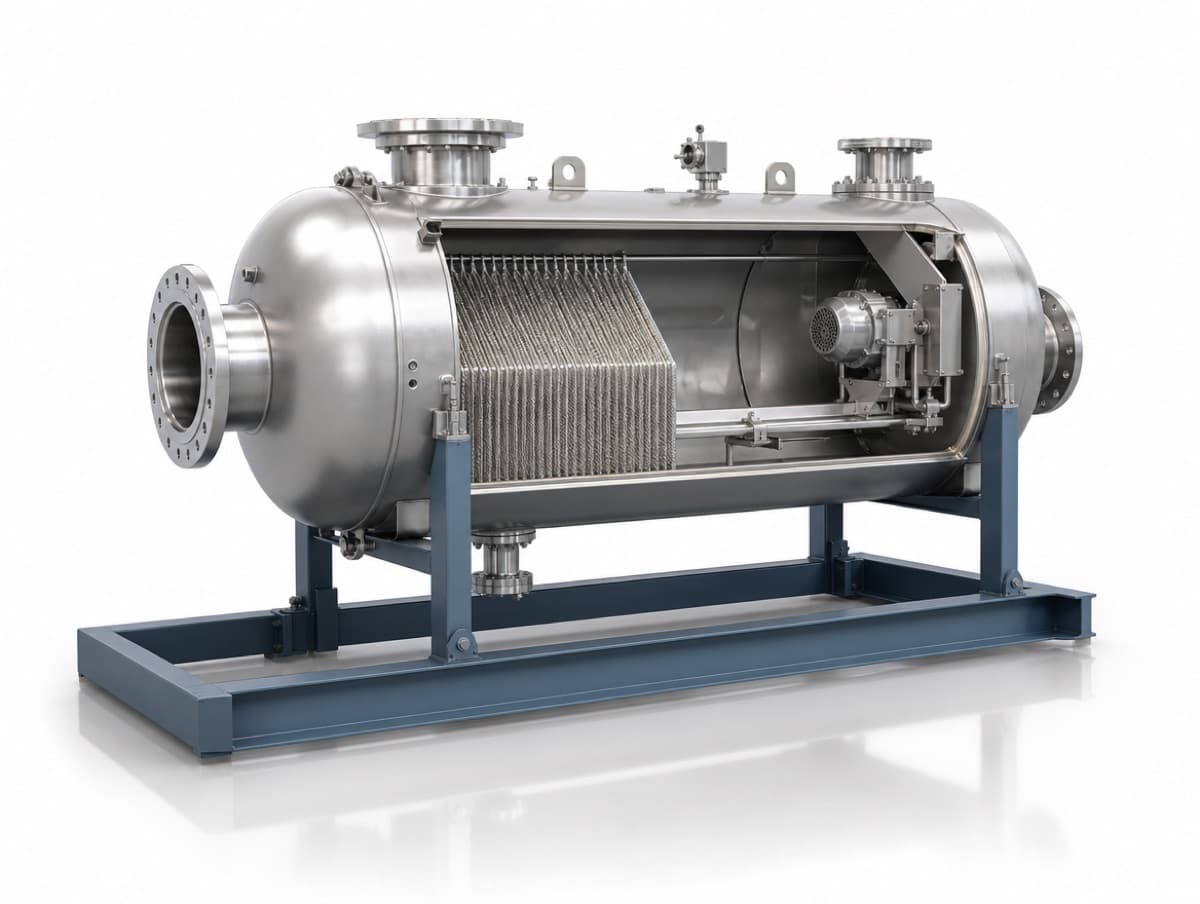
A gravity oil-water separator works on Stokes' law: oil droplets rise because they are lighter than water, and the vessel gives them time and quiet conditions to reach the surface. Coalescing plate packs speed this up by giving small droplets a surface to merge on. The whole mechanism depends on the oil being free, meaning present as droplets that can rise on their own.
That covers tramp oil at a machine shop, fuel spills in vehicle wash water, and hydraulic fluid leaks. A well-run coalescing separator brings free oil down to roughly 10 to 15 mg/L, which meets most Canadian municipal sewer bylaws for hydrocarbons. Operating cost is close to nil: no chemicals, no compressed air, occasional plate-pack cleaning and sludge pump-out.
What DAF water treatment removes that a separator cannot
Emulsified oil is a different substance in practice. Detergents from washdown, homogenized fats from food processing, and machining coolants all hold oil in droplets far too small to rise. They pass through a gravity separator nearly untouched.
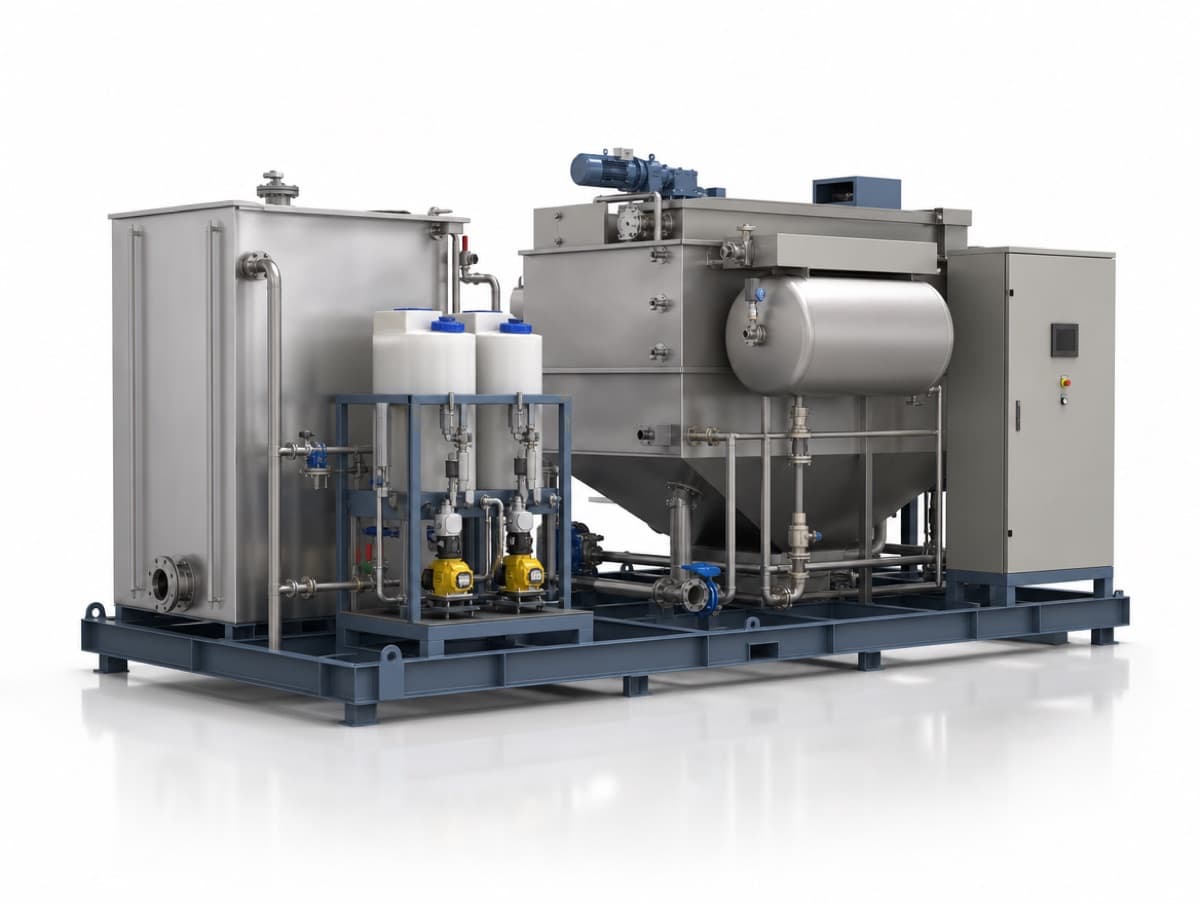
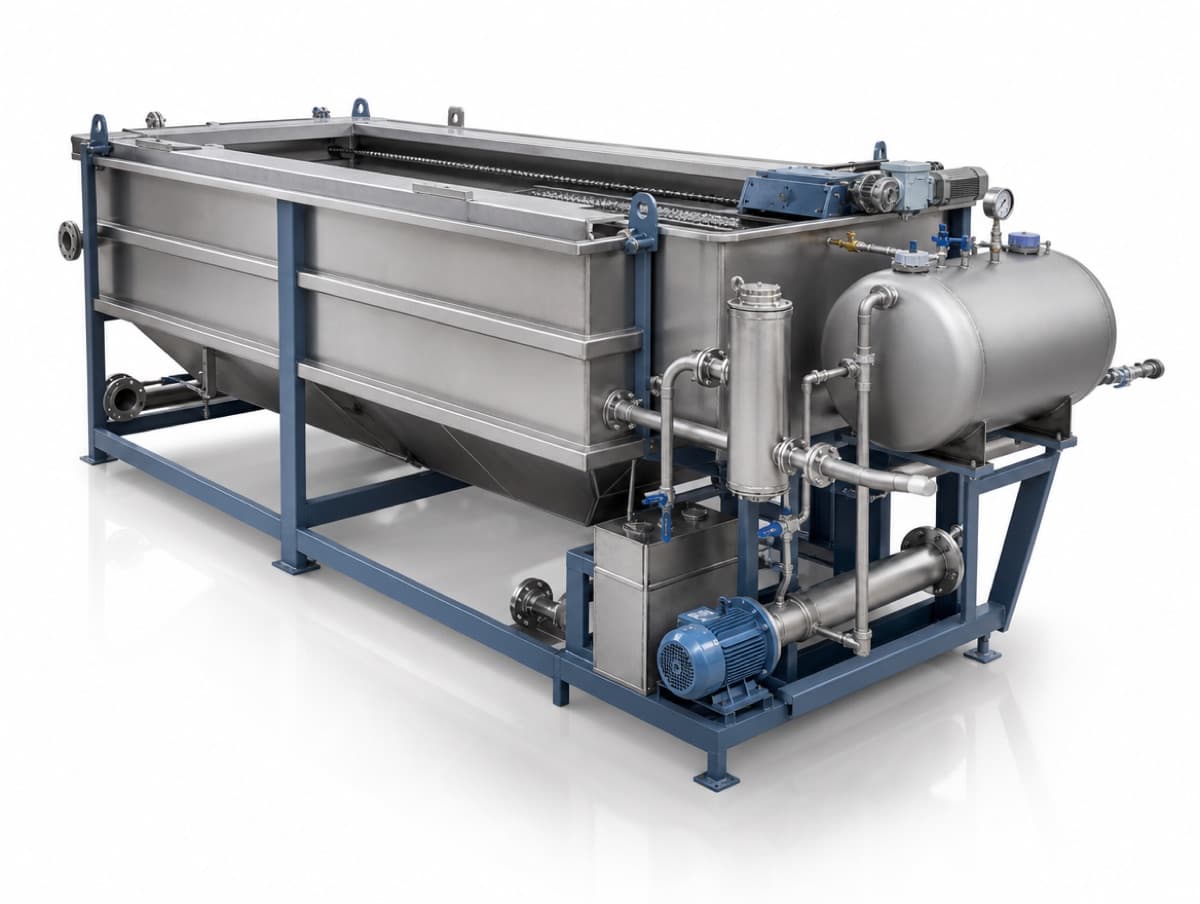
A DAF system attacks the emulsion instead of waiting for it. Coagulant breaks the chemical emulsion, flocculant gathers the freed material into flocs, and a cloud of dissolved-air microbubbles floats the flocs to the surface where a skimmer removes them. Because the bubbles attach to solids as well as oil, a DAF also removes the large majority of suspended solids with proper chemical pretreatment, which is why it is the workhorse in food processing, meat processing and rendering.
The side-by-side comparison
| Oil-water separator | DAF system | |
|---|---|---|
| Removes free oil | Yes | Yes |
| Removes emulsified oil | No | Yes, with coagulant |
| Removes suspended solids | Settleables only | The large majority of TSS |
| Chemical consumption | None | Coagulant and flocculant, dosed continuously |
| Power draw | Minimal | Recycle pump and air saturation system |
| Operator attention | Low | Daily checks; jar tests when effluent changes |
| Typical fit | Machine shops, vehicle wash, fuel handling | Food plants, rendering, industrial laundries |
What each unit costs to run
Purchase price is the smaller half of this comparison. A gravity separator has no consumables: its operating budget is a periodic plate-pack cleaning and a sludge pump-out, both measured in hours per year. A DAF carries three recurring lines. Coagulant and flocculant are dosed continuously against the incoming load, the recycle pump and air saturation system draw power around the clock during production, and someone has to check the float bed and chemical feed daily.
On a typical food-plant installation the chemical line alone runs into thousands of dollars a year, which is money well spent when the alternative is a surcharge, and money wasted when a passive separator would have met the limit. That is why the diagnosis below matters. The jar tells you which operating budget you are signing up for.
The afternoon test that settles it
Before quoting either unit, run this on a representative sample:
- Fill a clear jar with fresh effluent and let it stand for 30 to 60 minutes.
- If a distinct oil layer forms on top and the water below clears, your oil is mostly free. A separator will do the work.
- If the sample stays uniformly cloudy or milky, the oil is emulsified or the solids are colloidal. You are in DAF territory, and a lab jar test with coagulant will confirm the dose.
- If a layer forms and the water stays cloudy, you likely need both stages.
That last result is common. Plenty of installations run a separator ahead of a DAF deliberately:
- The separator knocks out free oil cheaply, cutting the DAF's chemical demand.
- The DAF then handles only what genuinely needs chemistry, so both units run smaller.
Send us your jar-test result, your flow rate and a recent lab analysis through the quote form, and the proposal will state which configuration your numbers support. If you only have the flow rate so far, that is enough to start the conversation. Plants that skip the diagnosis and order on intuition are the ones we later meet at retrofit time, usually after a season of effluent results that never quite reached the bylaw number. An afternoon with a jar is cheaper.
FAQ
My separator is installed but oil still shows in my lab results. Why? The remaining oil is almost certainly emulsified, either chemically by detergents or mechanically by pumps upstream. No amount of separator residence time removes it. The fixes are dosing ahead of a DAF, or moving the separator upstream of whatever is creating the emulsion.
Can a DAF run without chemicals? It can float already-free material, but against a real emulsion the removal collapses. Budget for coagulant and flocculant from day one; the jar test tells you the dose.
How much floor space do these units need? A packaged separator for a typical shop fits on a few square metres. DAF units start around the size of a pickup truck for small flows and scale with flow rate; footprint is one of the first things a sized proposal pins down.
Industrial Wastewater Canada Technical Team
Process Equipment Specialists
Industrial Wastewater Canada Technical Team writes about industrial wastewater treatment equipment and related topics for Industrial Wastewater Canada.
This article was AI-assisted and reviewed by the Industrial Wastewater Canada Technical Team.