Loading...
Food & Beverage Processing in Laval, Quebec
Industrial Wastewater Canada sizes and supplies food & beverage processing for plants in Laval, Quebec. Local demand is driven by pharmaceuticals, food processing, biotech, plastics, discharging under Laval's sewer-use rules toward Rivière des Mille Îles. Quote requests with flow rate and effluent type get a sized proposal.
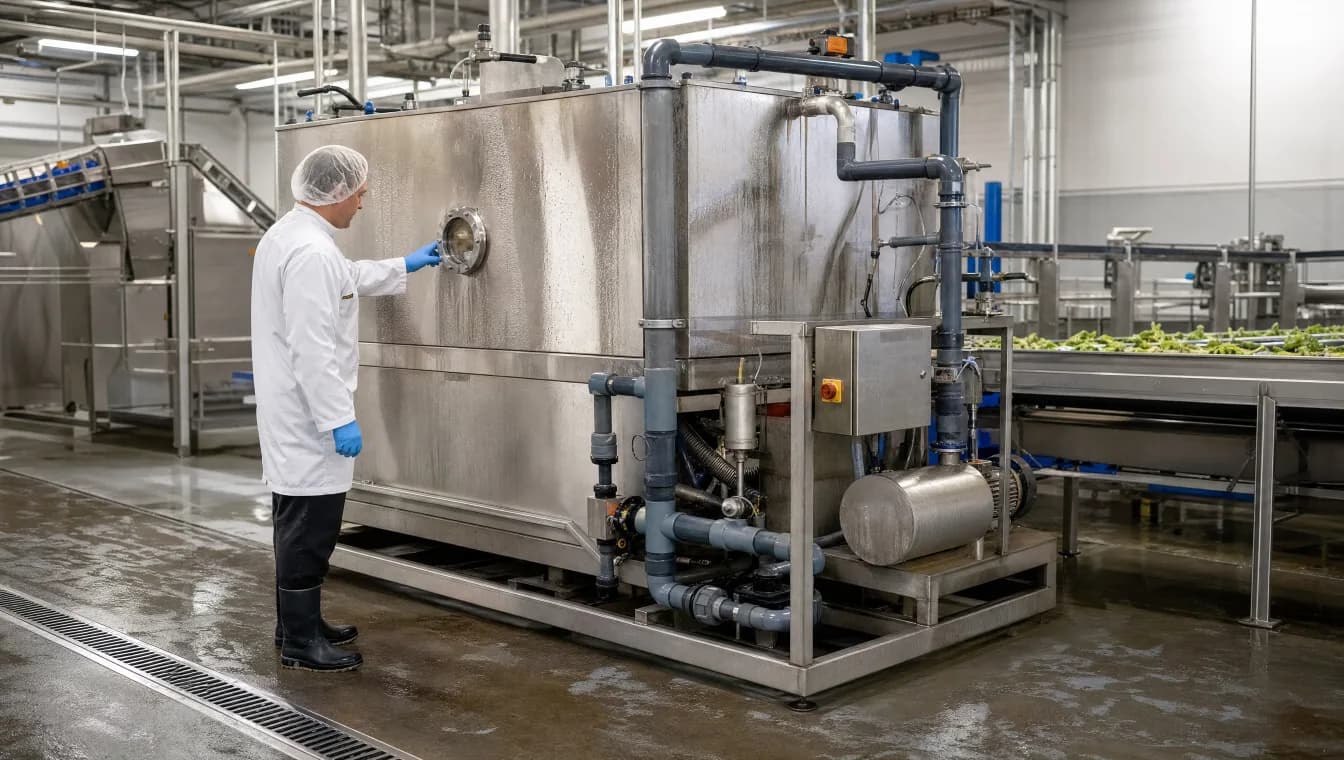
Food and beverage plants produce some of the hardest effluent in Canadian industry. Wash-down water carries fats, oils and grease from fryers and cookers. Blanching and cutting lines add suspended solids. Sugars, starches and proteins push BOD far above what a municipal sewer bylaw allows. A vegetable cannery and a snack-food plant can sit in the same industrial park and send completely different effluent to the same interceptor, which is why food processing wastewater treatment starts with a characterization of your actual discharge, not a catalogue number.
Two directions of regulatory pressure
The regulatory pressure comes from two directions. Municipal sewer-use bylaws in cities like Toronto, Calgary and Montreal set limits on FOG, BOD, TSS and pH, and charge overstrength surcharges when you exceed them. Provincial permits and the federal Fisheries Act apply the moment any effluent reaches a watercourse. For most food processors the surcharge line item is the first thing that gets management's attention: a plant paying tens of thousands of dollars a year in overstrength fees can often recover the cost of a DAF system within a few operating seasons.
A typical treatment train
A typical treatment train for this sector begins with rotary screening to pull out solids and peel fragments, followed by an equalization tank to flatten the swings between production and clean-in-place cycles. Dissolved air flotation with coagulant and flocculant dosing then removes FOG and fine solids. Where a receiving sewer cannot accept the remaining BOD, an MBBR or anaerobic stage polishes the effluent, and the recovered sludge goes to a screw press for dewatering before disposal or land application.
Sized from your flow data
We size each stage from your flow data and a composite sample. Send us your daily volume, your discharge permit or bylaw limits, and a recent lab analysis, and we return a scoped proposal with equipment selections, footprint and budget. Because we supply the equipment rather than operate the plant, the proposal is built around what your effluent needs, whether that is a single screen or a containerized package plant delivered to a plant in rural Ontario or coastal British Columbia. Seasonal packers deserve one extra note: a plant that runs hard for twelve weeks a year should not carry the capital cost of a system sized for year-round flow, and rental or staged equipment often fits that operating pattern better than a permanent build.
Laval's Cité de la Biotech is the reason its wastewater market punches above the weight of a 438,000-resident city. Vaccine manufacturers, pharmaceutical plants and contract research organizations cluster there alongside food processors and plastics plants, all discharging under CMM By-law 2008-47 with the Rivière des Mille Îles as the local receiving water. Biotech effluent plays by batch rules Pharma and biotech streams rarely fail sewer limits on volume; they fail on what a single batch contains. Cité de la Biotech pharma cluster; CMM By-law 2008-47 discharge limits. That is the regulatory backdrop for food & Beverage Processing in Laval: equipment gets sized against the local limits on the route to Rivière des Mille Îles, not against a national average.
Location
Laval, Quebec
Population 438K
Receiving Water
Rivière des Mille Îles
Pricing
Sized & quoted per project
What's Included in Laval
Sizing against Laval's sewer-use and surcharge regime (cité de la Biotech pharma cluster; CMM By-law 2008-47 discharge limits)
Support for direct-discharge projects requiring a ministerial authorization under section 22 of Quebec's Environment Quality Act
Effluent characterization matched to Laval's dominant dischargers: pharmaceuticals, food processing, biotech, plastics
Discharge route review for systems releasing toward Rivière des Mille Îles
Food & Beverage Processing on the ground in Laval
In Laval's Cité de la Biotech, industrial wastewater compliance is batch-wise: kill tanks, hold-test-release and pH swings from 2 to 12, documented once for the CMM and once for the GMP auditor. In Laval, the plants asking about food & Beverage Processing are mostly in pharmaceuticals, food processing, biotech and plastics, and each of those sectors puts a different load on a treatment train. Cité de la Biotech pharma cluster; CMM By-law 2008-47 discharge limits. Direct discharge toward Rivière des Mille Îles instead requires a ministerial authorization under section 22 of Quebec's Environment Quality Act. In a city of Laval's size the industrial dischargers are few enough that the utility knows each one by name, which cuts both ways at permit renewal. Projects in Laval tend to be one-of-a-kind rather than repeat configurations, which is exactly the case where sizing from measured effluent data matters most.
FAQ
Frequently Asked Questions
Everything you need to know about our services.
Do you supply food & Beverage Processing in Laval?
Yes. Industrial Wastewater Canada sizes and supplies food & Beverage Processing for plants across Laval and the surrounding region. Most local demand comes from pharmaceuticals, food processing, biotech, plastics. Send a quote request with your flow rate and effluent type and a sized proposal follows.
What discharge rules apply to industrial wastewater in Laval?
Cité de la Biotech pharma cluster; CMM By-law 2008-47 discharge limits. Cleaning-in-place cycles swing pH from 2 to 12 within an hour, spent media carries high COD, and certain actives must be deactivated before any drain. The engineering answer is batch-wise: kill tanks, hold-test-release protocols and equalization that flattens the swings before the by-law's sampling point. Plants discharging to the municipal sewer answer to that regime; anything released directly toward Rivière des Mille Îles needs a ministerial authorization under section 22 of Quebec's Environment Quality Act. We size equipment against whichever limit governs your outfall.
How is food & Beverage Processing sized for a plant in Laval?
From your numbers, not from the city's. We start with measured flow and effluent characterization, then check the result against Laval's local limits. A processor in a city of 438K with pharmaceuticals as the dominant sector rarely has the same loading profile as its neighbours, so treatability data drives the selection.
What does food & Beverage Processing cost in Laval?
There is no list price; every system is sized and quoted per project. The economics are local, though. Documentation matters double here, once for the CMM inspector and once for GMP auditors who treat the drain as part of the quality system. Food plants on the island still need classic BOD pretreatment, and both worlds fit inside one service territory. Payback in Laval is usually calculated against those surcharge and compliance costs, and the quote spells that comparison out.
Send the flow rate. Get the system.
Flow, contaminants, discharge limit. An engineer replies with a sized treatment train and a quote — no obligation.
In this city
Equipment available here.
Industrial Wastewater Treatment Systems→Oil Water Separators→Dissolved Air Flotation (DAF) Systems→Membrane Bioreactor (MBR) Systems→MBBR Systems (Moving Bed Biofilm Reactors)→Lamella Clarifiers→Sludge Dewatering Screw Presses→Dewatering Centrifuges→Industrial Reverse Osmosis Systems→Wastewater Evaporators & ZLD Systems→Belt Filter Presses→Coalescing Filters→Industrial Bag & Cartridge Filtration→Food & Beverage Processing→Dairy Processing→Breweries & Distilleries→Meat & Poultry Processing→Pulp & Paper→Pharmaceutical & Biotech→Textile & Dyeing→Mining & Mineral Processing→Oil & Gas / Produced Water→Metal Finishing & Plating→Chemical Manufacturing→Power, Boilers & Cooling Towers→
Nearby cities