Loading...
Membrane Bioreactor (MBR) Systems in Edmonton, Alberta
Industrial Wastewater Canada sizes and supplies membrane bioreactor (mbr) systems for plants in Edmonton, Alberta. Local demand is driven by petrochemicals, refining, food processing, manufacturing, discharging under Edmonton's sewer-use rules toward North Saskatchewan River. Quote requests with flow rate and effluent type get a sized proposal.
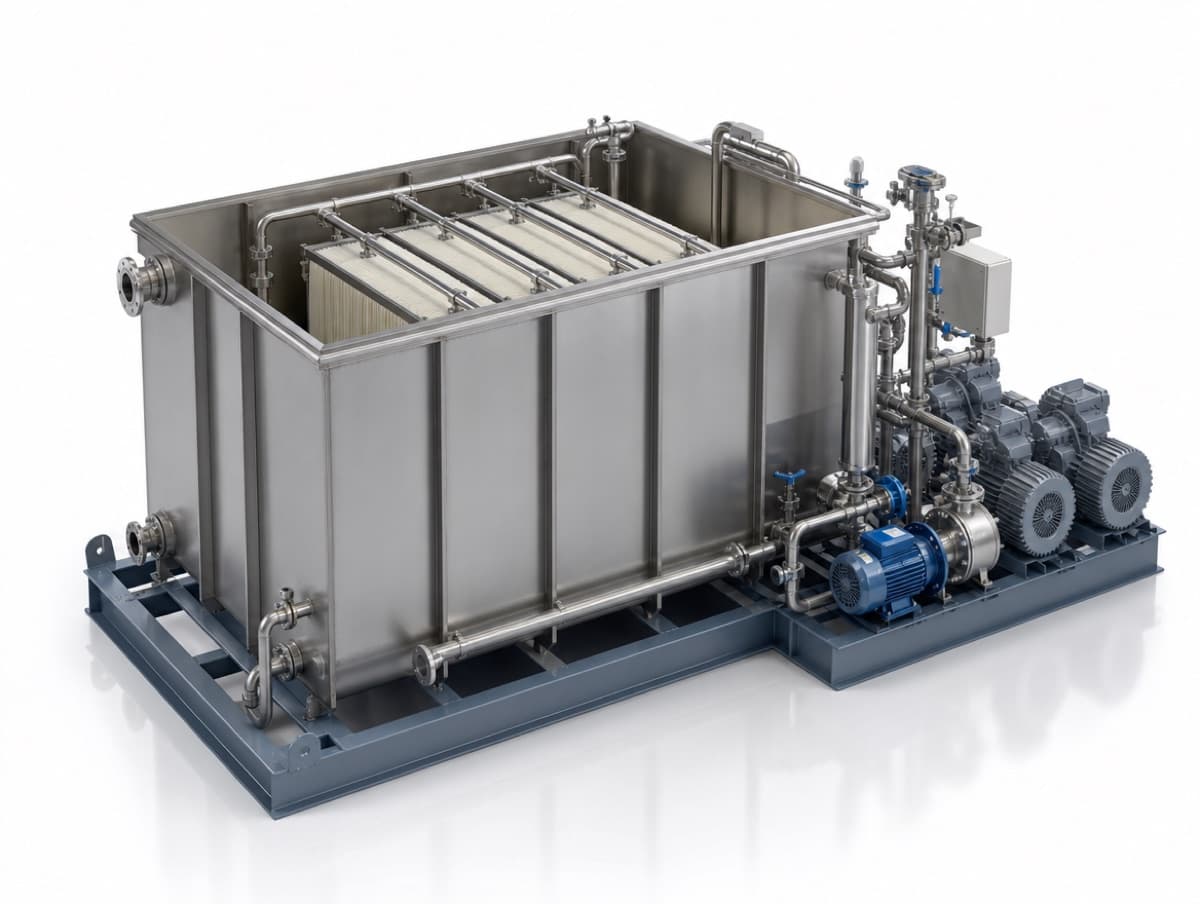
A membrane bioreactor combines two unit processes in one tank: biological treatment that consumes dissolved organics, and ultrafiltration membranes that physically retain the biomass instead of relying on a clarifier to settle it. The result is effluent that is essentially free of suspended solids and most bacteria, clean enough for reuse in washdown or cooling service, or for discharge to sensitive receiving waters.
Higher biomass, smaller footprint
Because the membranes decouple solids retention from settling, an MBR runs at much higher biomass concentrations than conventional activated sludge. That is where the footprint advantage comes from: 50 to 70 percent smaller than a conventional plant treating the same load, which matters when the only available space is inside an existing building. It also explains the stability. High biomass inventory absorbs the load swings that industrial production schedules create, so performance holds through washdown peaks and weekend shutdowns. The strongest fits are food and beverage plants, landfill leachate and high-BOD process water, and any site where reuse or a strict discharge limit justifies the premium.
What our MBR packages include
We supply MBR packages with submerged flat-sheet or hollow-fibre membranes, automated CIP cleaning systems, and the instrumentation to run unattended between operator rounds. The Canadian search interest is real; the membrane bioreactor cluster draws about 1,000 searches a month, the highest of any equipment family we track. But interest is not a specification, so here is the honest trade-off we walk every buyer through. Capital cost is higher than MBBR or conventional treatment because of the membrane modules. Energy use is higher too, since air scouring to keep membranes clean is a significant load. Membranes foul, need routine relaxation and periodic chemical cleaning, and are replaced roughly once a decade, a cost that belongs in your budget from day one. Fats, oils and abrasive solids shorten membrane life, so pre-treatment with fine screening at 1 to 3 mm and FOG removal ahead of the tank is not optional.
When an MBR is the right call
Where footprint is tight, limits are strict, or reuse pays back the premium, an MBR is the right call. Where none of those apply, we will usually recommend MBBR or conventional treatment instead. Send your flow rate, a recent lab analysis and your discharge destination, and a process engineer returns a sized configuration, budget price and delivery timeline for your site, anywhere in Canada. Where the effluent analysis is incomplete, we will specify the sampling program first, because an MBR sized on guesswork wastes exactly the capital premium that makes the technology worth buying.
Edmonton anchors the Alberta Industrial Heartland, the largest hydrocarbon processing cluster in Canada, and its wastewater market reflects that scale. Refineries, petrochemical plants and upgraders northeast of the city hold EPEA approvals as direct dischargers to the North Saskatchewan River, while inside the city itself, food processors and manufacturers discharge to municipal sewer under EPCOR's oversight. EPEA approvals versus sewer discharge The split matters commercially. Alberta Industrial Heartland — largest hydrocarbon processing cluster in Canada, EPEA approvals for direct dischargers. That is the regulatory backdrop for membrane Bioreactor (MBR) Systems in Edmonton: equipment gets sized against the local limits on the route to North Saskatchewan River, not against a national average.
Location
Edmonton, Alberta
Population 1,011K
Receiving Water
North Saskatchewan River
Pricing
Sized & quoted per project
What's Included in Edmonton
Sizing against Edmonton's sewer-use and surcharge regime (alberta Industrial Heartland — largest hydrocarbon processing cluster in Canada, EPEA approvals for direct dischargers)
Support for direct-discharge projects requiring an approval under Alberta's Environmental Protection and Enhancement Act
Effluent characterization matched to Edmonton's dominant dischargers: petrochemicals, refining, food processing, manufacturing
Discharge route review for systems releasing toward North Saskatchewan River
Membrane Bioreactor (MBR) Systems on the ground in Edmonton
Between the Industrial Heartland's EPEA-permitted refineries and the city's sewer-discharging food plants, every Edmonton wastewater system gets engineered for −35 °C winters from the first drawing. In Edmonton, the plants asking about membrane Bioreactor (MBR) Systems are mostly in petrochemicals, refining, food processing and manufacturing, and each of those sectors puts a different load on a treatment train. Alberta Industrial Heartland — largest hydrocarbon processing cluster in Canada, EPEA approvals for direct dischargers. Direct discharge toward North Saskatchewan River instead requires an approval under Alberta's Environmental Protection and Enhancement Act. A metro of Edmonton's size runs enough industrial flow that the municipal plant polices its intake closely, and surcharge invoices arrive on schedule. Projects in Edmonton tend to be one-of-a-kind rather than repeat configurations, which is exactly the case where sizing from measured effluent data matters most.
FAQ
Frequently Asked Questions
Everything you need to know about our services.
Do you supply membrane Bioreactor (MBR) Systems in Edmonton?
Yes. Industrial Wastewater Canada sizes and supplies membrane Bioreactor (MBR) Systems for plants across Edmonton and the surrounding region. Most local demand comes from petrochemicals, refining, food processing, manufacturing. Send a quote request with your flow rate and effluent type and a sized proposal follows.
What discharge rules apply to industrial wastewater in Edmonton?
Alberta Industrial Heartland — largest hydrocarbon processing cluster in Canada, EPEA approvals for direct dischargers. A direct discharger's approval sets site-specific limits on everything from ammonia to naphthenic acids, with continuous monitoring obligations, and a treatment upgrade there is a multi-discipline engineering project. A sausage plant on the south side, by contrast, needs a DAF and a surcharge strategy. Plants discharging to the municipal sewer answer to that regime; anything released directly toward North Saskatchewan River needs an approval under Alberta's Environmental Protection and Enhancement Act. We size equipment against whichever limit governs your outfall.
How is membrane Bioreactor (MBR) Systems sized for a plant in Edmonton?
From your numbers, not from the city's. We start with measured flow and effluent characterization, then check the result against Edmonton's local limits. A processor in a city of 1,011K with petrochemicals as the dominant sector rarely has the same loading profile as its neighbours, so treatability data drives the selection.
What does membrane Bioreactor (MBR) Systems cost in Edmonton?
There is no list price; every system is sized and quoted per project. The economics are local, though. Winter is the constant across both: process water that arrives at 60 °C in July still has to move through outdoor piping at −35 °C in January, so heat tracing, building enclosures and freeze-protected instrumentation are part of every Edmonton design, not options added later. Payback in Edmonton is usually calculated against those surcharge and compliance costs, and the quote spells that comparison out.
Send the flow rate. Get the system.
Flow, contaminants, discharge limit. An engineer replies with a sized treatment train and a quote — no obligation.
In this city
Equipment available here.
Industrial Wastewater Treatment Systems→Oil Water Separators→Dissolved Air Flotation (DAF) Systems→Membrane Bioreactor (MBR) Systems→MBBR Systems (Moving Bed Biofilm Reactors)→Lamella Clarifiers→Sludge Dewatering Screw Presses→Dewatering Centrifuges→Industrial Reverse Osmosis Systems→Wastewater Evaporators & ZLD Systems→Belt Filter Presses→Coalescing Filters→Industrial Bag & Cartridge Filtration→Food & Beverage Processing→Dairy Processing→Breweries & Distilleries→Meat & Poultry Processing→Pulp & Paper→Pharmaceutical & Biotech→Textile & Dyeing→Mining & Mineral Processing→Oil & Gas / Produced Water→Metal Finishing & Plating→Chemical Manufacturing→Power, Boilers & Cooling Towers→
Nearby cities