Loading...
Industrial Bag & Cartridge Filtration in Edmonton, Alberta
Industrial Wastewater Canada sizes and supplies industrial bag & cartridge filtration for plants in Edmonton, Alberta. Local demand is driven by petrochemicals, refining, food processing, manufacturing, discharging under Edmonton's sewer-use rules toward North Saskatchewan River. Quote requests with flow rate and effluent type get a sized proposal.
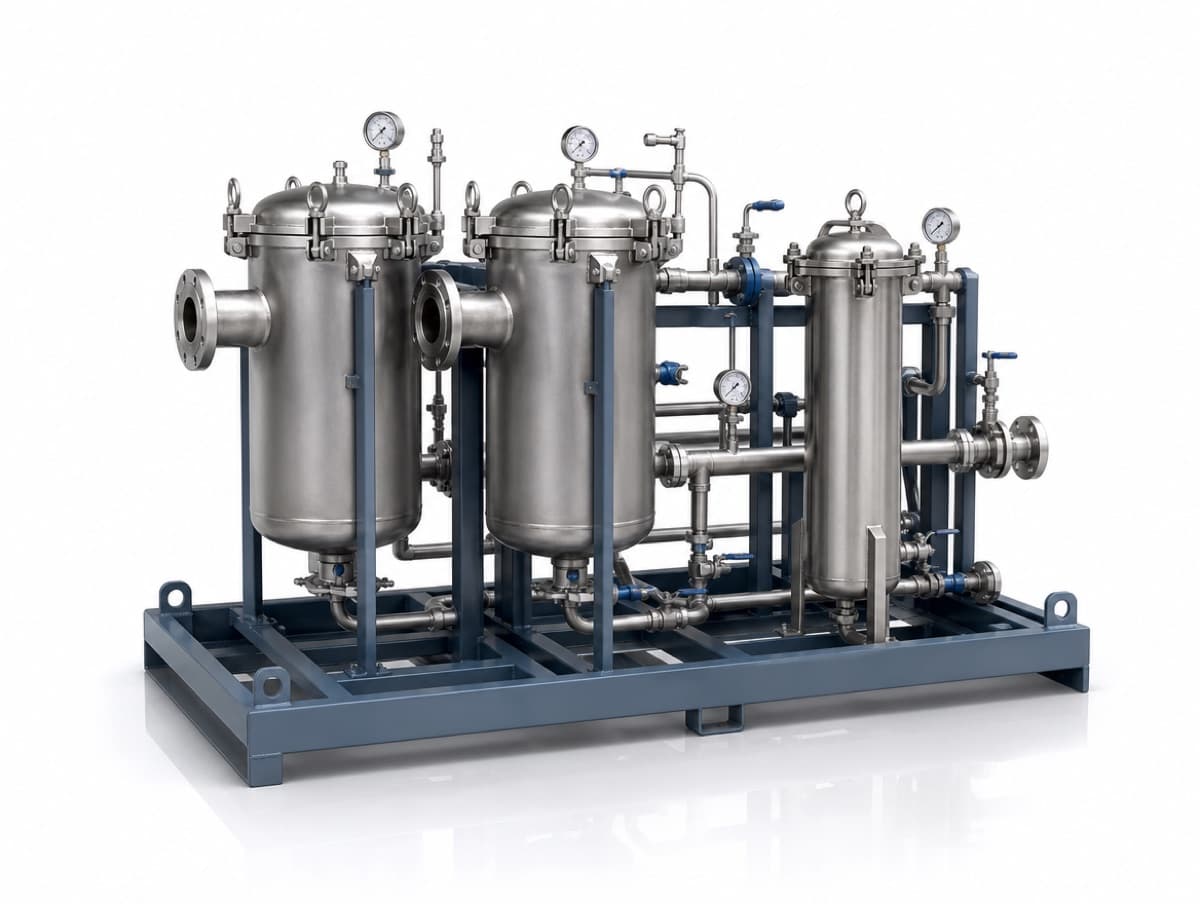
Bag and cartridge filtration is the unglamorous stage that keeps the rest of a water system honest. Ahead of an RO skid, it protects membranes worth many times its price. After a clarifier or separator, it catches the carryover that would otherwise become a permit exceedance. In a process loop, it holds product quality steady when the upstream supply wanders. Most plants have a dozen of these duties, which is why most plants have a dozen housings.
Matching the housing to the duty
The equipment itself is straightforward, and the value is in matching it correctly. Single-bag housings handle small sidestreams; multi-bag vessels with up to 12 bags carry full process flows through one shell. Micron ratings run from 1 to 800, from polishing duty to coarse solids knockout, in felt, mesh and specialty media. Cartridge housings cover the finer, lower-flow end of the range. Vessels come in stainless steel for corrosive or sanitary service and carbon steel where the chemistry allows, with sizing driven by flow, viscosity, solids load and the pressure drop your pumps can spare.
When self-cleaning strainers take over
Where solids loads are heavy or continuous, disposable media stop making sense, and self-cleaning and automatic strainers take over. A motorized scraper or backwash cycle clears the element while the unit stays in service, so what would have been a weekly bag change on a grit-laden stream becomes an occasional inspection. On streams like river water intake, scale-laden cooling loops or high-solids process water, the changeover from bags to a self-cleaning strainer usually pays for itself in labour alone.
The consumables reality
The recurring reality of filtration is consumables, and this is where suppliers differ most. We run a consumables program covering filter bags, cartridges, cloth and media, stocked for fast change-outs rather than quoted with a lead time, and we cross-reference existing housings so switching supply does not mean switching hardware. A housing is a decade-long purchase; the bags are a monthly one, and both deserve engineering attention.
What we need to size one
To size a housing or strainer, we need flow rate, target micron rating, and whatever you know about the solids: an analysis if you have one, a description of the process if you do not. A process engineer reviews the selection and returns a sized configuration, budget price and delivery timeline for your facility, anywhere in Canada, with consumables pricing quoted alongside the vessel. Housings are supplied with davit or swing-bolt closures sized so one person can manage a change-out safely, and gasket and basket spares ship with the vessel, because downtime on a filter change is almost always a missing small part.
Edmonton anchors the Alberta Industrial Heartland, the largest hydrocarbon processing cluster in Canada, and its wastewater market reflects that scale. Refineries, petrochemical plants and upgraders northeast of the city hold EPEA approvals as direct dischargers to the North Saskatchewan River, while inside the city itself, food processors and manufacturers discharge to municipal sewer under EPCOR's oversight. EPEA approvals versus sewer discharge The split matters commercially. Alberta Industrial Heartland — largest hydrocarbon processing cluster in Canada, EPEA approvals for direct dischargers. That is the regulatory backdrop for industrial Bag & Cartridge Filtration in Edmonton: equipment gets sized against the local limits on the route to North Saskatchewan River, not against a national average.
Location
Edmonton, Alberta
Population 1,011K
Receiving Water
North Saskatchewan River
Pricing
Sized & quoted per project
What's Included in Edmonton
Sizing against Edmonton's sewer-use and surcharge regime (alberta Industrial Heartland — largest hydrocarbon processing cluster in Canada, EPEA approvals for direct dischargers)
Support for direct-discharge projects requiring an approval under Alberta's Environmental Protection and Enhancement Act
Effluent characterization matched to Edmonton's dominant dischargers: petrochemicals, refining, food processing, manufacturing
Discharge route review for systems releasing toward North Saskatchewan River
Industrial Bag & Cartridge Filtration on the ground in Edmonton
Between the Industrial Heartland's EPEA-permitted refineries and the city's sewer-discharging food plants, every Edmonton wastewater system gets engineered for −35 °C winters from the first drawing. In Edmonton, the plants asking about industrial Bag & Cartridge Filtration are mostly in petrochemicals, refining, food processing and manufacturing, and each of those sectors puts a different load on a treatment train. Alberta Industrial Heartland — largest hydrocarbon processing cluster in Canada, EPEA approvals for direct dischargers. Direct discharge toward North Saskatchewan River instead requires an approval under Alberta's Environmental Protection and Enhancement Act. A metro of Edmonton's size runs enough industrial flow that the municipal plant polices its intake closely, and surcharge invoices arrive on schedule. Projects in Edmonton tend to be one-of-a-kind rather than repeat configurations, which is exactly the case where sizing from measured effluent data matters most.
FAQ
Frequently Asked Questions
Everything you need to know about our services.
Do you supply industrial Bag & Cartridge Filtration in Edmonton?
Yes. Industrial Wastewater Canada sizes and supplies industrial Bag & Cartridge Filtration for plants across Edmonton and the surrounding region. Most local demand comes from petrochemicals, refining, food processing, manufacturing. Send a quote request with your flow rate and effluent type and a sized proposal follows.
What discharge rules apply to industrial wastewater in Edmonton?
Alberta Industrial Heartland — largest hydrocarbon processing cluster in Canada, EPEA approvals for direct dischargers. A direct discharger's approval sets site-specific limits on everything from ammonia to naphthenic acids, with continuous monitoring obligations, and a treatment upgrade there is a multi-discipline engineering project. A sausage plant on the south side, by contrast, needs a DAF and a surcharge strategy. Plants discharging to the municipal sewer answer to that regime; anything released directly toward North Saskatchewan River needs an approval under Alberta's Environmental Protection and Enhancement Act. We size equipment against whichever limit governs your outfall.
How is industrial Bag & Cartridge Filtration sized for a plant in Edmonton?
From your numbers, not from the city's. We start with measured flow and effluent characterization, then check the result against Edmonton's local limits. A processor in a city of 1,011K with petrochemicals as the dominant sector rarely has the same loading profile as its neighbours, so treatability data drives the selection.
What does industrial Bag & Cartridge Filtration cost in Edmonton?
There is no list price; every system is sized and quoted per project. The economics are local, though. Winter is the constant across both: process water that arrives at 60 °C in July still has to move through outdoor piping at −35 °C in January, so heat tracing, building enclosures and freeze-protected instrumentation are part of every Edmonton design, not options added later. Payback in Edmonton is usually calculated against those surcharge and compliance costs, and the quote spells that comparison out.
Send the flow rate. Get the system.
Flow, contaminants, discharge limit. An engineer replies with a sized treatment train and a quote — no obligation.
In this city
Equipment available here.
Industrial Wastewater Treatment Systems→Oil Water Separators→Dissolved Air Flotation (DAF) Systems→Membrane Bioreactor (MBR) Systems→MBBR Systems (Moving Bed Biofilm Reactors)→Lamella Clarifiers→Sludge Dewatering Screw Presses→Dewatering Centrifuges→Industrial Reverse Osmosis Systems→Wastewater Evaporators & ZLD Systems→Belt Filter Presses→Coalescing Filters→Industrial Bag & Cartridge Filtration→Food & Beverage Processing→Dairy Processing→Breweries & Distilleries→Meat & Poultry Processing→Pulp & Paper→Pharmaceutical & Biotech→Textile & Dyeing→Mining & Mineral Processing→Oil & Gas / Produced Water→Metal Finishing & Plating→Chemical Manufacturing→Power, Boilers & Cooling Towers→
Nearby cities