Loading...
Metal Finishing & Plating in Charlottetown, Prince Edward Island
Industrial Wastewater Canada sizes and supplies metal finishing & plating for plants in Charlottetown, Prince Edward Island. Local demand is driven by food processing, seafood, agri-processing, breweries, discharging under Charlottetown's sewer-use rules toward Charlottetown Harbour. Quote requests with flow rate and effluent type get a sized proposal.
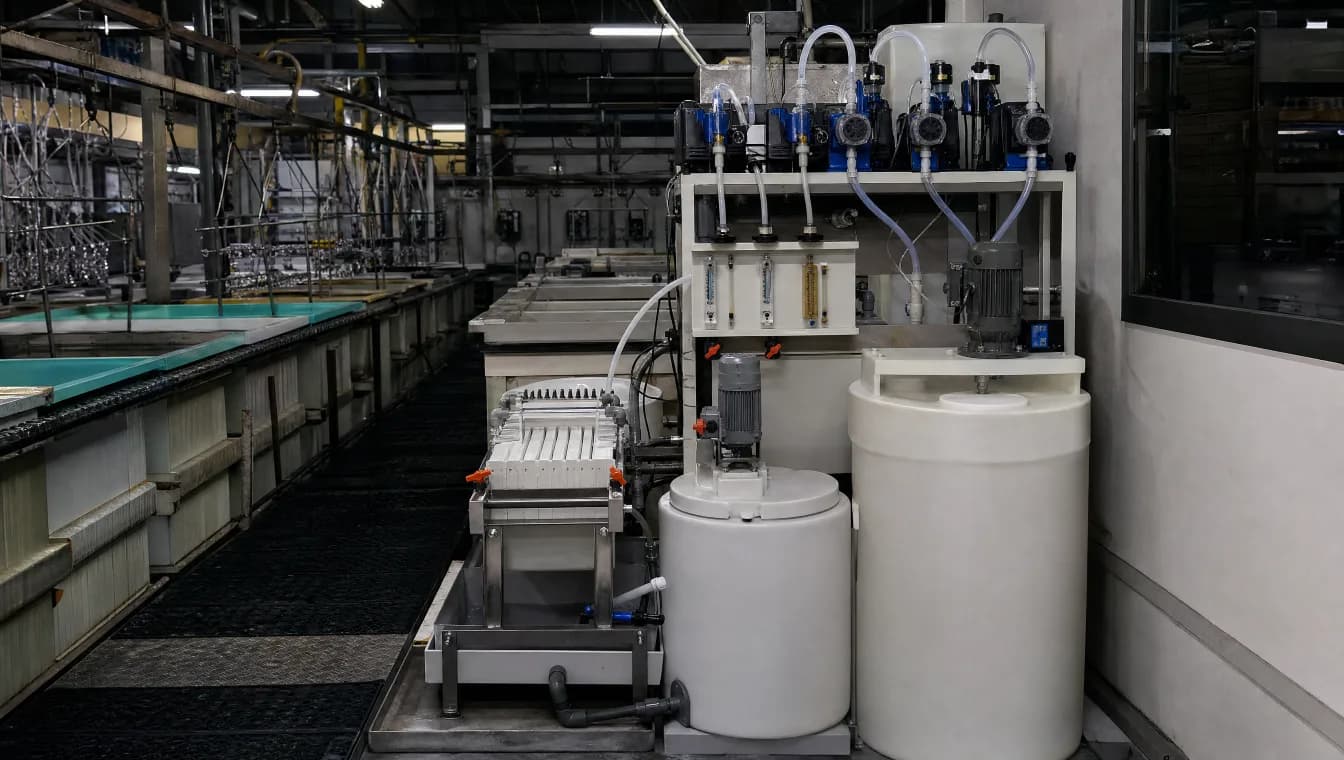
Metal finishing shops are small facilities with outsized regulatory exposure. A plating line occupying a few thousand square feet can discharge chromium, nickel, zinc, copper and cyanide, the exact substances that municipal sewer bylaws police most aggressively, because they pass through municipal plants untreated and end up in biosolids or receiving waters. Metal finishing wastewater treatment is consequently one of the few industrial sectors where even small operations run genuine chemical treatment plants, and where a compliance failure can close the business rather than just fine it.
Batch chemistry, in order
The chemistry is batch logic, done in the right order. Cyanide streams are oxidized first, alone, with alkaline chlorination, because mixing them with acid wastes releases hydrogen cyanide gas. Hexavalent chromium is reduced to trivalent under acid conditions before it will precipitate. Only then do the combined streams get pH adjustment to the hydroxide precipitation window, flocculation, and settling in a lamella clarifier or batch tank. The resulting metal hydroxide sludge is dewatered in a filter press and, in most provinces, ships as hazardous waste, which makes every kilogram of sludge a recurring cost worth engineering down.
Rinse water decides the size
Rinse water strategy decides the size of everything. Counterflow rinsing and drag-out reduction can cut treatment volume dramatically before a dollar is spent on equipment, and ion exchange on segregated rinse streams can recover metal and return polished water to the line. For shops chasing closed loop operation, an industrial reverse osmosis system after conventional treatment brings water back to rinse quality and shrinks the discharge to a concentrate stream.
Batch and continuous systems
We supply batch and continuous treatment systems, chrome reduction and cyanide destruction packages, clarifiers, filter presses and ion exchange skids, sized for the realities of a job shop: intermittent flow, changing work mix, and one operator who has other duties.
Tell us your line list
Tell us your line list, your bath chemistry and your bylaw limits. We will propose a system that treats in the right order, logs what your inspector wants logged, and fits the floor space you actually have. Anodizers and galvanizers fit the same framework with different chemistry, and job shops that add a new bath line should tell their treatment supplier before the first batch runs, because one new chelating agent can quietly defeat a hydroxide precipitation system.
Charlottetown's industry processes what Prince Edward Island grows and catches: potatoes bound for french-fry and chip lines, seafood from the island fleet, dairy and a lively brewing and distilling scene, all in a capital of 39,000 whose harbour receives the municipal discharge. The mismatch is structural: island food processing generates organic loads sized for the national market, flowing into infrastructure sized for a small city. Big food loads, small-island infrastructure Potato processing effluent, starch-heavy, solids-laden, seasonal, can exceed municipal treatment capacity on its own, which is why the island's processors run serious pretreatment and why the surcharge conversation here is really a capacity conversation. PEI's french-fry and seafood processing economy generates high-BOD effluent far above municipal capacity. That is the regulatory backdrop for metal Finishing & Plating in Charlottetown: equipment gets sized against the local limits on the route to Charlottetown Harbour, not against a national average.
Location
Charlottetown, Prince Edward Island
Population 39K
Receiving Water
Charlottetown Harbour
Pricing
Sized & quoted per project
What's Included in Charlottetown
Sizing against Charlottetown's sewer-use and surcharge regime (pEI's french-fry and seafood processing economy generates high-BOD effluent far above municipal capacity)
Support for direct-discharge projects requiring an approval under Prince Edward Island's Environmental Protection Act
Effluent characterization matched to Charlottetown's dominant dischargers: food processing, seafood, agri-processing, breweries
Discharge route review for systems releasing toward Charlottetown Harbour
Metal Finishing & Plating on the ground in Charlottetown
Charlottetown pushes national-market potato and seafood wastewater loads through small-island infrastructure, on an island where every drop of drinking water is groundwater. In Charlottetown, the plants asking about metal Finishing & Plating are mostly in food processing, seafood, agri-processing and breweries, and each of those sectors puts a different load on a treatment train. PEI's french-fry and seafood processing economy generates high-BOD effluent far above municipal capacity. Direct discharge toward Charlottetown Harbour instead requires an approval under Prince Edward Island's Environmental Protection Act. Charlottetown's municipal plant has limited spare capacity, so a single overloaded industrial connection shows up quickly in its intake numbers. Projects in Charlottetown tend to be one-of-a-kind rather than repeat configurations, which is exactly the case where sizing from measured effluent data matters most.
FAQ
Frequently Asked Questions
Everything you need to know about our services.
Do you supply metal Finishing & Plating in Charlottetown?
Yes. Industrial Wastewater Canada sizes and supplies metal Finishing & Plating for plants across Charlottetown and the surrounding region. Most local demand comes from food processing, seafood, agri-processing, breweries. Send a quote request with your flow rate and effluent type and a sized proposal follows.
What discharge rules apply to industrial wastewater in Charlottetown?
PEI's french-fry and seafood processing economy generates high-BOD effluent far above municipal capacity. Seafood plants add the Atlantic pattern of salty, high-BOD seasonal surges. Water stewardship carries extra weight on an island where all drinking water comes from groundwater, and nutrient management connects to PEI's long-running struggle with agricultural runoff and estuary anoxia. Plants discharging to the municipal sewer answer to that regime; anything released directly toward Charlottetown Harbour needs an approval under Prince Edward Island's Environmental Protection Act. We size equipment against whichever limit governs your outfall.
How is metal Finishing & Plating sized for a plant in Charlottetown?
From your numbers, not from the city's. We start with measured flow and effluent characterization, then check the result against Charlottetown's local limits. A processor in a city of 39K with food processing as the dominant sector rarely has the same loading profile as its neighbours, so treatability data drives the selection.
What does metal Finishing & Plating cost in Charlottetown?
There is no list price; every system is sized and quoted per project. The economics are local, though. Practical constraints complete the picture: equipment arrives by bridge, specialist service arrives by plane, and systems that local trades can maintain hold a decisive edge. Payback in Charlottetown is usually calculated against those surcharge and compliance costs, and the quote spells that comparison out.
Send the flow rate. Get the system.
Flow, contaminants, discharge limit. An engineer replies with a sized treatment train and a quote — no obligation.
In this city
Equipment available here.
Industrial Wastewater Treatment Systems→Oil Water Separators→Dissolved Air Flotation (DAF) Systems→Membrane Bioreactor (MBR) Systems→MBBR Systems (Moving Bed Biofilm Reactors)→Lamella Clarifiers→Sludge Dewatering Screw Presses→Dewatering Centrifuges→Industrial Reverse Osmosis Systems→Wastewater Evaporators & ZLD Systems→Belt Filter Presses→Coalescing Filters→Industrial Bag & Cartridge Filtration→Food & Beverage Processing→Dairy Processing→Breweries & Distilleries→Meat & Poultry Processing→Pulp & Paper→Pharmaceutical & Biotech→Textile & Dyeing→Mining & Mineral Processing→Oil & Gas / Produced Water→Metal Finishing & Plating→Chemical Manufacturing→Power, Boilers & Cooling Towers→
Nearby cities
Also serving these cities.
All wastewater treatment service areas in Prince Edward Island