Loading...
Breweries & Distilleries in Charlottetown, Prince Edward Island
Industrial Wastewater Canada sizes and supplies breweries & distilleries for plants in Charlottetown, Prince Edward Island. Local demand is driven by food processing, seafood, agri-processing, breweries, discharging under Charlottetown's sewer-use rules toward Charlottetown Harbour. Quote requests with flow rate and effluent type get a sized proposal.
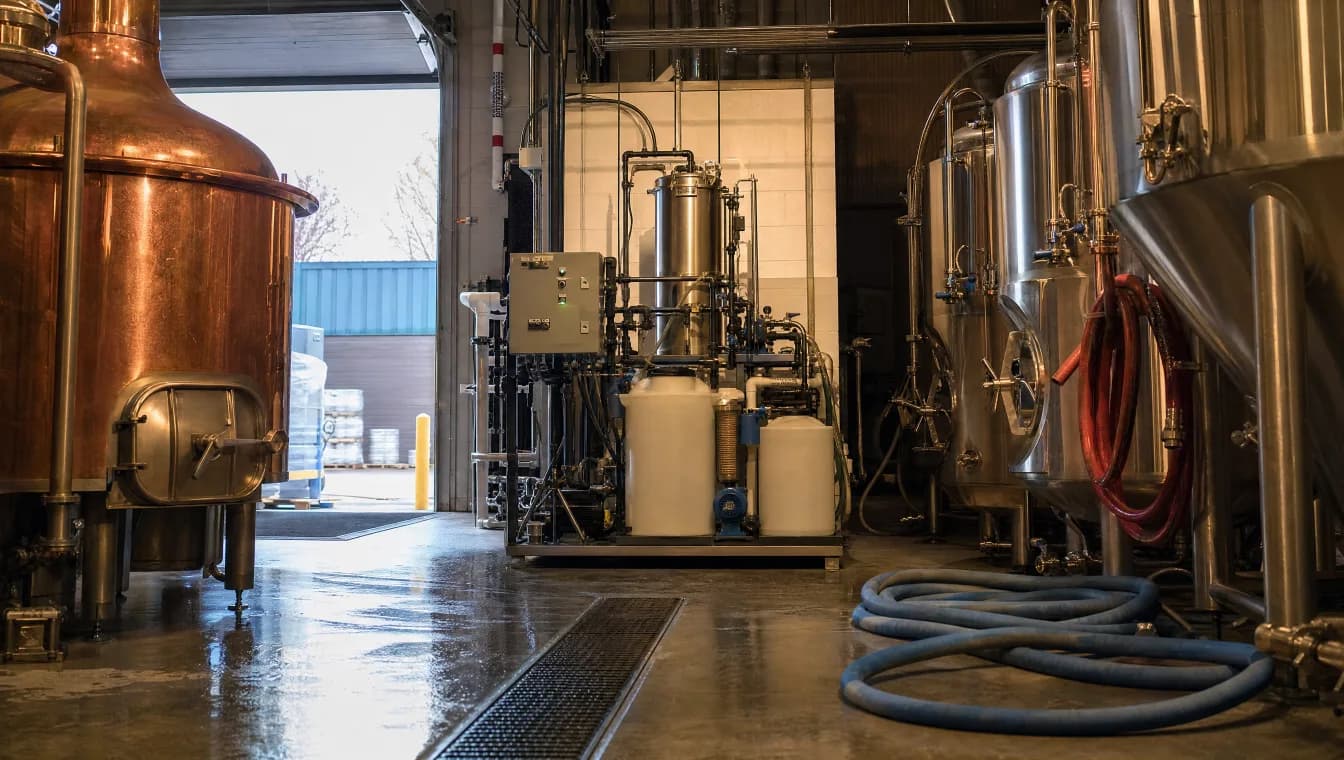
Brewery effluent looks harmless and behaves badly. Most of what goes down the drain is water, but the fraction that is not includes spent grain fines, yeast, trub, spilled wort and packaging-line beer, all of which are concentrated food for bacteria. That is why brewery wastewater treatment matters even for a craft operation producing a few thousand hectolitres a year: BOD in raw brewery discharge routinely runs ten to thirty times the strength of domestic sewage, and municipal sewer bylaws price that difference directly.
The pH problem
The second problem is pH. Caustic keg and tank washing pushes discharge alkaline, acid sanitizers push it the other way, and the swings arrive in slugs when a cleaning cycle finishes. Many breweries fail their sewer agreement on pH alone before BOD ever becomes the issue. A small equalization tank with automated pH correction is often the cheapest compliance step a brewery can take, and it is where we usually start.
The train depends on scale
Beyond equalization, the treatment train depends on scale. A regional craft brewery discharging to a tolerant municipal sewer may only need solids screening, pH control and side-streaming of high-strength waste like trub and yeast, which can go to farmers or anaerobic digestion instead of the drain. A production brewery, or one on a small-town sewer system, typically adds dissolved air flotation to strip solids and then biological treatment. Anaerobic wastewater treatment suits the strongest streams because it produces biogas rather than consuming aeration power, while an MBBR handles the polishing stage in a footprint that fits a utility room.
Water on the intake side
Water is also a cost on the intake side. Breweries that treat well enough can reuse effluent for floor wash and cooling, cutting both the water bill and the discharge volume the surcharge is calculated on.
What we need from you
Tell us your annual production, your cleaning chemistry and your sewer agreement limits, and we will size the tanks and equipment to match. For breweries in growth mode we design the first stage so the biological stage can bolt on later without rework. Distilleries follow the same logic with two differences worth naming: stillage is far stronger than any brewery stream and usually justifies dedicated handling, and copper carryover from the stills can matter to a sewer agreement even at low concentrations.
Charlottetown's industry processes what Prince Edward Island grows and catches: potatoes bound for french-fry and chip lines, seafood from the island fleet, dairy and a lively brewing and distilling scene, all in a capital of 39,000 whose harbour receives the municipal discharge. The mismatch is structural: island food processing generates organic loads sized for the national market, flowing into infrastructure sized for a small city. Big food loads, small-island infrastructure Potato processing effluent, starch-heavy, solids-laden, seasonal, can exceed municipal treatment capacity on its own, which is why the island's processors run serious pretreatment and why the surcharge conversation here is really a capacity conversation. PEI's french-fry and seafood processing economy generates high-BOD effluent far above municipal capacity. That is the regulatory backdrop for breweries & Distilleries in Charlottetown: equipment gets sized against the local limits on the route to Charlottetown Harbour, not against a national average.
Location
Charlottetown, Prince Edward Island
Population 39K
Receiving Water
Charlottetown Harbour
Pricing
Sized & quoted per project
What's Included in Charlottetown
Sizing against Charlottetown's sewer-use and surcharge regime (pEI's french-fry and seafood processing economy generates high-BOD effluent far above municipal capacity)
Support for direct-discharge projects requiring an approval under Prince Edward Island's Environmental Protection Act
Effluent characterization matched to Charlottetown's dominant dischargers: food processing, seafood, agri-processing, breweries
Discharge route review for systems releasing toward Charlottetown Harbour
Breweries & Distilleries on the ground in Charlottetown
Charlottetown pushes national-market potato and seafood wastewater loads through small-island infrastructure, on an island where every drop of drinking water is groundwater. In Charlottetown, the plants asking about breweries & Distilleries are mostly in food processing, seafood, agri-processing and breweries, and each of those sectors puts a different load on a treatment train. PEI's french-fry and seafood processing economy generates high-BOD effluent far above municipal capacity. Direct discharge toward Charlottetown Harbour instead requires an approval under Prince Edward Island's Environmental Protection Act. Charlottetown's municipal plant has limited spare capacity, so a single overloaded industrial connection shows up quickly in its intake numbers. Projects in Charlottetown tend to be one-of-a-kind rather than repeat configurations, which is exactly the case where sizing from measured effluent data matters most.
FAQ
Frequently Asked Questions
Everything you need to know about our services.
Do you supply breweries & Distilleries in Charlottetown?
Yes. Industrial Wastewater Canada sizes and supplies breweries & Distilleries for plants across Charlottetown and the surrounding region. Most local demand comes from food processing, seafood, agri-processing, breweries. Send a quote request with your flow rate and effluent type and a sized proposal follows.
What discharge rules apply to industrial wastewater in Charlottetown?
PEI's french-fry and seafood processing economy generates high-BOD effluent far above municipal capacity. Seafood plants add the Atlantic pattern of salty, high-BOD seasonal surges. Water stewardship carries extra weight on an island where all drinking water comes from groundwater, and nutrient management connects to PEI's long-running struggle with agricultural runoff and estuary anoxia. Plants discharging to the municipal sewer answer to that regime; anything released directly toward Charlottetown Harbour needs an approval under Prince Edward Island's Environmental Protection Act. We size equipment against whichever limit governs your outfall.
How is breweries & Distilleries sized for a plant in Charlottetown?
From your numbers, not from the city's. We start with measured flow and effluent characterization, then check the result against Charlottetown's local limits. A processor in a city of 39K with food processing as the dominant sector rarely has the same loading profile as its neighbours, so treatability data drives the selection.
What does breweries & Distilleries cost in Charlottetown?
There is no list price; every system is sized and quoted per project. The economics are local, though. Practical constraints complete the picture: equipment arrives by bridge, specialist service arrives by plane, and systems that local trades can maintain hold a decisive edge. Payback in Charlottetown is usually calculated against those surcharge and compliance costs, and the quote spells that comparison out.
Send the flow rate. Get the system.
Flow, contaminants, discharge limit. An engineer replies with a sized treatment train and a quote — no obligation.
In this city
Equipment available here.
Industrial Wastewater Treatment Systems→Oil Water Separators→Dissolved Air Flotation (DAF) Systems→Membrane Bioreactor (MBR) Systems→MBBR Systems (Moving Bed Biofilm Reactors)→Lamella Clarifiers→Sludge Dewatering Screw Presses→Dewatering Centrifuges→Industrial Reverse Osmosis Systems→Wastewater Evaporators & ZLD Systems→Belt Filter Presses→Coalescing Filters→Industrial Bag & Cartridge Filtration→Food & Beverage Processing→Dairy Processing→Breweries & Distilleries→Meat & Poultry Processing→Pulp & Paper→Pharmaceutical & Biotech→Textile & Dyeing→Mining & Mineral Processing→Oil & Gas / Produced Water→Metal Finishing & Plating→Chemical Manufacturing→Power, Boilers & Cooling Towers→
Nearby cities
Also serving these cities.
All wastewater treatment service areas in Prince Edward Island