Loading...
Power, Boilers & Cooling Towers in Charlottetown, Prince Edward Island
Industrial Wastewater Canada sizes and supplies power, boilers & cooling towers for plants in Charlottetown, Prince Edward Island. Local demand is driven by food processing, seafood, agri-processing, breweries, discharging under Charlottetown's sewer-use rules toward Charlottetown Harbour. Quote requests with flow rate and effluent type get a sized proposal.
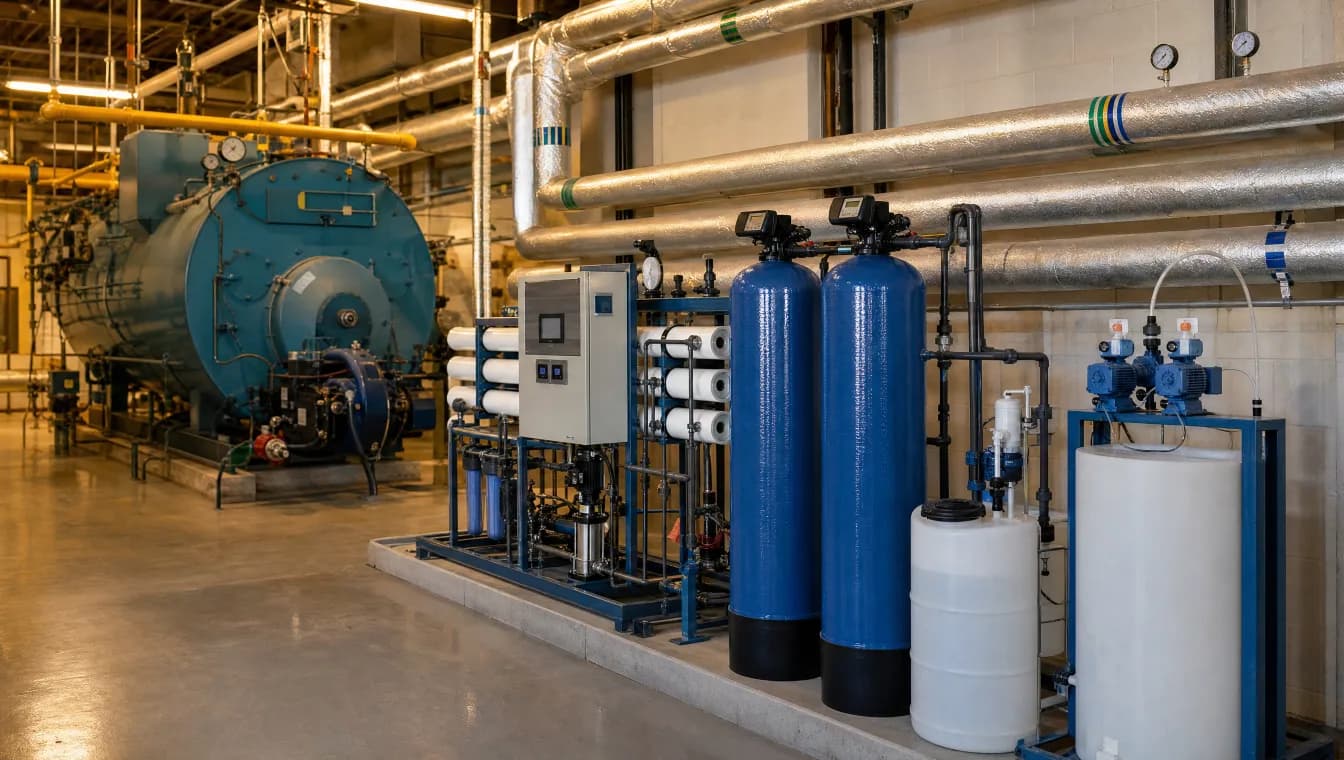
Boilers and cooling towers are the two places where a plant's water problems become energy problems. A millimetre of scale on a boiler tube forces the burner to work measurably harder for the same steam. A fouled cooling tower approaches its design temperature limit on the hottest week of the year, exactly when production can least afford it. Boiler and cooling tower water treatment is therefore less about meeting a discharge permit than about protecting the equipment the water passes through, though the blowdown from both systems still has to go somewhere legal.
The boiler side
On the boiler side, the goal is feedwater that will not scale, corrode or carry over into the steam. Softening removes hardness; an industrial reverse osmosis system ahead of the softener or in place of it takes out the dissolved solids load wholesale, which cuts chemical consumption and lets the boiler run more cycles of concentration before blowdown. Higher cycles mean less blowdown, and less blowdown means less fuel heating water that goes straight to the drain. For high-pressure boilers, RO followed by demineralization or electrodeionization is the standard train. The payback arithmetic usually favours RO strongly at Canadian fuel prices, and we will run it with your numbers rather than assert it.
The cooling tower side
Cooling towers concentrate whatever the makeup water brings, so the levers are the same: better makeup, smarter cycles, and side-stream filtration to strip the solids that the tower scrubs from the air. A side-stream filter on a recirculating loop keeps heat-exchange surfaces cleaner and reduces the biocide demand. Where makeup water is scarce or expensive, treated plant effluent can serve as tower makeup after polishing, a reuse route more Canadian plants adopt every year.
Sized from your water analysis
We supply RO skids, softeners, filtration packages, blowdown heat-recovery equipment and side-stream filters, and we size them from your water analysis and operating pressures. Send the analysis, the boiler and tower specifications and your current cycle count. The proposal will show the water, fuel and chemical savings line by line. Legionella management has also moved from good practice to expectation in Canadian facilities, and while control programs are chemical and operational, the filtration and makeup-quality improvements we supply reduce the nutrient and solids load that makes towers hospitable in the first place.
Charlottetown's industry processes what Prince Edward Island grows and catches: potatoes bound for french-fry and chip lines, seafood from the island fleet, dairy and a lively brewing and distilling scene, all in a capital of 39,000 whose harbour receives the municipal discharge. The mismatch is structural: island food processing generates organic loads sized for the national market, flowing into infrastructure sized for a small city. Big food loads, small-island infrastructure Potato processing effluent, starch-heavy, solids-laden, seasonal, can exceed municipal treatment capacity on its own, which is why the island's processors run serious pretreatment and why the surcharge conversation here is really a capacity conversation. PEI's french-fry and seafood processing economy generates high-BOD effluent far above municipal capacity. That is the regulatory backdrop for power, Boilers & Cooling Towers in Charlottetown: equipment gets sized against the local limits on the route to Charlottetown Harbour, not against a national average.
Location
Charlottetown, Prince Edward Island
Population 39K
Receiving Water
Charlottetown Harbour
Pricing
Sized & quoted per project
What's Included in Charlottetown
Sizing against Charlottetown's sewer-use and surcharge regime (pEI's french-fry and seafood processing economy generates high-BOD effluent far above municipal capacity)
Support for direct-discharge projects requiring an approval under Prince Edward Island's Environmental Protection Act
Effluent characterization matched to Charlottetown's dominant dischargers: food processing, seafood, agri-processing, breweries
Discharge route review for systems releasing toward Charlottetown Harbour
Power, Boilers & Cooling Towers on the ground in Charlottetown
Charlottetown pushes national-market potato and seafood wastewater loads through small-island infrastructure, on an island where every drop of drinking water is groundwater. In Charlottetown, the plants asking about power, Boilers & Cooling Towers are mostly in food processing, seafood, agri-processing and breweries, and each of those sectors puts a different load on a treatment train. PEI's french-fry and seafood processing economy generates high-BOD effluent far above municipal capacity. Direct discharge toward Charlottetown Harbour instead requires an approval under Prince Edward Island's Environmental Protection Act. Charlottetown's municipal plant has limited spare capacity, so a single overloaded industrial connection shows up quickly in its intake numbers. Projects in Charlottetown tend to be one-of-a-kind rather than repeat configurations, which is exactly the case where sizing from measured effluent data matters most.
FAQ
Frequently Asked Questions
Everything you need to know about our services.
Do you supply power, Boilers & Cooling Towers in Charlottetown?
Yes. Industrial Wastewater Canada sizes and supplies power, Boilers & Cooling Towers for plants across Charlottetown and the surrounding region. Most local demand comes from food processing, seafood, agri-processing, breweries. Send a quote request with your flow rate and effluent type and a sized proposal follows.
What discharge rules apply to industrial wastewater in Charlottetown?
PEI's french-fry and seafood processing economy generates high-BOD effluent far above municipal capacity. Seafood plants add the Atlantic pattern of salty, high-BOD seasonal surges. Water stewardship carries extra weight on an island where all drinking water comes from groundwater, and nutrient management connects to PEI's long-running struggle with agricultural runoff and estuary anoxia. Plants discharging to the municipal sewer answer to that regime; anything released directly toward Charlottetown Harbour needs an approval under Prince Edward Island's Environmental Protection Act. We size equipment against whichever limit governs your outfall.
How is power, Boilers & Cooling Towers sized for a plant in Charlottetown?
From your numbers, not from the city's. We start with measured flow and effluent characterization, then check the result against Charlottetown's local limits. A processor in a city of 39K with food processing as the dominant sector rarely has the same loading profile as its neighbours, so treatability data drives the selection.
What does power, Boilers & Cooling Towers cost in Charlottetown?
There is no list price; every system is sized and quoted per project. The economics are local, though. Practical constraints complete the picture: equipment arrives by bridge, specialist service arrives by plane, and systems that local trades can maintain hold a decisive edge. Payback in Charlottetown is usually calculated against those surcharge and compliance costs, and the quote spells that comparison out.
Send the flow rate. Get the system.
Flow, contaminants, discharge limit. An engineer replies with a sized treatment train and a quote — no obligation.
In this city
Equipment available here.
Industrial Wastewater Treatment Systems→Oil Water Separators→Dissolved Air Flotation (DAF) Systems→Membrane Bioreactor (MBR) Systems→MBBR Systems (Moving Bed Biofilm Reactors)→Lamella Clarifiers→Sludge Dewatering Screw Presses→Dewatering Centrifuges→Industrial Reverse Osmosis Systems→Wastewater Evaporators & ZLD Systems→Belt Filter Presses→Coalescing Filters→Industrial Bag & Cartridge Filtration→Food & Beverage Processing→Dairy Processing→Breweries & Distilleries→Meat & Poultry Processing→Pulp & Paper→Pharmaceutical & Biotech→Textile & Dyeing→Mining & Mineral Processing→Oil & Gas / Produced Water→Metal Finishing & Plating→Chemical Manufacturing→Power, Boilers & Cooling Towers→
Nearby cities
Also serving these cities.
All wastewater treatment service areas in Prince Edward Island