Loading...
Cooling Tower Water Treatment
Cooling tower water treatment for Canadian plants: filtration, softening and blowdown treatment that cut scale, corrosion and water bills.
Key takeaways
Cooling Tower Water Treatment: Cooling tower water treatment for Canadian plants: filtration, softening and blowdown treatment that cut scale, corrosion and water bills.
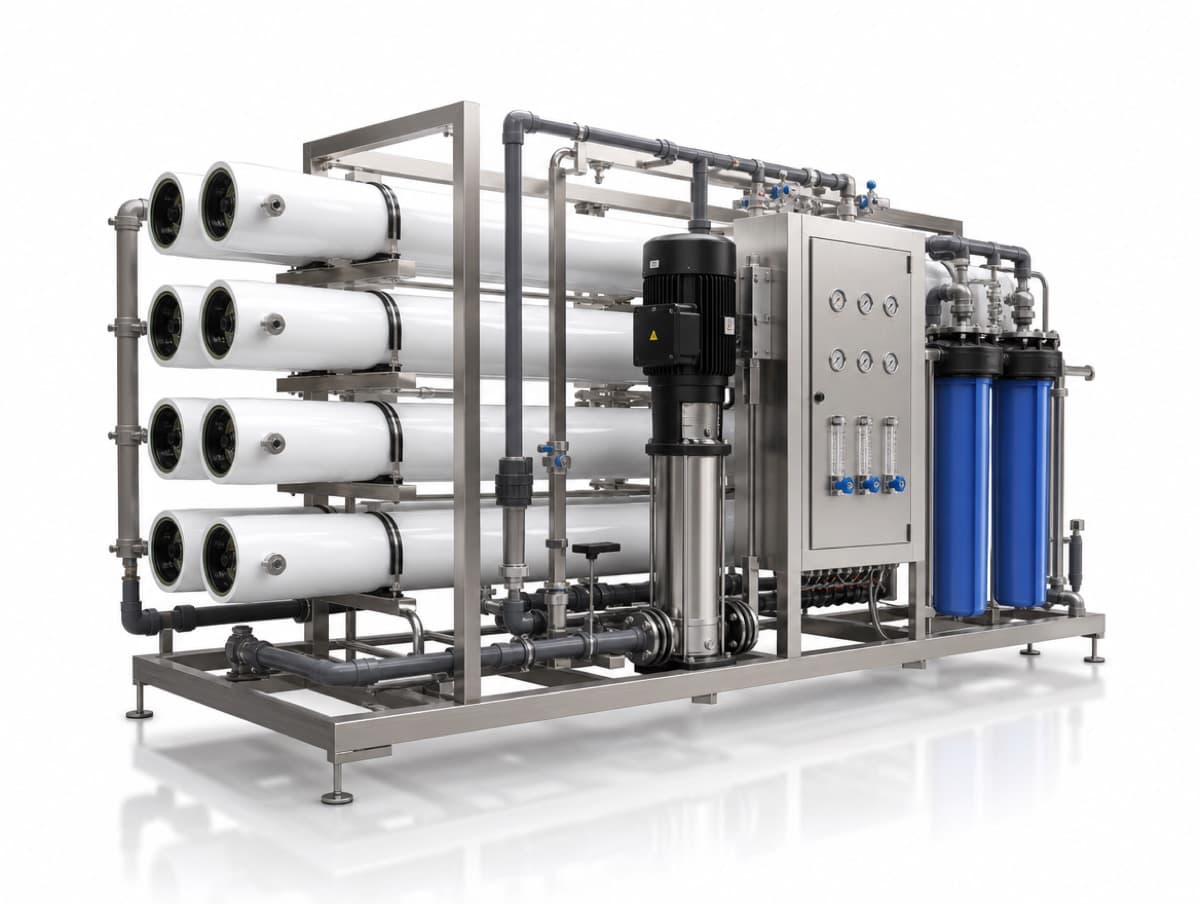
Closest matching equipment: Industrial Reverse Osmosis Systems (By quote)
Why cooling tower water treatment is a chemistry problem
A cooling tower is an evaporator: pure water leaves as vapour, and everything dissolved in the make-up stays behind and concentrates. Left alone, that concentration drives the four failure modes every operator knows: scale on heat-exchange surfaces, corrosion of piping and fill, fouling by suspended solids, and biological growth, including Legionella, which Canadian public-health authorities treat as a registrable risk in several jurisdictions.
Cooling tower water treatment manages all four at once, because fixing one in isolation worsens another. Softening the make-up cuts scale but makes the water more corrosive; heavy biocide dosing controls slime but can attack galvanized fill. A working program balances:
- Cycles of concentration, set by conductivity-controlled blowdown; raising cycles from 3 to 6 cuts make-up water demand by roughly 10 percent and blowdown volume nearly in half
- Scale and corrosion inhibitors, phosphonates and azoles dosed to the recirculating volume
- Oxidizing and non-oxidizing biocides, alternated so biofilms never adapt
- Side-stream filtration, which removes the airborne dust a tower scrubs out of the atmosphere all day
Equipment for cooling tower and blowdown treatment
Our scope is the hardware that makes the chemistry work: chemical dosing skids with conductivity and ORP control, water meters on make-up and blowdown, side-stream sand or screen filters, and softeners or reverse osmosis on make-up where raw-water hardness is high. RO-treated make-up is increasingly common at Canadian plants chasing higher cycles, because it removes the silica that usually caps them.
Blowdown itself is a wastewater stream, and municipalities treat it as one. Sewer-use bylaws set limits on temperature, pH and total dissolved solids, and a tower running high cycles can breach them. We size neutralization and cooling for blowdown where the bylaw requires it.
Send us your make-up water analysis, tower tonnage and current cycles of concentration. We will quote a control-and-dosing package, with the water and chemical savings calculated against what you run today.
FAQ
Frequently Asked Questions
Everything you need to know about our services.
What are cycles of concentration and why do they matter?
It is the ratio of dissolved solids in the basin versus the makeup water. Higher cycles mean less water purged and bought. Treatment quality is what allows higher cycles without scale.
Can cooling tower blowdown go to the sanitary sewer?
Usually yes, if it meets the local sewer-use bylaw for temperature, pH and treatment chemicals. Some municipalities require declaration of the water treatment program. Discharge to storm sewers or the environment is a different matter and normally prohibited.
Do I still need chemical treatment if I install a side-stream filter?
Yes. Filtration removes suspended solids, but scale, corrosion and biological growth are controlled chemically. The two work together: cleaner water lets the chemical program run at lower dose.
Send the flow rate. Get the system.
Flow, contaminants, discharge limit. An engineer replies with a sized treatment train and a quote — no obligation.