Loading...
Textile & Dyeing in Moncton, New Brunswick
Industrial Wastewater Canada sizes and supplies textile & dyeing for plants in Moncton, New Brunswick. Local demand is driven by food processing, transportation, metal fabrication, warehousing, discharging under Moncton's sewer-use rules toward Petitcodiac River. Quote requests with flow rate and effluent type get a sized proposal.
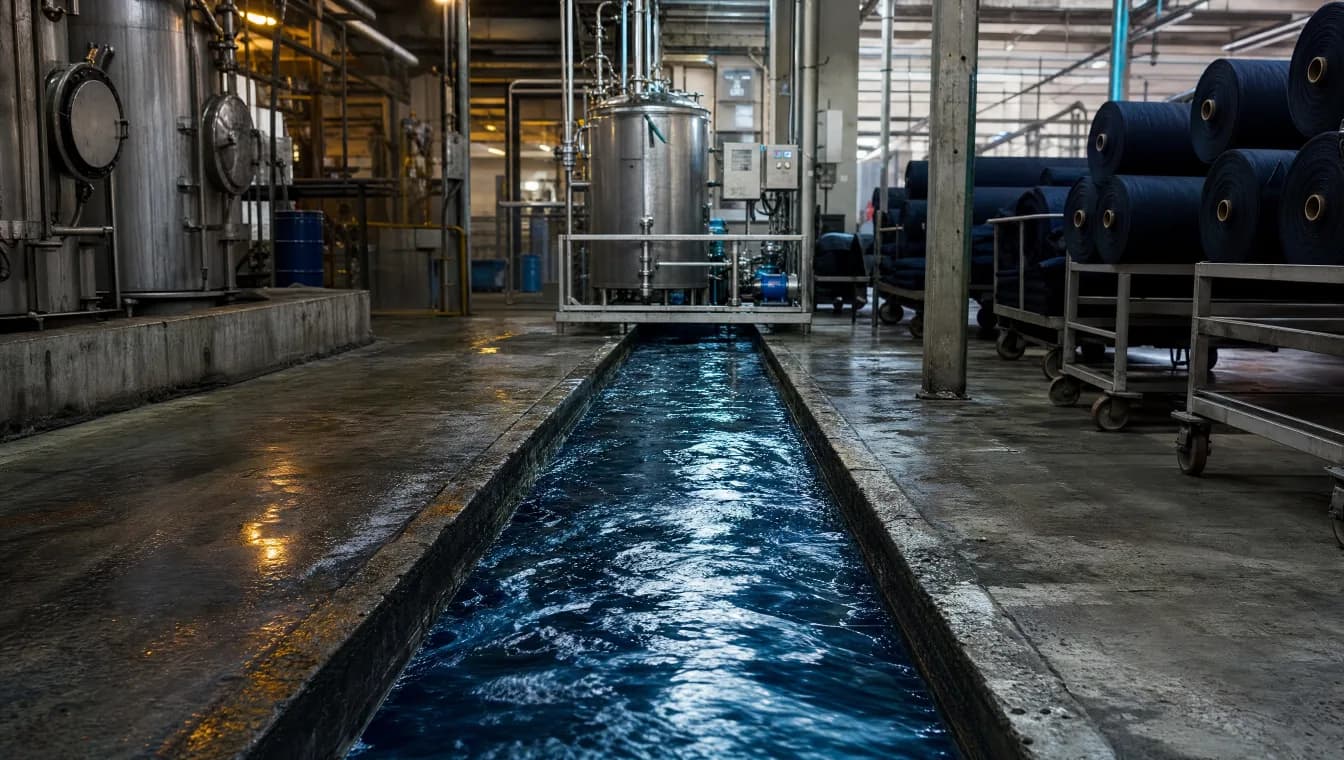
Colour is the contaminant that gets textile plants in trouble first. A dyehouse can meet every numeric limit in its sewer agreement and still draw a complaint because the discharge is visibly blue, and most synthetic dyes resist the biological treatment that municipal plants rely on. Textile wastewater treatment in Canada is therefore built around two jobs that ordinary treatment does poorly: removing colour, and dealing with the salt, surfactants and sizing agents that dyeing and finishing chemistry leaves behind.
A smaller, more specialized sector
The Canadian sector today is smaller than it once was but more specialized. Technical textile makers, commercial dyers and finishers, carpet and nonwoven producers, and industrial laundries all generate the same family of effluent: warm, coloured, alkaline, loaded with surfactants and with COD that outruns its BOD because so much of the organic load is synthetic. That COD-to-BOD gap is the tell that biological treatment alone will not finish the job.
Screening, equalization, then colour removal
An effective train starts with screening for lint and fibre, then equalization, because dye batches arrive as slugs of a single concentrated colour. Chemical coagulation and flocculation follow, breaking the dye dispersion so a lamella clarifier or a dissolved air flotation unit can pull the solids out. This physicochemical stage removes most colour and a large share of COD. Where discharge limits are tighter, or where the plant wants to reuse water, an MBBR handles the biodegradable fraction and an industrial reverse osmosis system polishes the effluent to reuse quality. RO matters more in this sector than most, because dyeing consumes large volumes of heated, softened water that is expensive to buy and heat once and wasteful to buy and heat twice.
Dewatering the gelatinous sludge
Sludge from coagulation is voluminous and gelatinous, so we size the dewatering stage honestly: a screw press or belt filter press with polymer conditioning, selected from a jar test on your actual sludge rather than a table.
Send us a litre
Send us a litre of your worst effluent and your discharge limits. We will run the jar tests, then quote the chemistry, the clarifier and the polishing stages from results, not assumptions. Industrial laundries deserve a note of their own: their effluent adds lint, oil and heavy metals from wiped parts to the standard surfactant load, and heat recovery from the hot discharge often pays back faster than any treatment stage.
Moncton is the Maritimes' distribution hub, and its industrial base reflects the role: food processors, transportation and fleet operations, metal fabricators and warehousing spread through a bilingual metro of 79,000 in the city proper. Wastewater flows to TransAqua, the Greater Moncton commission whose treatment plant discharges to the Petitcodiac River, a tidal-bore estuary in active ecological recovery since its causeway gates opened. A recovering river and a bilingual market The Petitcodiac's restoration, fish passage returning, the bore rebuilding, gives Moncton's wastewater governance a visible success story to protect, and TransAqua's surcharge program prices industrial strength accordingly. Maritimes distribution hub; TransAqua sewer surcharge program. That is the regulatory backdrop for textile & Dyeing in Moncton: equipment gets sized against the local limits on the route to Petitcodiac River, not against a national average.
Location
Moncton, New Brunswick
Population 79K
Receiving Water
Petitcodiac River
Pricing
Sized & quoted per project
What's Included in Moncton
Sizing against Moncton's sewer-use and surcharge regime (maritimes distribution hub; TransAqua sewer surcharge program)
Support for direct-discharge projects requiring an approval to operate under New Brunswick's Clean Environment Act
Effluent characterization matched to Moncton's dominant dischargers: food processing, transportation, metal fabrication, warehousing
Discharge route review for systems releasing toward Petitcodiac River
Textile & Dyeing on the ground in Moncton
Moncton's wastewater flows toward a recovering tidal-bore estuary under TransAqua's surcharge program, in a market where genuinely bilingual operator training is a competitive edge. In Moncton, the plants asking about textile & Dyeing are mostly in food processing, transportation, metal fabrication and warehousing, and each of those sectors puts a different load on a treatment train. Maritimes distribution hub; TransAqua sewer surcharge program. Direct discharge toward Petitcodiac River instead requires an approval to operate under New Brunswick's Clean Environment Act. Moncton's municipal plant has limited spare capacity, so a single overloaded industrial connection shows up quickly in its intake numbers. Projects in Moncton tend to be one-of-a-kind rather than repeat configurations, which is exactly the case where sizing from measured effluent data matters most.
FAQ
Frequently Asked Questions
Everything you need to know about our services.
Do you supply textile & Dyeing in Moncton?
Yes. Industrial Wastewater Canada sizes and supplies textile & Dyeing for plants across Moncton and the surrounding region. Most local demand comes from food processing, transportation, metal fabrication, warehousing. Send a quote request with your flow rate and effluent type and a sized proposal follows.
What discharge rules apply to industrial wastewater in Moncton?
Maritimes distribution hub; TransAqua sewer surcharge program. Food processors carry the highest loads and get the clearest payback from DAF-based pretreatment; fleet and fabrication operations need oil-water separation and wash-bay treatment. The market's practical distinction is language: greater Moncton operates genuinely bilingually, and suppliers who deliver operator training and documentation in both English and French hold an advantage that pure-anglophone competitors from outside the region consistently underestimate. Plants discharging to the municipal sewer answer to that regime; anything released directly toward Petitcodiac River needs an approval to operate under New Brunswick's Clean Environment Act. We size equipment against whichever limit governs your outfall.
How is textile & Dyeing sized for a plant in Moncton?
From your numbers, not from the city's. We start with measured flow and effluent characterization, then check the result against Moncton's local limits. A processor in a city of 79K with food processing as the dominant sector rarely has the same loading profile as its neighbours, so treatability data drives the selection.
What does textile & Dyeing cost in Moncton?
There is no list price; every system is sized and quoted per project. The economics are local, though. Payback in Moncton is usually calculated against those surcharge and compliance costs, and the quote spells that comparison out.
Send the flow rate. Get the system.
Flow, contaminants, discharge limit. An engineer replies with a sized treatment train and a quote — no obligation.
In this city
Equipment available here.
Industrial Wastewater Treatment Systems→Oil Water Separators→Dissolved Air Flotation (DAF) Systems→Membrane Bioreactor (MBR) Systems→MBBR Systems (Moving Bed Biofilm Reactors)→Lamella Clarifiers→Sludge Dewatering Screw Presses→Dewatering Centrifuges→Industrial Reverse Osmosis Systems→Wastewater Evaporators & ZLD Systems→Belt Filter Presses→Coalescing Filters→Industrial Bag & Cartridge Filtration→Food & Beverage Processing→Dairy Processing→Breweries & Distilleries→Meat & Poultry Processing→Pulp & Paper→Pharmaceutical & Biotech→Textile & Dyeing→Mining & Mineral Processing→Oil & Gas / Produced Water→Metal Finishing & Plating→Chemical Manufacturing→Power, Boilers & Cooling Towers→
Nearby cities