Loading...
Mining & Mineral Processing in Fredericton, New Brunswick
Industrial Wastewater Canada sizes and supplies mining & mineral processing for plants in Fredericton, New Brunswick. Local demand is driven by food processing, forestry products, IT, government, discharging under Fredericton's sewer-use rules toward Saint John River. Quote requests with flow rate and effluent type get a sized proposal.
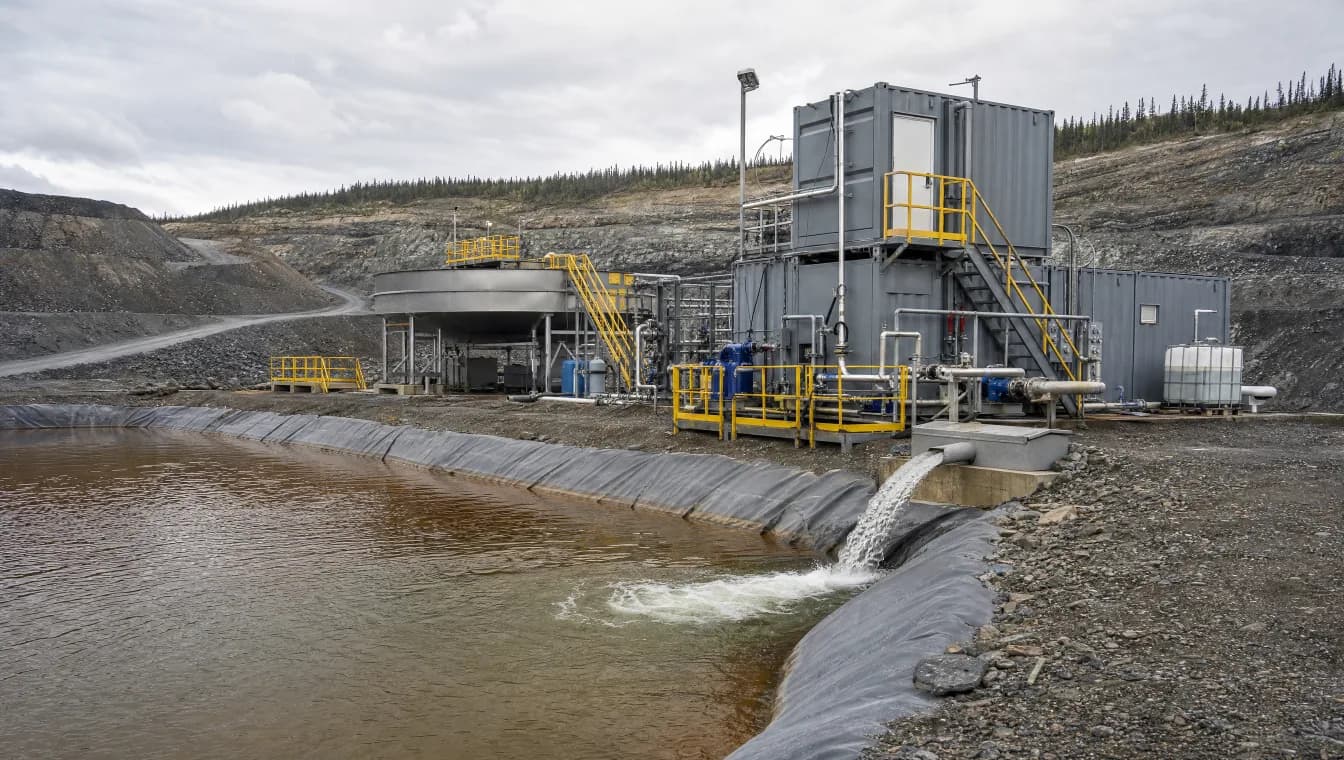
Mine water treatment is a logistics problem wearing a chemistry costume. The chemistry is well understood: neutralize acidity with lime, precipitate dissolved metals as hydroxides, settle or filter the solids, and polish for whatever the permit singles out, whether that is selenium, arsenic, ammonia from blasting residue, or cyanide at gold operations. What makes mining hard is where it happens. The treatment plant that works on paper must also work at the end of a winter road, staffed by a rotating crew, at minus forty, for a mine life that might be nine years or ninety.
The federal effluent rules
Canadian mines discharge under the federal Metal and Diamond Mining Effluent Regulations, which set limits on metals, pH, total suspended solids and toxicity to fish, alongside provincial and territorial permits that are often tighter and site-specific. Water balance drives everything: a mine in the wet season is fighting volume, a mine in freeze-up is storing water it cannot treat fast enough, and closure planning means the water often needs treating long after the ore is gone.
Solids and metals first
Our equipment scope in this sector centres on solids and metals. Lime dosing and reaction tanks, lamella clarifiers that put high settling capacity inside a heated building footprint, filter presses and dewatering centrifuges for the metal hydroxide sludge, and industrial reverse osmosis or ion exchange where dissolved contaminants like selenium and sulphate need more than precipitation. For camps and advanced exploration sites we supply containerized mine water treatment plants that arrive winterized, pre-piped and tested, because field construction hours are the most expensive line in any northern budget.
Maintainability decides
The difference between a plant that runs and a plant that gets bypassed is usually maintainability. We select equipment that a millwright can service with the parts on site, and we design the sludge line for the haul distance the mine actually faces.
What to bring us
Bring us your water quality data, your permit limits and your site logistics. We will size the treatment train around all three, because at a mine, ignoring the third one is how projects fail. We also support the front end of mine life: bulk sample programs and advanced exploration camps carry discharge obligations of their own, and a rented or repurposed containerized plant is usually the right-sized answer at that stage.
Fredericton is where New Brunswick's environmental approvals get decided. The provincial Department of Environment and Local Government sits in this capital of 63,000 on the Saint John River, alongside a market of food processors, forestry-product operations, an IT sector and the government itself, whose facilities discharge like the institutions they are. The market where the regulator lives Proximity to DELG shapes how projects run here. Provincial approvals (NB DELG) decided here; agri-food valley market. That is the regulatory backdrop for mining & Mineral Processing in Fredericton: equipment gets sized against the local limits on the route to Saint John River, not against a national average.
Location
Fredericton, New Brunswick
Population 63K
Receiving Water
Saint John River
Pricing
Sized & quoted per project
What's Included in Fredericton
Sizing against Fredericton's sewer-use and surcharge regime (provincial approvals (NB DELG) decided here; agri-food valley market)
Support for direct-discharge projects requiring an approval to operate under New Brunswick's Clean Environment Act
Effluent characterization matched to Fredericton's dominant dischargers: food processing, forestry products, IT, government
Discharge route review for systems releasing toward Saint John River
Mining & Mineral Processing on the ground in Fredericton
Fredericton hosts the DELG offices where New Brunswick's discharge approvals are decided, so knowing what a complete application looks like is worth weeks on any wastewater project here. In Fredericton, the plants asking about mining & Mineral Processing are mostly in food processing, forestry products, IT and government, and each of those sectors puts a different load on a treatment train. Provincial approvals (NB DELG) decided here; agri-food valley market. Direct discharge toward Saint John River instead requires an approval to operate under New Brunswick's Clean Environment Act. Fredericton's municipal plant has limited spare capacity, so a single overloaded industrial connection shows up quickly in its intake numbers. Projects in Fredericton tend to be one-of-a-kind rather than repeat configurations, which is exactly the case where sizing from measured effluent data matters most.
FAQ
Frequently Asked Questions
Everything you need to know about our services.
Do you supply mining & Mineral Processing in Fredericton?
Yes. Industrial Wastewater Canada sizes and supplies mining & Mineral Processing for plants across Fredericton and the surrounding region. Most local demand comes from food processing, forestry products, IT, government. Send a quote request with your flow rate and effluent type and a sized proposal follows.
What discharge rules apply to industrial wastewater in Fredericton?
Provincial approvals (NB DELG) decided here; agri-food valley market. Provincial approval files for dischargers across New Brunswick pass through offices a few blocks from downtown, and suppliers who understand the department's expectations, what a complete application looks like, which parameters draw questions, save their clients weeks of back-and-forth. The local industrial base is modest but real: agri-food plants drawing on the Saint John River valley's farm economy, wood-products operations, and institutional streams from government and university campuses. Plants discharging to the municipal sewer answer to that regime; anything released directly toward Saint John River needs an approval to operate under New Brunswick's Clean Environment Act. We size equipment against whichever limit governs your outfall.
How is mining & Mineral Processing sized for a plant in Fredericton?
From your numbers, not from the city's. We start with measured flow and effluent characterization, then check the result against Fredericton's local limits. A processor in a city of 63K with food processing as the dominant sector rarely has the same loading profile as its neighbours, so treatability data drives the selection.
What does mining & Mineral Processing cost in Fredericton?
There is no list price; every system is sized and quoted per project. The economics are local, though. The Saint John River, the province's defining waterway, receives the region's treated flows, and its profile in provincial politics keeps municipal and industrial performance visible. Payback in Fredericton is usually calculated against those surcharge and compliance costs, and the quote spells that comparison out.
Send the flow rate. Get the system.
Flow, contaminants, discharge limit. An engineer replies with a sized treatment train and a quote — no obligation.
In this city
Equipment available here.
Industrial Wastewater Treatment Systems→Oil Water Separators→Dissolved Air Flotation (DAF) Systems→Membrane Bioreactor (MBR) Systems→MBBR Systems (Moving Bed Biofilm Reactors)→Lamella Clarifiers→Sludge Dewatering Screw Presses→Dewatering Centrifuges→Industrial Reverse Osmosis Systems→Wastewater Evaporators & ZLD Systems→Belt Filter Presses→Coalescing Filters→Industrial Bag & Cartridge Filtration→Food & Beverage Processing→Dairy Processing→Breweries & Distilleries→Meat & Poultry Processing→Pulp & Paper→Pharmaceutical & Biotech→Textile & Dyeing→Mining & Mineral Processing→Oil & Gas / Produced Water→Metal Finishing & Plating→Chemical Manufacturing→Power, Boilers & Cooling Towers→
Nearby cities