Loading...
Industrial Wastewater Treatment Systems in Calgary, Alberta
Industrial Wastewater Canada sizes and supplies industrial wastewater treatment systems for plants in Calgary, Alberta. Local demand is driven by oil & gas services, food processing, chemicals, logistics, discharging under Calgary's sewer-use rules toward Bow River. Quote requests with flow rate and effluent type get a sized proposal.
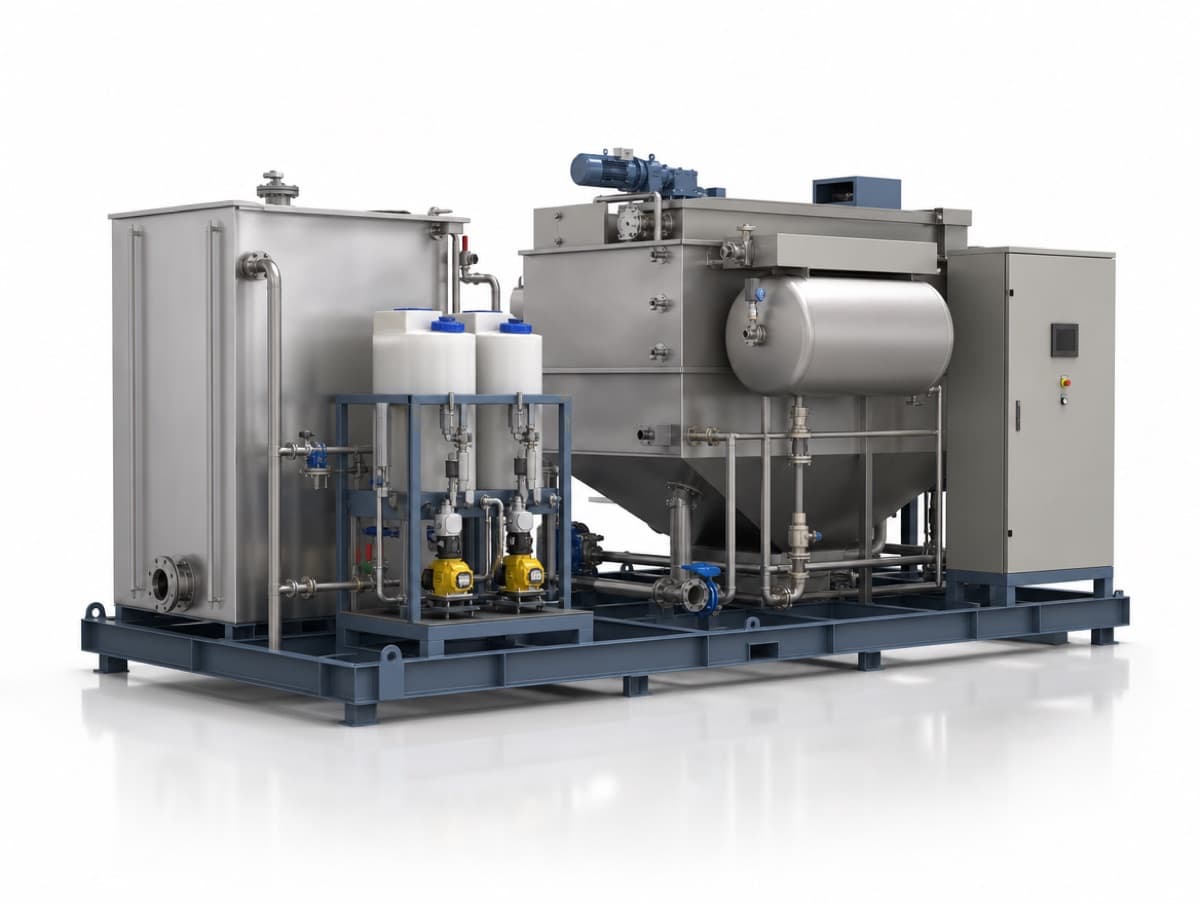
An industrial wastewater treatment system is rarely one machine. It is a train: screening to protect everything downstream, equalization to flatten the peaks your process throws at it, then the stages that actually remove what your permit or sewer-use bylaw regulates. We supply that train as a turnkey scope, from the first lab characterization through pilot testing, fabrication, commissioning and the paperwork your province expects, including ECA and CofA support in Ontario.
What you discharge sets the design
The starting point is always the same question: what are you discharging, and what are you allowed to discharge? A food plant fighting BOD surcharges under an industrial waste surcharge agreement needs a different train than a metal finisher holding zinc below a bylaw limit, and both differ from a remote camp discharging to a receiving water under a provincial permit. We size against your actual numbers, not a catalogue page. That means a composite sample or a recent lab analysis, your peak flow rather than your average, and the exact parameter list in your permit.
Engineered as one system
What arrives on site is engineered as a system, not a collection of vendors. PLC automation with remote monitoring comes standard, so an operator can watch chemical dosing, flows and alarms from a phone rather than a control room. Modular expansion capacity is designed in from the start; if production doubles in five years, the civil works and hydraulic profile already anticipate the second unit. Where the treatability is uncertain, we run a pilot on your effluent first, because a few weeks of pilot data is cheaper than a mis-sized clarifier.
The surcharge math
The economics usually decide the scope. Municipal surcharges are permanent operating costs that scale with production, while on-site treatment is a capital cost that stops the meter. Toronto bills over-strength discharge under Sewers By-law 681, Metro Vancouver permits industrial discharge under GVS&DD Bylaw 299, and most Ontario municipalities offer surcharge agreements for effluent above sewer limits. For many plants the payback question is a single spreadsheet: this year's surcharge invoice against a quoted system.
What we need to quote
To get a budget number, send three things: your flow rate, a lab analysis or a plain description of the process generating the water, and where the effluent goes. A process engineer reviews every proposal before it reaches you, and the quote comes back with a sized configuration, budget price and delivery timeline for your facility, anywhere in Canada, in English or French. Pilot rentals and treatability studies are quoted separately when the stream demands proof before capital, and commissioning support stays available after handover, so the plant you buy keeps meeting the permit it was sized for.
Calgary sits at the junction of two wastewater markets. Inside city limits, well over a million people and a growing base of food processors, chemical blenders and logistics operators discharge under Wastewater Bylaw 14M2012, with the Bow River as the receiving water. Outside the city, the surrounding basin runs on produced water and work-camp utilities, a market with no municipal sewer at all. City of Calgary Wastewater Bylaw 14M2012; large produced-water and camp wastewater market in surrounding basin. That is the regulatory backdrop for industrial Wastewater Treatment Systems in Calgary: equipment gets sized against the local limits on the route to Bow River, not against a national average.
Location
Calgary, Alberta
Population 1,307K
Receiving Water
Bow River
Pricing
Sized & quoted per project
What's Included in Calgary
Sizing against Calgary's sewer-use and surcharge regime (city of Calgary Wastewater Bylaw 14M2012; large produced-water and camp wastewater market in surrounding basin)
Support for direct-discharge projects requiring an approval under Alberta's Environmental Protection and Enhancement Act
Effluent characterization matched to Calgary's dominant dischargers: oil & gas services, food processing, chemicals, logistics
Discharge route review for systems releasing toward Bow River
Industrial Wastewater Treatment Systems on the ground in Calgary
Calgary plants answer to Bylaw 14M2012 and a trout river with no assimilative capacity to spare, while an hour away the produced-water market needs wastewater treatment skids that run unattended at −30 °C. In Calgary, the plants asking about industrial Wastewater Treatment Systems are mostly in oil & gas services, food processing, chemicals and logistics, and each of those sectors puts a different load on a treatment train. City of Calgary Wastewater Bylaw 14M2012; large produced-water and camp wastewater market in surrounding basin. Direct discharge toward Bow River instead requires an approval under Alberta's Environmental Protection and Enhancement Act. A metro of Calgary's size runs enough industrial flow that the municipal plant polices its intake closely, and surcharge invoices arrive on schedule. We quote industrial Wastewater Treatment Systems in Calgary often, and the sizing conversation usually starts from a surcharge bill or a compliance letter rather than from a catalogue.
FAQ
Frequently Asked Questions
Everything you need to know about our services.
Do you supply industrial Wastewater Treatment Systems in Calgary?
Yes. Industrial Wastewater Canada sizes and supplies industrial Wastewater Treatment Systems for plants across Calgary and the surrounding region. Most local demand comes from oil & gas services, food processing, chemicals, logistics. Send a quote request with your flow rate and effluent type and a sized proposal follows.
What discharge rules apply to industrial wastewater in Calgary?
City of Calgary Wastewater Bylaw 14M2012; large produced-water and camp wastewater market in surrounding basin. Bow River limits meet oilfield volumes The Bow is a cold, clear trout river with little assimilative capacity to spare, so the city keeps its bylaw limits tight and its sampling frequent. Meanwhile an oil and gas service company an hour away may need to treat 500 m³/day of produced water to reuse or disposal standards with nothing but a skid and a generator. Plants discharging to the municipal sewer answer to that regime; anything released directly toward Bow River needs an approval under Alberta's Environmental Protection and Enhancement Act. We size equipment against whichever limit governs your outfall.
How is industrial Wastewater Treatment Systems sized for a plant in Calgary?
From your numbers, not from the city's. We start with measured flow and effluent characterization, then check the result against Calgary's local limits. A processor in a city of 1,307K with oil & gas services as the dominant sector rarely has the same loading profile as its neighbours, so treatability data drives the selection.
What does industrial Wastewater Treatment Systems cost in Calgary?
There is no list price; every system is sized and quoted per project. The economics are local, though. We design for both ends: sewer-compliance pretreatment for plants inside Calgary, and self-contained packaged systems for camps and well sites where winter operation at −30 °C is a design requirement, not an edge case. Payback in Calgary is usually calculated against those surcharge and compliance costs, and the quote spells that comparison out.
Send the flow rate. Get the system.
Flow, contaminants, discharge limit. An engineer replies with a sized treatment train and a quote — no obligation.
In this city
Equipment available here.
Industrial Wastewater Treatment Systems→Oil Water Separators→Dissolved Air Flotation (DAF) Systems→Membrane Bioreactor (MBR) Systems→MBBR Systems (Moving Bed Biofilm Reactors)→Lamella Clarifiers→Sludge Dewatering Screw Presses→Dewatering Centrifuges→Industrial Reverse Osmosis Systems→Wastewater Evaporators & ZLD Systems→Belt Filter Presses→Coalescing Filters→Industrial Bag & Cartridge Filtration→Food & Beverage Processing→Dairy Processing→Breweries & Distilleries→Meat & Poultry Processing→Pulp & Paper→Pharmaceutical & Biotech→Textile & Dyeing→Mining & Mineral Processing→Oil & Gas / Produced Water→Metal Finishing & Plating→Chemical Manufacturing→Power, Boilers & Cooling Towers→
Nearby cities