Loading...
Flocculant Water Treatment
Flocculant selection and polymer dosing systems for industrial water treatment. Anionic and cationic polymers matched to your sludge and separator.
Key takeaways
Flocculant Water Treatment: Flocculant selection and polymer dosing systems for industrial water treatment. Anionic and cationic polymers matched to your sludge and separator.
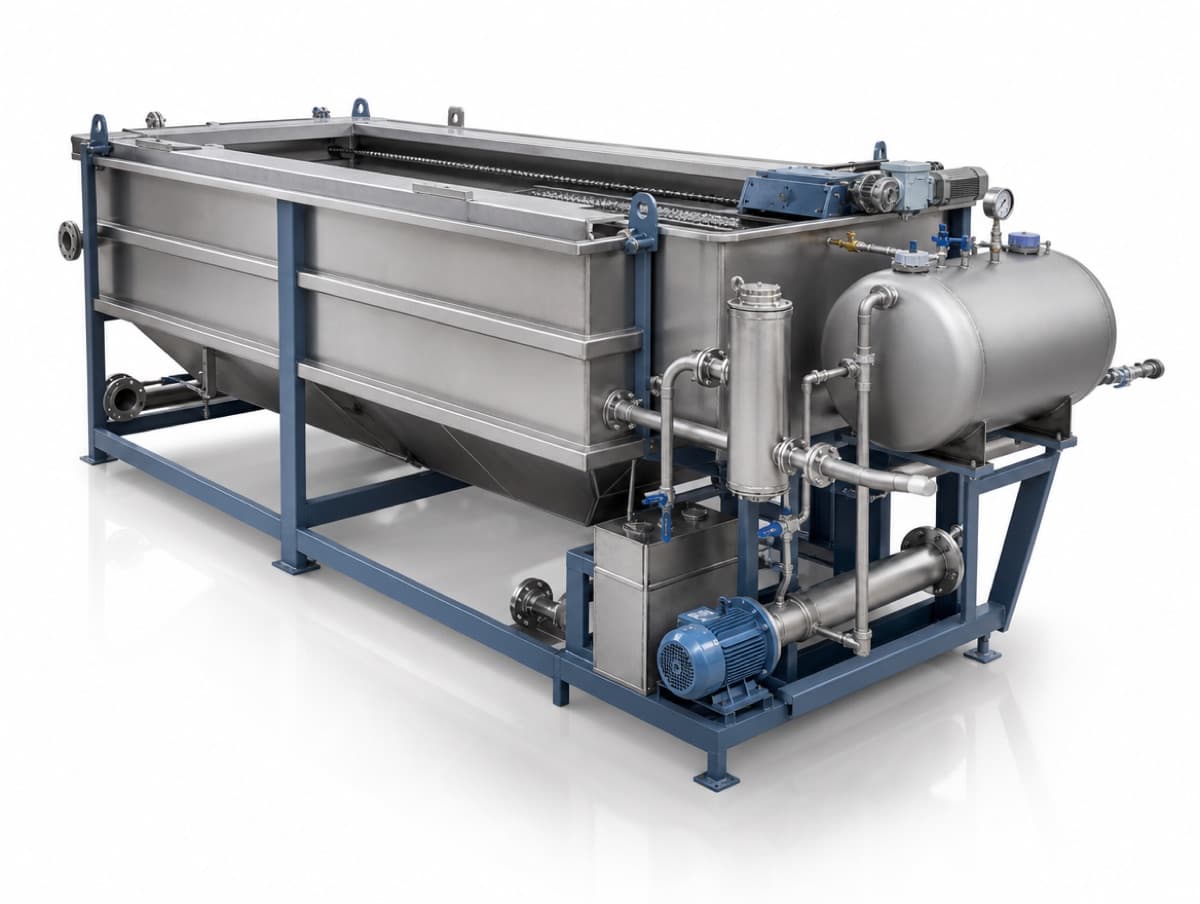
Closest matching equipment: Dissolved Air Flotation (DAF) Systems (By quote)
Where flocculant fits in water treatment
Coagulation kills the charge; flocculation builds the body. A flocculant (in practice, a high molecular weight polyacrylamide) bridges the pin floc a coagulant creates into large, tough flocs that float cleanly in a DAF or settle fast in a clarifier. Skip the polymer and you get carryover: hazy effluent, a thin float layer, and a dewatering press that blinds.
Polymers are specified on three axes, and each one changes performance on your sludge:
- Charge type: anionic for mineral and inorganic solids, cationic for biological and oily sludges, non-ionic for a narrow band in between
- Charge density: how much of the chain carries charge, typically 10 to 80 percent
- Molecular weight: longer chains bridge better but shear apart in aggressive pumping
Form matters too. Dry powder is cheapest per active kilogram but needs a make-down system with proper aging (30 to 60 minutes is common). Emulsion polymer activates in minutes through an inline blending unit and suits plants without an operator watching the make-down.
Flocculant selection for water and sludge treatment
We select polymer the same way we select coagulant: on your sample, not from a chart. Bench screening runs a candidate set across charge types and densities, scoring floc size, water release and filtrate clarity. For dewatering duty we also run a free-drainage test, because the polymer that wins in the clarifier often loses on the belt press.
Overdosing is the most common field problem we see. Past the optimum, excess polymer re-stabilizes solids, slimes the filter cloth and wastes money on every batch. Flow-paced dosing with a make-down unit sized to demand keeps you at the setpoint instead of chasing it.
We stock anionic and cationic grades in powder and emulsion, supply make-down skids from 500 L/h up, and quote polymer trials as part of any DAF or dewatering project. Send us your application and a sludge or effluent sample, and we will shortlist grades and doses with a firm price.
Flocculant selection depends on the machine it feeds, whether a DAF system, a screw press or a dewatering centrifuge; jar testing comes with every equipment quote.
FAQ
Frequently Asked Questions
Everything you need to know about our services.
What is the difference between a coagulant and a flocculant?
The coagulant neutralizes particle charge so particles can touch; the flocculant bridges the neutralized particles into large flocs. Most systems need both, dosed in that order with mixing between.
How do I choose between anionic and cationic flocculant?
By the charge of the particles you are settling: mineral solids usually take an anionic polymer, organic and biological sludges usually take a cationic one. A jar test on your effluent confirms the grade before you buy a tote.
Why is my flocculant not forming good flocs?
The usual causes are wrong make-down concentration, overmixing that shears the flocs apart, or a coagulation step that never neutralized the particles. Check preparation and mixing energy before switching products.
Send the flow rate. Get the system.
Flow, contaminants, discharge limit. An engineer replies with a sized treatment train and a quote — no obligation.