Loading...
Coagulant for Water Treatment
Coagulant selection and dosing systems for water treatment in Canadian plants. Alum, ferric and PAC matched to your effluent by jar testing.
Key takeaways
Coagulant for Water Treatment: Coagulant selection and dosing systems for water treatment in Canadian plants. Alum, ferric and PAC matched to your effluent by jar testing.
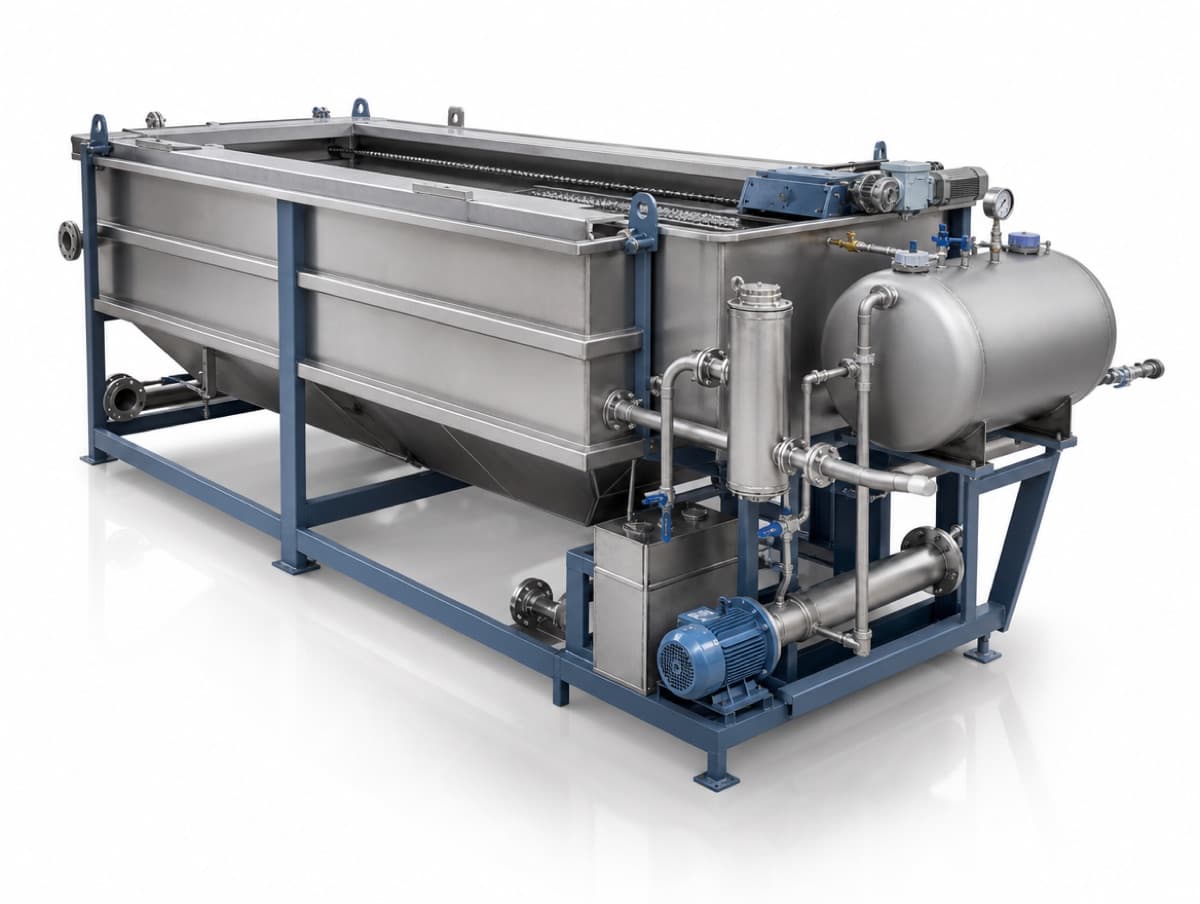
Closest matching equipment: Dissolved Air Flotation (DAF) Systems (By quote)
How a coagulant for water treatment works
Fine particles in industrial effluent carry a negative surface charge, so they repel each other and stay suspended for hours. A coagulant for water treatment neutralizes that charge. Once the repulsion collapses, particles collide and stick, forming pin floc that downstream equipment (a DAF, a clarifier, a filter) can actually remove.
The workhorse chemistries in Canadian plants are:
- Aluminum sulfate (alum): cheap, effective on turbidity, works best at pH 5.5 to 7.5
- Polyaluminum chloride (PAC): wider pH window, less sludge, better in cold water, which matters from October to April in most of the country
- Ferric chloride and ferric sulfate: strong on phosphorus and sulfide odour, aggressive on carbon steel, so materials selection counts
- Organic coagulants (polyamines, polyDADMAC): low dose, no metal hydroxide sludge, often blended with inorganics
Cold-water performance is not a footnote here. Alum floc forms slowly below about 5 °C, which is one reason PAC has displaced it in many northern plants.
Choosing the right coagulant: jar testing before dosing
There is no lookup table that replaces a jar test. Effluent chemistry shifts with production schedules, CIP cycles and season, so we test candidate coagulants on your actual water at a range of doses and pH setpoints, then read supernatant turbidity, floc size and settling rate. The winning chemistry is the one that hits your limit at the lowest total cost, counting sludge disposal, not just the price per tote.
Dosing hardware is the second half of the job. We supply metering pump skids with flow-paced control, calibration columns and secondary containment, sized so your day tank holds a sensible delivery interval. If your discharge agreement caps aluminum or iron in the effluent, we design to that residual too.
Send a one-litre sample and your discharge limits. We run the jar tests, recommend a chemistry and a dose, and quote the feed system with it.
Coagulant dosing is normally paired with a DAF system or a lamella clarifier; ask for a quote that covers both the chemistry and the equipment.
FAQ
Frequently Asked Questions
Everything you need to know about our services.
Which coagulant should I use for my effluent?
There is no universal answer: it depends on the particles, the pH and the downstream process. A jar test on a sample of your effluent answers it in an afternoon. We run them as part of quoting.
How is coagulant dose controlled day to day?
A metering pump doses against flow, and the setpoint comes from jar tests repeated when the effluent changes. Sites with variable effluent add streaming-current or turbidity control so the dose follows the load automatically.
Does coagulant dosing change my effluent pH?
Metal-salt coagulants such as alum and ferric consume alkalinity and pull pH down. Most dosing systems pair the coagulant pump with pH adjustment so the downstream process and the discharge permit both stay in range.
Send the flow rate. Get the system.
Flow, contaminants, discharge limit. An engineer replies with a sized treatment train and a quote — no obligation.