Loading...
Wastewater Evaporators & ZLD Systems in Victoria, British Columbia
Industrial Wastewater Canada sizes and supplies wastewater evaporators & zld systems for plants in Victoria, British Columbia. Local demand is driven by marine industry, breweries, food processing, tech, discharging under Victoria's sewer-use rules toward Juan de Fuca Strait. Quote requests with flow rate and effluent type get a sized proposal.
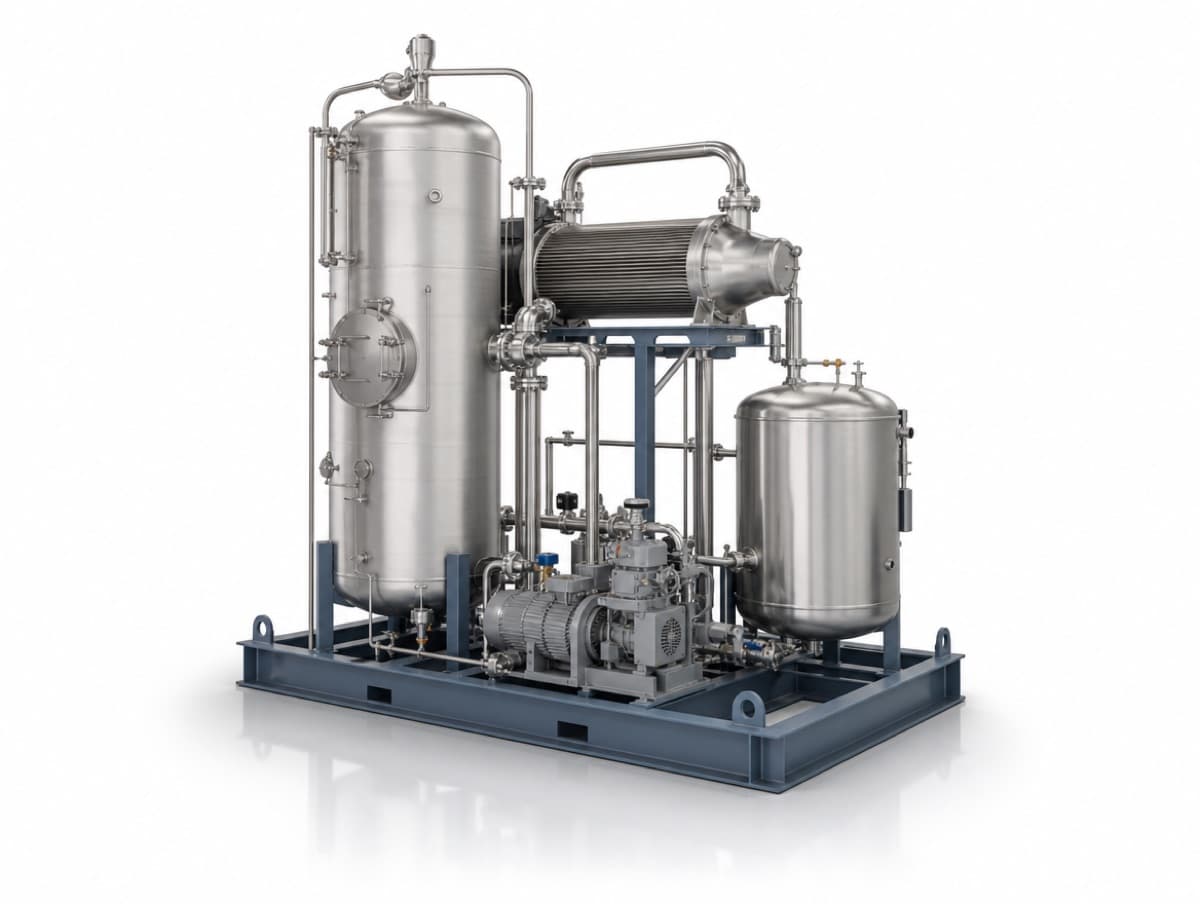
Some wastewater cannot be treated to a sewer limit at any sensible cost: saturated brines, landfill leachate, spent coolants and washwaters loaded with dissolved solids that no membrane or biology will touch. For decades the default answer has been the tanker truck, and the invoice that comes with it, forever. An industrial wastewater evaporator ends that arrangement by concentrating the problem instead of hauling it, boiling off clean water and reducing waste volume by up to 95 percent, so five truckloads become one.
The energy story
The energy story is what makes modern evaporation economical, and it is worth understanding. Mechanical vapour recompression takes the vapour boiled off the wastewater, compresses it slightly to raise its condensation temperature, and uses that same vapour as the heat source for further evaporation. The latent heat is recycled continuously rather than spent once, which is why an MVR evaporator runs on electricity at a fraction of the energy a direct-fired unit burns, and why it can run economically on streams that would bankrupt a gas-heated design.
To zero liquid discharge
Where discharge must reach zero, crystallizer options take the concentrate the rest of the way to a dry, disposal-ready residue, a full zero liquid discharge configuration. That capability is moving from exotic to expected in Canadian sectors where regulators are tightening what may leave the site in liquid form at all. The distillate coming off the evaporator is clean enough for reuse in many plants, which turns a disposal problem into a modest water supply.
The buying math
The buying math is blunt. Take your current annual haul-away spend, including the trucking line and the disposal fee per litre, and set it against the capital and power cost of an evaporator sized for your volume. Streams with high disposal costs, spent coolant from machining operations being the classic case, often show paybacks short enough to surprise a CFO. Canadian search interest in water evaporators runs around 260 queries a month, and the callers are almost always plants staring at exactly that invoice.
Sizing inputs
Evaporator sizing turns on volume, dissolved solids content and what the concentrate must become, so the quoting inputs are a recent analysis of the stream, your monthly volume and your disposal cost today. A process engineer reviews every proposal and returns a sized configuration, budget price and delivery timeline for your site, anywhere in Canada. Materials of construction are selected against the chloride and pH profile of your concentrate, because an evaporator is a corrosion problem before it is a heat transfer problem, and the alloy choice decides the service life.
Victoria's industrial wastewater era effectively began in 2021, when the McLoughlin Point plant ended more than a century of screened-only discharge to the Juan de Fuca Strait. With actual treatment now protecting the marine outfall, the Capital Regional District's Sewer Use Bylaw 2922 acquired teeth, and the region's dischargers, shipyards and marine industry, breweries and distilleries, food processors and a technology sector, in a core city of 92,000, face source-control scrutiny that simply didn't exist before. After McLoughlin Point, source control got real A treatment plant changes the politics of pretreatment: what an industrial discharger sends now affects a facility the region spent hundreds of millions building, and CRD source-control officers act accordingly. CRD Sewer Use Bylaw 2922; new McLoughlin Point treatment era raised pretreatment scrutiny. That is the regulatory backdrop for wastewater Evaporators & ZLD Systems in Victoria: equipment gets sized against the local limits on the route to Juan de Fuca Strait, not against a national average.
Location
Victoria, British Columbia
Population 92K
Receiving Water
Juan de Fuca Strait
Pricing
Sized & quoted per project
What's Included in Victoria
Sizing against Victoria's sewer-use and surcharge regime (cRD Sewer Use Bylaw 2922; new McLoughlin Point treatment era raised pretreatment scrutiny)
Support for direct-discharge projects requiring a waste discharge authorization under British Columbia's Environmental Management Act
Effluent characterization matched to Victoria's dominant dischargers: marine industry, breweries, food processing, tech
Discharge route review for systems releasing toward Juan de Fuca Strait
Wastewater Evaporators & ZLD Systems on the ground in Victoria
Since McLoughlin Point started treating Victoria's discharge in 2021, CRD Bylaw 2922 source control has real teeth, and many of the region's shipyards and breweries are building their first genuine industrial wastewater compliance programs. In Victoria, the plants asking about wastewater Evaporators & ZLD Systems are mostly in marine industry, breweries, food processing and tech, and each of those sectors puts a different load on a treatment train. CRD Sewer Use Bylaw 2922; new McLoughlin Point treatment era raised pretreatment scrutiny. Direct discharge toward Juan de Fuca Strait instead requires a waste discharge authorization under British Columbia's Environmental Management Act. Victoria's municipal plant has limited spare capacity, so a single overloaded industrial connection shows up quickly in its intake numbers. Projects in Victoria tend to be one-of-a-kind rather than repeat configurations, which is exactly the case where sizing from measured effluent data matters most.
FAQ
Frequently Asked Questions
Everything you need to know about our services.
Do you supply wastewater Evaporators & ZLD Systems in Victoria?
Yes. Industrial Wastewater Canada sizes and supplies wastewater Evaporators & ZLD Systems for plants across Victoria and the surrounding region. Most local demand comes from marine industry, breweries, food processing, tech. Send a quote request with your flow rate and effluent type and a sized proposal follows.
What discharge rules apply to industrial wastewater in Victoria?
CRD Sewer Use Bylaw 2922; new McLoughlin Point treatment era raised pretreatment scrutiny. Shipyard work, hull washing, blast water, bilge streams, draws the closest attention for metals and hydrocarbons. Victoria's dense brewing and distilling scene contributes high-BOD, low-pH streams from small sites with no room for conventional tanks, pushing demand toward compact neutralization and fine-bubble DAF units. Plants discharging to the municipal sewer answer to that regime; anything released directly toward Juan de Fuca Strait needs a waste discharge authorization under British Columbia's Environmental Management Act. We size equipment against whichever limit governs your outfall.
How is wastewater Evaporators & ZLD Systems sized for a plant in Victoria?
From your numbers, not from the city's. We start with measured flow and effluent characterization, then check the result against Victoria's local limits. A processor in a city of 92K with marine industry as the dominant sector rarely has the same loading profile as its neighbours, so treatability data drives the selection.
What does wastewater Evaporators & ZLD Systems cost in Victoria?
There is no list price; every system is sized and quoted per project. The economics are local, though. The common thread is newness: many dischargers are writing their first real compliance programs, and getting the foundations right matters more than sophistication. Payback in Victoria is usually calculated against those surcharge and compliance costs, and the quote spells that comparison out.
Send the flow rate. Get the system.
Flow, contaminants, discharge limit. An engineer replies with a sized treatment train and a quote — no obligation.
In this city
Equipment available here.
Industrial Wastewater Treatment Systems→Oil Water Separators→Dissolved Air Flotation (DAF) Systems→Membrane Bioreactor (MBR) Systems→MBBR Systems (Moving Bed Biofilm Reactors)→Lamella Clarifiers→Sludge Dewatering Screw Presses→Dewatering Centrifuges→Industrial Reverse Osmosis Systems→Wastewater Evaporators & ZLD Systems→Belt Filter Presses→Coalescing Filters→Industrial Bag & Cartridge Filtration→Food & Beverage Processing→Dairy Processing→Breweries & Distilleries→Meat & Poultry Processing→Pulp & Paper→Pharmaceutical & Biotech→Textile & Dyeing→Mining & Mineral Processing→Oil & Gas / Produced Water→Metal Finishing & Plating→Chemical Manufacturing→Power, Boilers & Cooling Towers→
Nearby cities