Loading...
Belt Filter Presses in Saint John, New Brunswick
Industrial Wastewater Canada sizes and supplies belt filter presses for plants in Saint John, New Brunswick. Local demand is driven by oil refining, pulp & paper, port industry, brewing, discharging under Saint John's sewer-use rules toward Bay of Fundy. Quote requests with flow rate and effluent type get a sized proposal.
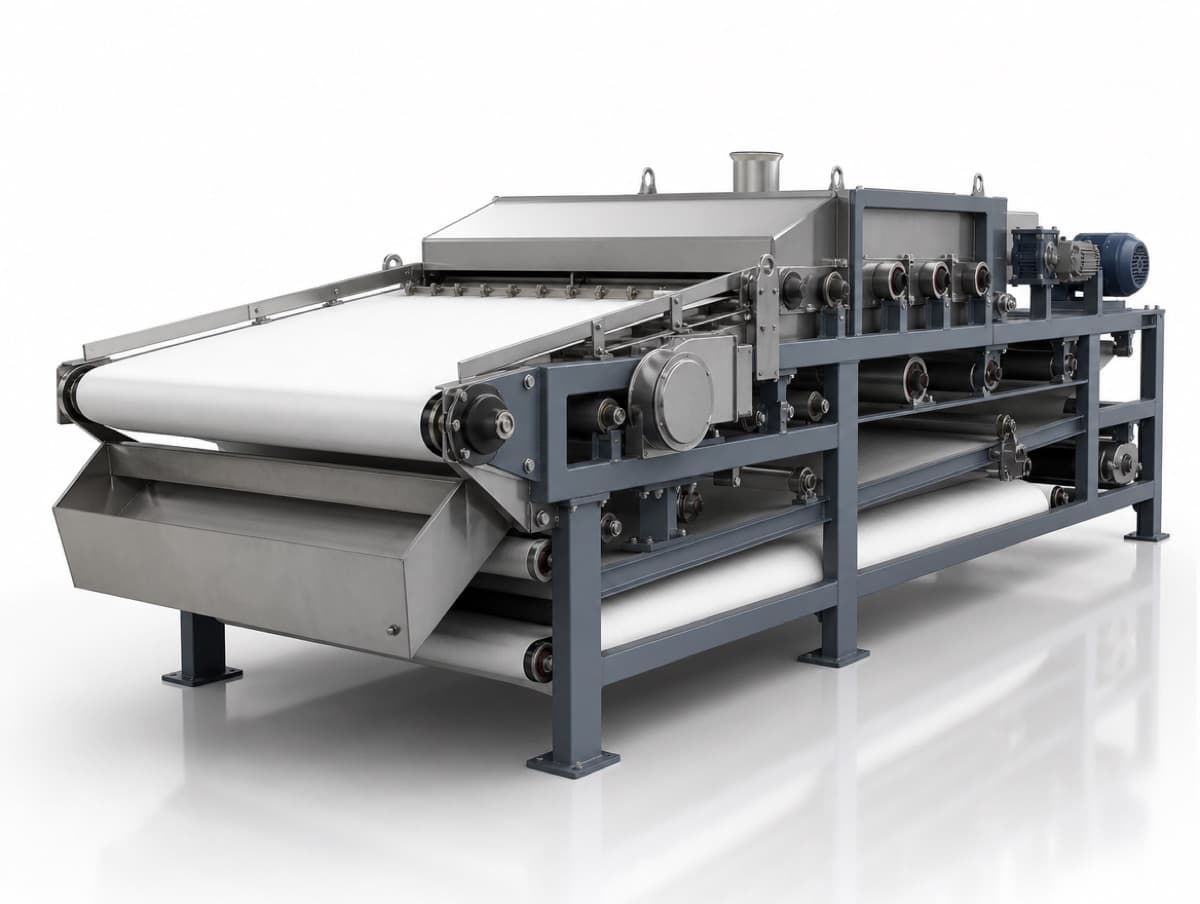
The belt filter press remains the throughput champion of continuous sludge dewatering. Where volumes are large and the sludge keeps coming, municipal digesters, pulp and paper mills, food processors with round-the-clock production, a belt press turns a river of conditioned sludge into a steady discharge of cake, hour after hour, at an energy cost per tonne that newer technologies still struggle to match.
Three stages, one belt
The machine works in three stages, and understanding them is the key to specifying one. In the gravity zone, free water drains through a moving porous belt, often removing the majority of the volume before any pressure is applied. In the wedge zone, a second belt converges over the first, gently confining the sludge as drainage continues. Then the high-pressure zone carries the sandwiched sludge around a series of rollers of decreasing diameter, shearing and squeezing out the remaining water before the cake is scraped off. Each zone is tuned to your sludge: belt speed, belt tension and polymer dose are all adjustable in operation, which is why the same machine can dewater digested municipal biosolids on Monday and paper mill sludge on Tuesday.
Polymer economy
Polymer economy is a quiet strength of the design. Because the gravity zone does so much of the work unpressurized, belt presses typically run at low polymer consumption per tonne compared with machines that rely on force alone, and over years of continuous operation the chemical line on the budget notices. Belt widths from 1.0 to 3.0 metres cover the range from a small plant running one shift to a large mill running three.
Belts, cloths and consumables
Consumables are part of the ownership picture and we treat them that way: replacement belts and cloths are supplied and stocked, matched to your machine rather than sourced generically, because a belt press is only as good as the belt on it. Wash water systems, doctor blades and rollers are all serviceable in place.
Specification inputs
The specification inputs are sludge type, feed solids concentration and required throughput. Send those with a recent analysis, or simply describe the process generating the sludge, and we return a sized configuration, budget price and delivery timeline for your facility, anywhere in Canada. Every proposal is reviewed by a process engineer before it reaches you, and commissioning support is quoted per project alongside the machine. Gravity-zone drainage trials on your actual sludge are available before purchase, and belt tracking and tensioning systems are serviceable in place, so routine care happens beside the machine rather than in a shop.
Saint John carries the heaviest industrial effluent concentration in Atlantic Canada. The Irving Oil refinery, Canada's largest, the Irving pulp operations at Reversing Falls, brewing and port industry share this city of 70,000 on the Bay of Fundy, whose 12-metre tides produce a receiving environment unlike any other Canadian harbour. Refinery-scale effluent on Fundy tides The big sites run their own sophisticated treatment under federal and provincial oversight, refinery sour-water and desalter streams, pulp-mill organics, and their scale means even efficiency projects move volumes most cities never see. Irving refinery and pulp operations — Atlantic Canada's heaviest industrial effluent concentration. That is the regulatory backdrop for belt Filter Presses in Saint John: equipment gets sized against the local limits on the route to Bay of Fundy, not against a national average.
Location
Saint John, New Brunswick
Population 70K
Receiving Water
Bay of Fundy
Pricing
Sized & quoted per project
What's Included in Saint John
Sizing against Saint John's sewer-use and surcharge regime (irving refinery and pulp operations — Atlantic Canada's heaviest industrial effluent concentration)
Support for direct-discharge projects requiring an approval to operate under New Brunswick's Clean Environment Act
Effluent characterization matched to Saint John's dominant dischargers: oil refining, pulp & paper, port industry, brewing
Discharge route review for systems releasing toward Bay of Fundy
Belt Filter Presses on the ground in Saint John
Saint John pairs Canada's largest refinery and Fundy's 12-metre tides, refinery-scale wastewater in a marine environment regulators treat as non-negotiable. In Saint John, the plants asking about belt Filter Presses are mostly in oil refining, pulp & paper, port industry and brewing, and each of those sectors puts a different load on a treatment train. Irving refinery and pulp operations — Atlantic Canada's heaviest industrial effluent concentration. Direct discharge toward Bay of Fundy instead requires an approval to operate under New Brunswick's Clean Environment Act. Saint John's municipal plant has limited spare capacity, so a single overloaded industrial connection shows up quickly in its intake numbers. Projects in Saint John tend to be one-of-a-kind rather than repeat configurations, which is exactly the case where sizing from measured effluent data matters most.
FAQ
Frequently Asked Questions
Everything you need to know about our services.
Do you supply belt Filter Presses in Saint John?
Yes. Industrial Wastewater Canada sizes and supplies belt Filter Presses for plants across Saint John and the surrounding region. Most local demand comes from oil refining, pulp & paper, port industry, brewing. Send a quote request with your flow rate and effluent type and a sized proposal follows.
What discharge rules apply to industrial wastewater in Saint John?
Irving refinery and pulp operations — Atlantic Canada's heaviest industrial effluent concentration. The Fundy tides cut both ways: enormous exchange volumes, but a marine ecosystem, including right whale habitat offshore, that regulators and the public treat as non-negotiable. Around the anchors, a tier of brewers, food operations and port services discharges to Saint John's municipal system with conventional pretreatment needs. Plants discharging to the municipal sewer answer to that regime; anything released directly toward Bay of Fundy needs an approval to operate under New Brunswick's Clean Environment Act. We size equipment against whichever limit governs your outfall.
How is belt Filter Presses sized for a plant in Saint John?
From your numbers, not from the city's. We start with measured flow and effluent characterization, then check the result against Saint John's local limits. A processor in a city of 70K with oil refining as the dominant sector rarely has the same loading profile as its neighbours, so treatability data drives the selection.
What does belt Filter Presses cost in Saint John?
There is no list price; every system is sized and quoted per project. The economics are local, though. Industrial families run this town's economy, and supplier relationships here are long, personal and earned through service performance rather than proposals. Payback in Saint John is usually calculated against those surcharge and compliance costs, and the quote spells that comparison out.
Send the flow rate. Get the system.
Flow, contaminants, discharge limit. An engineer replies with a sized treatment train and a quote — no obligation.
In this city
Equipment available here.
Industrial Wastewater Treatment Systems→Oil Water Separators→Dissolved Air Flotation (DAF) Systems→Membrane Bioreactor (MBR) Systems→MBBR Systems (Moving Bed Biofilm Reactors)→Lamella Clarifiers→Sludge Dewatering Screw Presses→Dewatering Centrifuges→Industrial Reverse Osmosis Systems→Wastewater Evaporators & ZLD Systems→Belt Filter Presses→Coalescing Filters→Industrial Bag & Cartridge Filtration→Food & Beverage Processing→Dairy Processing→Breweries & Distilleries→Meat & Poultry Processing→Pulp & Paper→Pharmaceutical & Biotech→Textile & Dyeing→Mining & Mineral Processing→Oil & Gas / Produced Water→Metal Finishing & Plating→Chemical Manufacturing→Power, Boilers & Cooling Towers→
Nearby cities