Loading...
MBBR Systems (Moving Bed Biofilm Reactors) in Regina, Saskatchewan
Industrial Wastewater Canada sizes and supplies mbbr systems (moving bed biofilm reactors) for plants in Regina, Saskatchewan. Local demand is driven by oil refining, steel, agri-food, fertilizer, discharging under Regina's sewer-use rules toward Wascana Creek. Quote requests with flow rate and effluent type get a sized proposal.
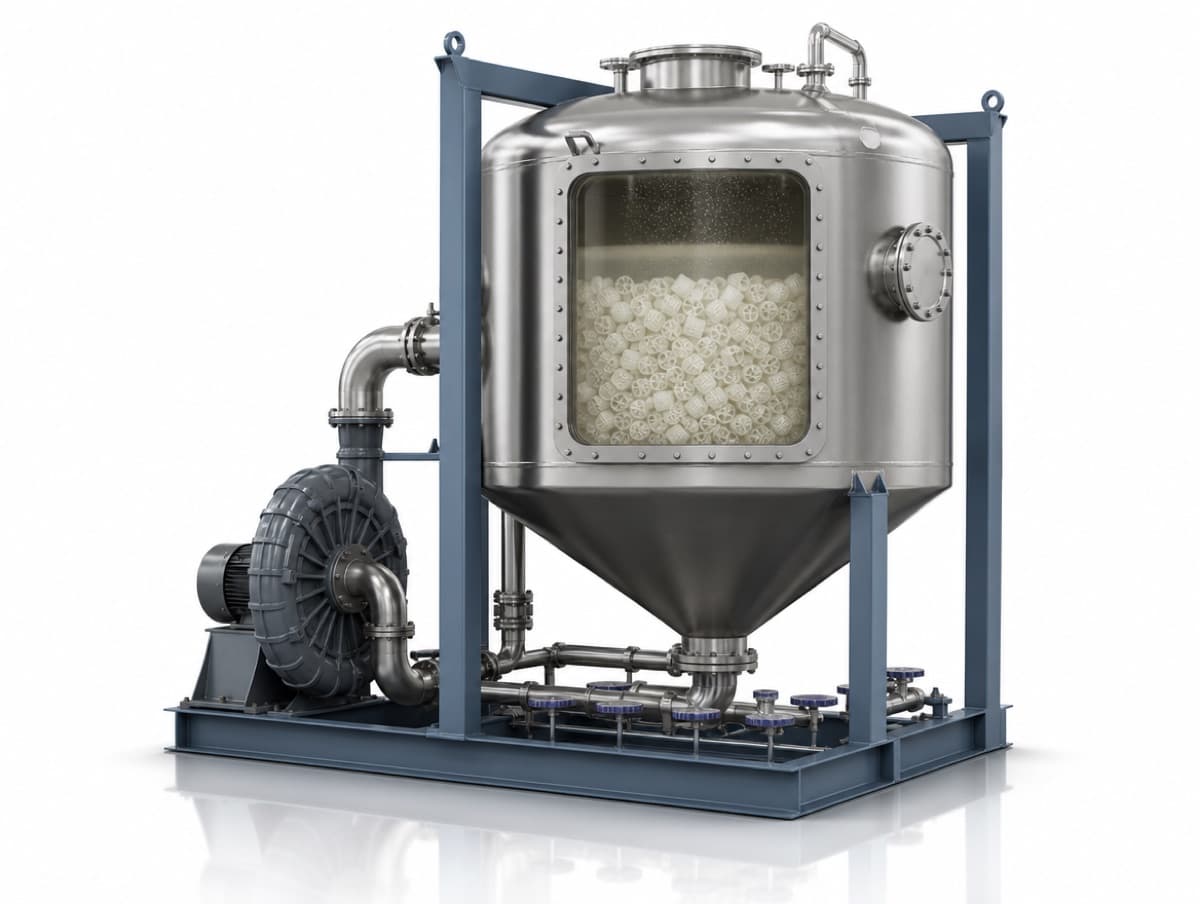
A moving bed biofilm reactor grows its bacteria as a film on thousands of small plastic carriers that circulate freely in an aerated tank. The carriers are engineered for high protected surface area, so treatment capacity depends on carrier surface rather than on how well sludge settles. Aeration keeps the media moving and supplies oxygen, and a simple screen at the outlet keeps the carriers in the tank. That is the whole mechanism, and its simplicity is exactly what plants like about it.
Three consequences of the moving bed
Three consequences follow. First, there is no sludge recirculation to manage, no return activated sludge pumps, no daily settleability worries; the biofilm regulates itself, which is why an MBBR runs with minimal operator attention. Second, shock loads that would wash out a suspended-growth system mostly bounce off a biofilm, because the biomass is attached and stays put. Third, capacity upgrades are often as simple as raising the carrier fill fraction in the existing tank, which makes MBBR the standard answer for retrofits into existing tankage when production has outgrown an old aeration basin.
Built for Canadian winters
Cold weather is the other reason this technology keeps getting specified in Canada. Biological reaction rates fall as water cools, and winter is where suspended-growth plants struggle, losing slow-settling sludge exactly when they can least afford it. A biofilm process holds its population on the carriers regardless of temperature. We size carrier fill and tank volume against your coldest month, not the annual average, and our cold-climate nitrification designs treat both BOD and ammonia at water temperatures down to a few degrees Celsius. Tanks can be insulated or covered for remote and northern sites where freeze protection is part of the design brief.
Where MBBR fits
Typical applications run from food processing and breweries, where high-strength organic loads need a compact biological stage, to municipal upgrades and remote camps where nobody is standing next to the tank all day. The mbbr search term draws about 260 queries a month in Canada, mostly from engineers comparing it against MBR and conventional activated sludge; the short version of that comparison is that MBBR trades some effluent polish for lower cost, lower energy and far less operational fuss.
What we need to size one
To get a sized proposal, send your flow rate, a lab analysis or a description of the process, and your discharge limits. A process engineer reviews the sizing and returns a configuration, budget price and delivery timeline for anywhere in Canada. Carrier media is stocked for expansions, so raising the fill fraction later is a purchase order rather than a project, and startup seeding support shortens the commissioning curve on cold-weather installations.
Regina's heavy industry is concentrated in a way few Canadian cities match: the Co-op Refinery Complex, one of the country's largest refineries, and the EVRAZ steel works anchor the north end of a city of 226,000, with fertilizer and agri-food operations around them. The receiving water is Wascana Creek, a small prairie stream with almost no dilution to offer, which shapes every discharge decision in the city. Big industry, small creek A refinery and a steel mill discharging in a city drained by a creek you can wade across is the central tension of Regina's wastewater picture. Co-op Refinery Complex and EVRAZ steel anchor a concentrated heavy-industry effluent market. That is the regulatory backdrop for mBBR Systems (Moving Bed Biofilm Reactors) in Regina: equipment gets sized against the local limits on the route to Wascana Creek, not against a national average.
Location
Regina, Saskatchewan
Population 226K
Receiving Water
Wascana Creek
Pricing
Sized & quoted per project
What's Included in Regina
Sizing against Regina's sewer-use and surcharge regime (co-op Refinery Complex and EVRAZ steel anchor a concentrated heavy-industry effluent market)
Support for direct-discharge projects requiring a permit under Saskatchewan's Environmental Management and Protection Act
Effluent characterization matched to Regina's dominant dischargers: oil refining, steel, agri-food, fertilizer
Discharge route review for systems releasing toward Wascana Creek
MBBR Systems (Moving Bed Biofilm Reactors) on the ground in Regina
Regina puts one of Canada's largest refineries and a steel mill on Wascana Creek, a prairie stream with no dilution to spare, which makes water reuse the industrial wastewater conversation that gets funded here. In Regina, the plants asking about mBBR Systems (Moving Bed Biofilm Reactors) are mostly in oil refining, steel, agri-food and fertilizer, and each of those sectors puts a different load on a treatment train. Co-op Refinery Complex and EVRAZ steel anchor a concentrated heavy-industry effluent market. Direct discharge toward Wascana Creek instead requires a permit under Saskatchewan's Environmental Management and Protection Act. In a city of Regina's size the industrial dischargers are few enough that the utility knows each one by name, which cuts both ways at permit renewal. Projects in Regina tend to be one-of-a-kind rather than repeat configurations, which is exactly the case where sizing from measured effluent data matters most.
FAQ
Frequently Asked Questions
Everything you need to know about our services.
Do you supply mBBR Systems (Moving Bed Biofilm Reactors) in Regina?
Yes. Industrial Wastewater Canada sizes and supplies mBBR Systems (Moving Bed Biofilm Reactors) for plants across Regina and the surrounding region. Most local demand comes from oil refining, steel, agri-food, fertilizer. Send a quote request with your flow rate and effluent type and a sized proposal follows.
What discharge rules apply to industrial wastewater in Regina?
Co-op Refinery Complex and EVRAZ steel anchor a concentrated heavy-industry effluent market. The big sites run sophisticated internal treatment, sour-water stripping, oil-water separation, mill-scale management, because their approvals leave little room for error. For the surrounding tier of fertilizer blenders, food processors and metal shops, the municipal system offers more flexibility but the same underlying constraint. Plants discharging to the municipal sewer answer to that regime; anything released directly toward Wascana Creek needs a permit under Saskatchewan's Environmental Management and Protection Act. We size equipment against whichever limit governs your outfall.
How is mBBR Systems (Moving Bed Biofilm Reactors) sized for a plant in Regina?
From your numbers, not from the city's. We start with measured flow and effluent characterization, then check the result against Regina's local limits. A processor in a city of 226K with oil refining as the dominant sector rarely has the same loading profile as its neighbours, so treatability data drives the selection.
What does mBBR Systems (Moving Bed Biofilm Reactors) cost in Regina?
There is no list price; every system is sized and quoted per project. The economics are local, though. Water reuse carries unusual weight here: in a semi-arid region where the refinery already recycles wastewater at scale, projects that cut intake and discharge together get management attention faster than compliance-only spending. Payback in Regina is usually calculated against those surcharge and compliance costs, and the quote spells that comparison out.
Send the flow rate. Get the system.
Flow, contaminants, discharge limit. An engineer replies with a sized treatment train and a quote — no obligation.
In this city
Equipment available here.
Industrial Wastewater Treatment Systems→Oil Water Separators→Dissolved Air Flotation (DAF) Systems→Membrane Bioreactor (MBR) Systems→MBBR Systems (Moving Bed Biofilm Reactors)→Lamella Clarifiers→Sludge Dewatering Screw Presses→Dewatering Centrifuges→Industrial Reverse Osmosis Systems→Wastewater Evaporators & ZLD Systems→Belt Filter Presses→Coalescing Filters→Industrial Bag & Cartridge Filtration→Food & Beverage Processing→Dairy Processing→Breweries & Distilleries→Meat & Poultry Processing→Pulp & Paper→Pharmaceutical & Biotech→Textile & Dyeing→Mining & Mineral Processing→Oil & Gas / Produced Water→Metal Finishing & Plating→Chemical Manufacturing→Power, Boilers & Cooling Towers→
Nearby cities