Loading...
Dissolved Air Flotation (DAF) Systems in Regina, Saskatchewan
Industrial Wastewater Canada sizes and supplies dissolved air flotation (daf) systems for plants in Regina, Saskatchewan. Local demand is driven by oil refining, steel, agri-food, fertilizer, discharging under Regina's sewer-use rules toward Wascana Creek. Quote requests with flow rate and effluent type get a sized proposal.
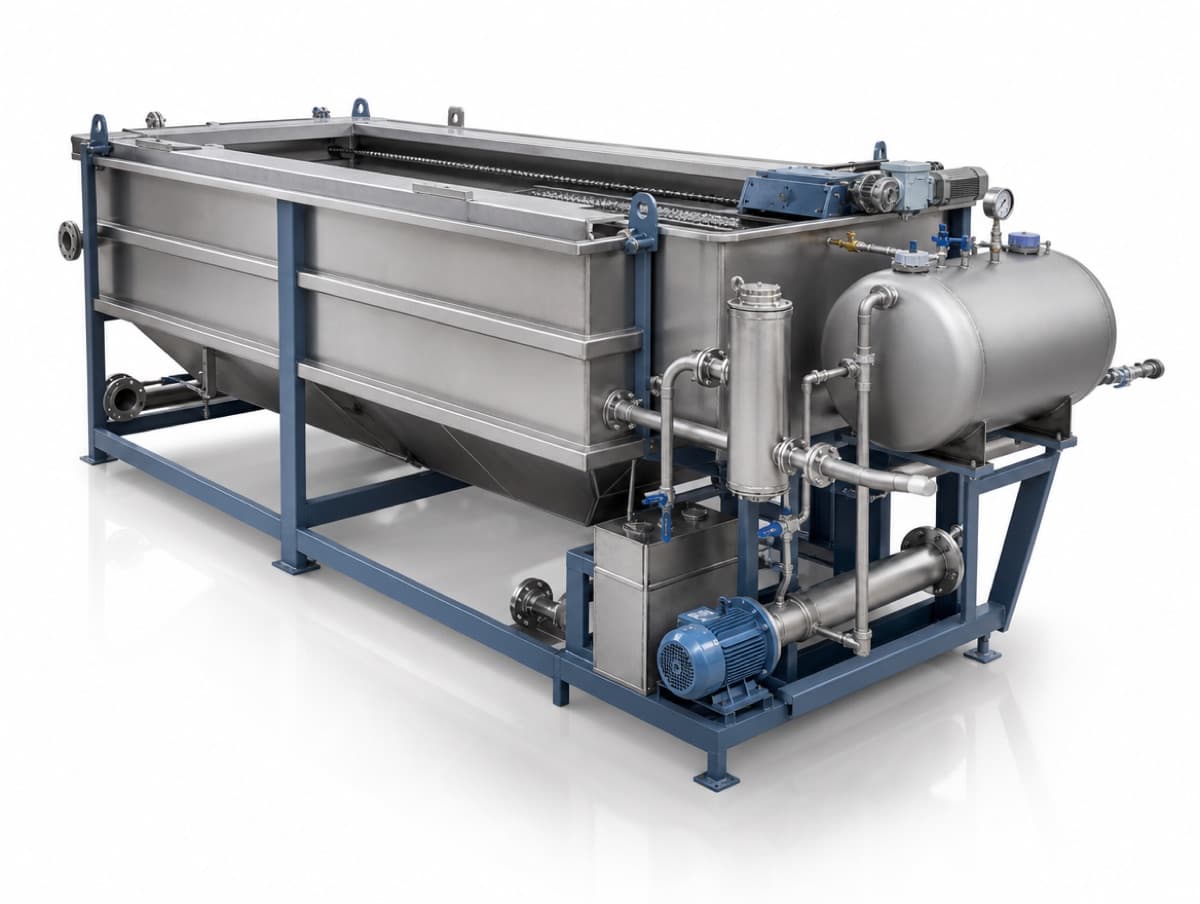
Dissolved air flotation earns its keep in one specific situation: wastewater loaded with fats, oils, grease and suspended solids that settle poorly or not at all. That is the daily reality of food and beverage plants, dairies, meat and poultry processors and rendering operations, which is why the DAF has become the default pre-treatment technology in those sectors across Canada.
How dissolved air flotation works
The process is the inverse of settling. A portion of clarified effluent is saturated with air under pressure and released at the tank inlet, where it forms clouds of microbubbles. The bubbles attach to solids and grease particles, float them to the surface as a stable sludge blanket, and a skimmer removes the blanket continuously. With the integrated chemical dosing and flocculation tube on our units, coagulant and polymer conditioning happens in-line ahead of the flotation zone, and removal rates run from 90 to 99 percent on TSS and FOG when the chemistry is tuned to the stream.
Surcharges drive the payback
The economics are usually driven by surcharges rather than fines. A plant discharging over-strength effluent to a Canadian municipality pays for it, either through an industrial waste surcharge agreement in much of Ontario or through permit conditions like Metro Vancouver's Bylaw 299. Those fees scale with production and never stop. A DAF is a one-time capital cost that cuts the surcharged load at the source, and we size every unit with that payback math in view, using your actual surcharge invoice where you have one. For many food processors the system pays for itself against fees alone.
Stainless skids, ready to connect
Construction is stainless steel, and the compact skid packages arrive pre-piped and pre-wired, which keeps installation to utility connections and commissioning rather than a fabrication project on your floor. A DAF also protects whatever sits downstream: a biological system runs far more stably when the grease load is removed ahead of it, and a municipality sees a plant that holds its numbers.
Why we size from your effluent
Sizing a DAF from a brochure is guesswork. Sizing it from data takes three inputs: your peak flow rate, a lab analysis of the effluent or at minimum a description of the process producing it, and your discharge limits. Send those and we return a sized configuration, budget price and delivery timeline for your plant, anywhere in Canada, with every proposal reviewed by a process engineer first. Commissioning includes jar testing on site to lock in the coagulant and polymer recipe, and operator training is part of the startup scope, because a DAF tuned once and understood by the people running it holds its removal rates for years.
Regina's heavy industry is concentrated in a way few Canadian cities match: the Co-op Refinery Complex, one of the country's largest refineries, and the EVRAZ steel works anchor the north end of a city of 226,000, with fertilizer and agri-food operations around them. The receiving water is Wascana Creek, a small prairie stream with almost no dilution to offer, which shapes every discharge decision in the city. Big industry, small creek A refinery and a steel mill discharging in a city drained by a creek you can wade across is the central tension of Regina's wastewater picture. Co-op Refinery Complex and EVRAZ steel anchor a concentrated heavy-industry effluent market. That is the regulatory backdrop for dissolved Air Flotation (DAF) Systems in Regina: equipment gets sized against the local limits on the route to Wascana Creek, not against a national average.
Location
Regina, Saskatchewan
Population 226K
Receiving Water
Wascana Creek
Pricing
Sized & quoted per project
What's Included in Regina
Sizing against Regina's sewer-use and surcharge regime (co-op Refinery Complex and EVRAZ steel anchor a concentrated heavy-industry effluent market)
Support for direct-discharge projects requiring a permit under Saskatchewan's Environmental Management and Protection Act
Effluent characterization matched to Regina's dominant dischargers: oil refining, steel, agri-food, fertilizer
Discharge route review for systems releasing toward Wascana Creek
Dissolved Air Flotation (DAF) Systems on the ground in Regina
Regina puts one of Canada's largest refineries and a steel mill on Wascana Creek, a prairie stream with no dilution to spare, which makes water reuse the industrial wastewater conversation that gets funded here. In Regina, the plants asking about dissolved Air Flotation (DAF) Systems are mostly in oil refining, steel, agri-food and fertilizer, and each of those sectors puts a different load on a treatment train. Co-op Refinery Complex and EVRAZ steel anchor a concentrated heavy-industry effluent market. Direct discharge toward Wascana Creek instead requires a permit under Saskatchewan's Environmental Management and Protection Act. In a city of Regina's size the industrial dischargers are few enough that the utility knows each one by name, which cuts both ways at permit renewal. Projects in Regina tend to be one-of-a-kind rather than repeat configurations, which is exactly the case where sizing from measured effluent data matters most.
FAQ
Frequently Asked Questions
Everything you need to know about our services.
Do you supply dissolved Air Flotation (DAF) Systems in Regina?
Yes. Industrial Wastewater Canada sizes and supplies dissolved Air Flotation (DAF) Systems for plants across Regina and the surrounding region. Most local demand comes from oil refining, steel, agri-food, fertilizer. Send a quote request with your flow rate and effluent type and a sized proposal follows.
What discharge rules apply to industrial wastewater in Regina?
Co-op Refinery Complex and EVRAZ steel anchor a concentrated heavy-industry effluent market. The big sites run sophisticated internal treatment, sour-water stripping, oil-water separation, mill-scale management, because their approvals leave little room for error. For the surrounding tier of fertilizer blenders, food processors and metal shops, the municipal system offers more flexibility but the same underlying constraint. Plants discharging to the municipal sewer answer to that regime; anything released directly toward Wascana Creek needs a permit under Saskatchewan's Environmental Management and Protection Act. We size equipment against whichever limit governs your outfall.
How is dissolved Air Flotation (DAF) Systems sized for a plant in Regina?
From your numbers, not from the city's. We start with measured flow and effluent characterization, then check the result against Regina's local limits. A processor in a city of 226K with oil refining as the dominant sector rarely has the same loading profile as its neighbours, so treatability data drives the selection.
What does dissolved Air Flotation (DAF) Systems cost in Regina?
There is no list price; every system is sized and quoted per project. The economics are local, though. Water reuse carries unusual weight here: in a semi-arid region where the refinery already recycles wastewater at scale, projects that cut intake and discharge together get management attention faster than compliance-only spending. Payback in Regina is usually calculated against those surcharge and compliance costs, and the quote spells that comparison out.
Send the flow rate. Get the system.
Flow, contaminants, discharge limit. An engineer replies with a sized treatment train and a quote — no obligation.
In this city
Equipment available here.
Industrial Wastewater Treatment Systems→Oil Water Separators→Dissolved Air Flotation (DAF) Systems→Membrane Bioreactor (MBR) Systems→MBBR Systems (Moving Bed Biofilm Reactors)→Lamella Clarifiers→Sludge Dewatering Screw Presses→Dewatering Centrifuges→Industrial Reverse Osmosis Systems→Wastewater Evaporators & ZLD Systems→Belt Filter Presses→Coalescing Filters→Industrial Bag & Cartridge Filtration→Food & Beverage Processing→Dairy Processing→Breweries & Distilleries→Meat & Poultry Processing→Pulp & Paper→Pharmaceutical & Biotech→Textile & Dyeing→Mining & Mineral Processing→Oil & Gas / Produced Water→Metal Finishing & Plating→Chemical Manufacturing→Power, Boilers & Cooling Towers→
Nearby cities