Loading...
Meat & Poultry Processing in Oshawa, Ontario
Industrial Wastewater Canada sizes and supplies meat & poultry processing for plants in Oshawa, Ontario. Local demand is driven by automotive, food processing, fabrication, logistics, discharging under Oshawa's sewer-use rules toward Lake Ontario. Quote requests with flow rate and effluent type get a sized proposal.
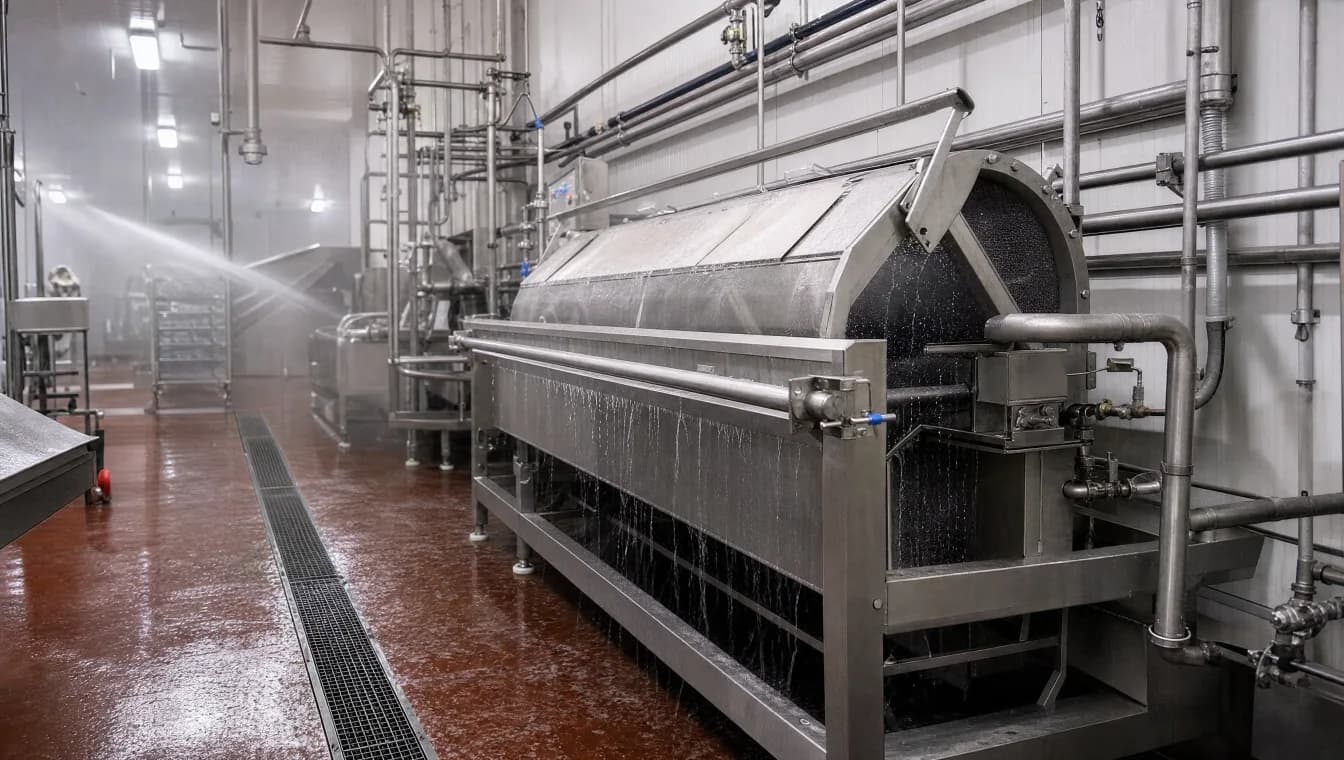
No industrial effluent responds better to dissolved air flotation than meat processing wastewater. Blood, fat, grease and manure solids are exactly the contaminants DAF was built to remove, which is why a properly conditioned flotation unit at a slaughterhouse or rendering plant will routinely capture the bulk of the incoming load in a single step. The engineering challenge in meat processing wastewater treatment is not choosing the core technology. It is sizing for a load that changes with every species, shift and wash-down cycle.
Blood management comes first
Blood management decides half the outcome before treatment starts. A plant that captures blood at the kill floor and sells it or renders it keeps an enormous BOD load out of the drain. A plant that lets it reach the sewer will fight that decision at every downstream stage. The same logic applies to paunch content and manure solids, which belong in dry handling and screening rather than in suspension.
The wet-side treatment train
The wet-side treatment train is consistent across the sector: coarse and fine screening, an equalization tank to buffer wash-down peaks, then DAF with coagulant and polymer dosing. Fat recovered in the float has rendering value, so the sludge line is a revenue question as much as a disposal one. Plants discharging under a provincial permit rather than to a municipal sewer add biological treatment, most often an anaerobic stage for the strength followed by aerobic polishing for the ammonia that blood and protein break down into.
A closely watched sector
Canadian regulators watch this sector closely. Federally inspected plants answer to both CFIA sanitation requirements, which drive the water use up, and to sewer bylaws or Fisheries Act provisions, which drive the discharge quality requirement. The two pressures meet in the effluent plant.
Equipment for abattoirs and renderers
We supply screens, DAF systems, dewatering presses and complete packaged plants for abattoirs, poultry processors and rendering operations. Bring us your kill schedule, water use and a composite analysis, and we will return a sized proposal with realistic sludge-handling numbers rather than brochure figures. Poultry plants deserve a specific mention, because feathers and scald-tank water behave differently from red-meat streams and change both the screening selection and the DAF chemical program, a distinction that generic sizing tables consistently miss.
Oshawa's industrial identity still runs through the GM assembly complex and the parts, fabrication and logistics operations that grew around it. The city of 175,000 discharges through Durham Region's sewer system to Lake Ontario under Sewer Use By-law 55-2011, and the region's industrial-waste staff administer a market where automotive chemistry dominates: machining coolants, oily wash waters, phosphate and paint-line streams. Coolant management is half the battle In an auto-parts plant the wastewater problem often starts as a fluids problem. Durham Region Sewer Use By-law 55-2011; GM-anchored auto supply chain. That is the regulatory backdrop for meat & Poultry Processing in Oshawa: equipment gets sized against the local limits on the route to Lake Ontario, not against a national average.
Location
Oshawa, Ontario
Population 175K
Receiving Water
Lake Ontario
Pricing
Sized & quoted per project
What's Included in Oshawa
Sizing against Oshawa's sewer-use and surcharge regime (durham Region Sewer Use By-law 55-2011; GM-anchored auto supply chain)
Support for direct-discharge projects requiring an Environmental Compliance Approval from Ontario's Ministry of the Environment, Conservation and Parks
Effluent characterization matched to Oshawa's dominant dischargers: automotive, food processing, fabrication, logistics
Discharge route review for systems releasing toward Lake Ontario
Meat & Poultry Processing on the ground in Oshawa
In Oshawa's GM-anchored parts corridor, the industrial wastewater win is usually ultrafiltration of machining coolant, turning a forever tanker-disposal cost into a Durham By-law 55-2011 compliant discharge. In Oshawa, the plants asking about meat & Poultry Processing are mostly in automotive, food processing, fabrication and logistics, and each of those sectors puts a different load on a treatment train. Durham Region Sewer Use By-law 55-2011; GM-anchored auto supply chain. Direct discharge toward Lake Ontario instead requires an Environmental Compliance Approval from Ontario's Ministry of the Environment, Conservation and Parks. In a city of Oshawa's size the industrial dischargers are few enough that the utility knows each one by name, which cuts both ways at permit renewal. Projects in Oshawa tend to be one-of-a-kind rather than repeat configurations, which is exactly the case where sizing from measured effluent data matters most.
FAQ
Frequently Asked Questions
Everything you need to know about our services.
Do you supply meat & Poultry Processing in Oshawa?
Yes. Industrial Wastewater Canada sizes and supplies meat & Poultry Processing for plants across Oshawa and the surrounding region. Most local demand comes from automotive, food processing, fabrication, logistics. Send a quote request with your flow rate and effluent type and a sized proposal follows.
What discharge rules apply to industrial wastewater in Oshawa?
Durham Region Sewer Use By-law 55-2011; GM-anchored auto supply chain. Spent machining coolant is a stable oil-in-water emulsion that resists gravity separation entirely; sent untreated to sewer it fails the by-law, and hauled away by tanker it costs by the litre forever. Ultrafiltration changes that arithmetic, splitting the emulsion into a small concentrate for disposal and a permeate the sewer will take, and typically recovering its capital within a couple of years at moderate volumes. Plants discharging to the municipal sewer answer to that regime; anything released directly toward Lake Ontario needs an Environmental Compliance Approval from Ontario's Ministry of the Environment, Conservation and Parks. We size equipment against whichever limit governs your outfall.
How is meat & Poultry Processing sized for a plant in Oshawa?
From your numbers, not from the city's. We start with measured flow and effluent characterization, then check the result against Oshawa's local limits. A processor in a city of 175K with automotive as the dominant sector rarely has the same loading profile as its neighbours, so treatability data drives the selection.
What does meat & Poultry Processing cost in Oshawa?
There is no list price; every system is sized and quoted per project. The economics are local, though. Around the automotive core, Oshawa's food processors and fabricators bring conventional BOD and metals work, and Durham's surcharge framework gives every plant a number to beat. Payback in Oshawa is usually calculated against those surcharge and compliance costs, and the quote spells that comparison out.
Send the flow rate. Get the system.
Flow, contaminants, discharge limit. An engineer replies with a sized treatment train and a quote — no obligation.
In this city
Equipment available here.
Industrial Wastewater Treatment Systems→Oil Water Separators→Dissolved Air Flotation (DAF) Systems→Membrane Bioreactor (MBR) Systems→MBBR Systems (Moving Bed Biofilm Reactors)→Lamella Clarifiers→Sludge Dewatering Screw Presses→Dewatering Centrifuges→Industrial Reverse Osmosis Systems→Wastewater Evaporators & ZLD Systems→Belt Filter Presses→Coalescing Filters→Industrial Bag & Cartridge Filtration→Food & Beverage Processing→Dairy Processing→Breweries & Distilleries→Meat & Poultry Processing→Pulp & Paper→Pharmaceutical & Biotech→Textile & Dyeing→Mining & Mineral Processing→Oil & Gas / Produced Water→Metal Finishing & Plating→Chemical Manufacturing→Power, Boilers & Cooling Towers→
Nearby cities