Loading...
Chemical Manufacturing in Kamloops, British Columbia
Industrial Wastewater Canada sizes and supplies chemical manufacturing for plants in Kamloops, British Columbia. Local demand is driven by pulp, mining, food processing, logistics, discharging under Kamloops's sewer-use rules toward Thompson River. Quote requests with flow rate and effluent type get a sized proposal.
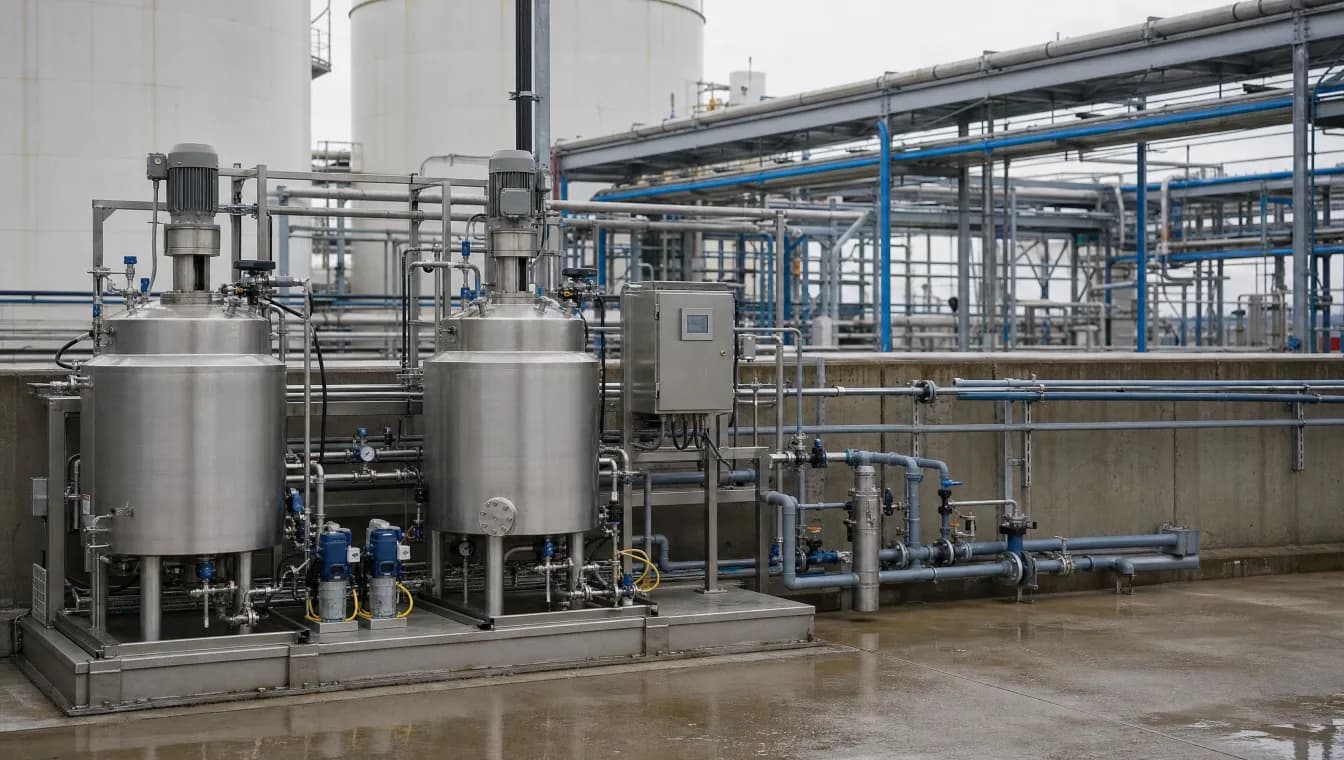
There is no such thing as typical chemical plant effluent, and any supplier who quotes chemical wastewater treatment equipment without asking what you make is guessing with your compliance record. A specialty chemicals site producing adhesives generates monomer-laden, high-COD washwater. A blender of cleaning products discharges surfactants that foam through every downstream tank. A resin plant fights phenols and formaldehyde. An agrochemical formulator handles active ingredients measured in parts per billion at the outfall. The common thread is not the contaminant. It is variability, and the discipline of characterizing before treating.
Characterization first
That characterization step is where chemical sector projects succeed or fail. We start from your product list, your batch records and a sampling campaign that covers changeovers, not just steady production, because the changeover wash is usually the worst water of the week. From there the treatability logic is straightforward: what fraction is biodegradable, what fraction needs physicochemical removal, and what needs to be kept out of the combined stream entirely and handled as concentrated waste.
The treatment building blocks
The treatment building blocks we supply follow that split. Equalization with pH control buffers batch swings and protects everything downstream. Coagulation, flocculation and dissolved air flotation or lamella clarification remove suspended and colloidal load. For the biodegradable fraction, MBBR systems tolerate the shock loads that batch chemistry produces better than conventional activated sludge, and anaerobic pretreatment earns its cost on high-strength streams. Recalcitrant COD calls for activated carbon or chemical oxidation, selected from treatability testing rather than a brochure. Where a site wants water reuse or faces tight dissolved-solids limits, industrial reverse osmosis closes the loop, with wastewater evaporators as the end point for concentrates that have nowhere else to go.
Provincial, municipal and federal layers
Canadian chemical facilities answer to provincial approvals, municipal bylaws, and federal requirements under CEPA for listed substances, and many also carry Responsible Care commitments that go beyond all three.
Your worst discharge day
Send us your product portfolio and a candid description of your worst discharge day. The proposal will be built for that day, not the average one. We also stock the unglamorous parts that keep these systems honest: dosing pumps, static mixers, industrial bag filter housings and instrumentation, because a chemical treatment plant is only as reliable as its weakest metering pump.
Kamloops works at the meeting point of two rivers and two resource industries. The pulp mill on the South Thompson and the Highland Valley copper operation southwest of the city, one of the largest open-pit copper mines in the world, anchor an economy that also includes food processors and a growing logistics sector in this city of 98,000. The Thompson River system, a major salmon and steelhead water, receives the region's treated discharges. Pulp mill and Highland Valley copper corridor. That is the regulatory backdrop for chemical Manufacturing in Kamloops: equipment gets sized against the local limits on the route to Thompson River, not against a national average.
Location
Kamloops, British Columbia
Population 98K
Receiving Water
Thompson River
Pricing
Sized & quoted per project
What's Included in Kamloops
Sizing against Kamloops's sewer-use and surcharge regime (pulp mill and Highland Valley copper corridor)
Support for direct-discharge projects requiring a waste discharge authorization under British Columbia's Environmental Management Act
Effluent characterization matched to Kamloops's dominant dischargers: pulp, mining, food processing, logistics
Discharge route review for systems releasing toward Thompson River
Chemical Manufacturing on the ground in Kamloops
Kamloops splits its wastewater expertise between pulp-mill organics on the Thompson and Highland Valley's copper-district metals and sulphate, both discharging into prime salmon water. In Kamloops, the plants asking about chemical Manufacturing are mostly in pulp, mining, food processing and logistics, and each of those sectors puts a different load on a treatment train. Pulp mill and Highland Valley copper corridor. Direct discharge toward Thompson River instead requires a waste discharge authorization under British Columbia's Environmental Management Act. Kamloops's municipal plant has limited spare capacity, so a single overloaded industrial connection shows up quickly in its intake numbers. Projects in Kamloops tend to be one-of-a-kind rather than repeat configurations, which is exactly the case where sizing from measured effluent data matters most.
FAQ
Frequently Asked Questions
Everything you need to know about our services.
Do you supply chemical Manufacturing in Kamloops?
Yes. Industrial Wastewater Canada sizes and supplies chemical Manufacturing for plants across Kamloops and the surrounding region. Most local demand comes from pulp, mining, food processing, logistics. Send a quote request with your flow rate and effluent type and a sized proposal follows.
What discharge rules apply to industrial wastewater in Kamloops?
Pulp mill and Highland Valley copper corridor. Pulp fibre and copper tailings water The mill and the mine frame the local discipline. Pulp effluent is high-volume organics managed through primary clarification and biological treatment, where the current agenda is efficiency: better fibre capture, lower energy, tighter colour and AOX performance. Plants discharging to the municipal sewer answer to that regime; anything released directly toward Thompson River needs a waste discharge authorization under British Columbia's Environmental Management Act. We size equipment against whichever limit governs your outfall.
How is chemical Manufacturing sized for a plant in Kamloops?
From your numbers, not from the city's. We start with measured flow and effluent characterization, then check the result against Kamloops's local limits. A processor in a city of 98K with pulp as the dominant sector rarely has the same loading profile as its neighbours, so treatability data drives the selection.
What does chemical Manufacturing cost in Kamloops?
There is no list price; every system is sized and quoted per project. The economics are local, though. Mine water is the opposite, low organics, high metals and sulphate, managed through impoundments and treatment ahead of any release, with molybdenum among the parameters that draw attention in copper districts. Between them sit municipal-sewer dischargers with conventional needs. A dry-belt climate that swings from 35 °C summers to genuine cold snaps, plus wildfire smoke seasons that stress outdoor equipment, rounds out the design environment. Payback in Kamloops is usually calculated against those surcharge and compliance costs, and the quote spells that comparison out.
Send the flow rate. Get the system.
Flow, contaminants, discharge limit. An engineer replies with a sized treatment train and a quote — no obligation.
In this city
Equipment available here.
Industrial Wastewater Treatment Systems→Oil Water Separators→Dissolved Air Flotation (DAF) Systems→Membrane Bioreactor (MBR) Systems→MBBR Systems (Moving Bed Biofilm Reactors)→Lamella Clarifiers→Sludge Dewatering Screw Presses→Dewatering Centrifuges→Industrial Reverse Osmosis Systems→Wastewater Evaporators & ZLD Systems→Belt Filter Presses→Coalescing Filters→Industrial Bag & Cartridge Filtration→Food & Beverage Processing→Dairy Processing→Breweries & Distilleries→Meat & Poultry Processing→Pulp & Paper→Pharmaceutical & Biotech→Textile & Dyeing→Mining & Mineral Processing→Oil & Gas / Produced Water→Metal Finishing & Plating→Chemical Manufacturing→Power, Boilers & Cooling Towers→
Nearby cities