Loading...
Lamella Clarifiers in Windsor, Ontario
Industrial Wastewater Canada sizes and supplies lamella clarifiers for plants in Windsor, Ontario. Local demand is driven by automotive, metal finishing, food & beverage, greenhouse agriculture, discharging under Windsor's sewer-use rules toward Detroit River. Quote requests with flow rate and effluent type get a sized proposal.
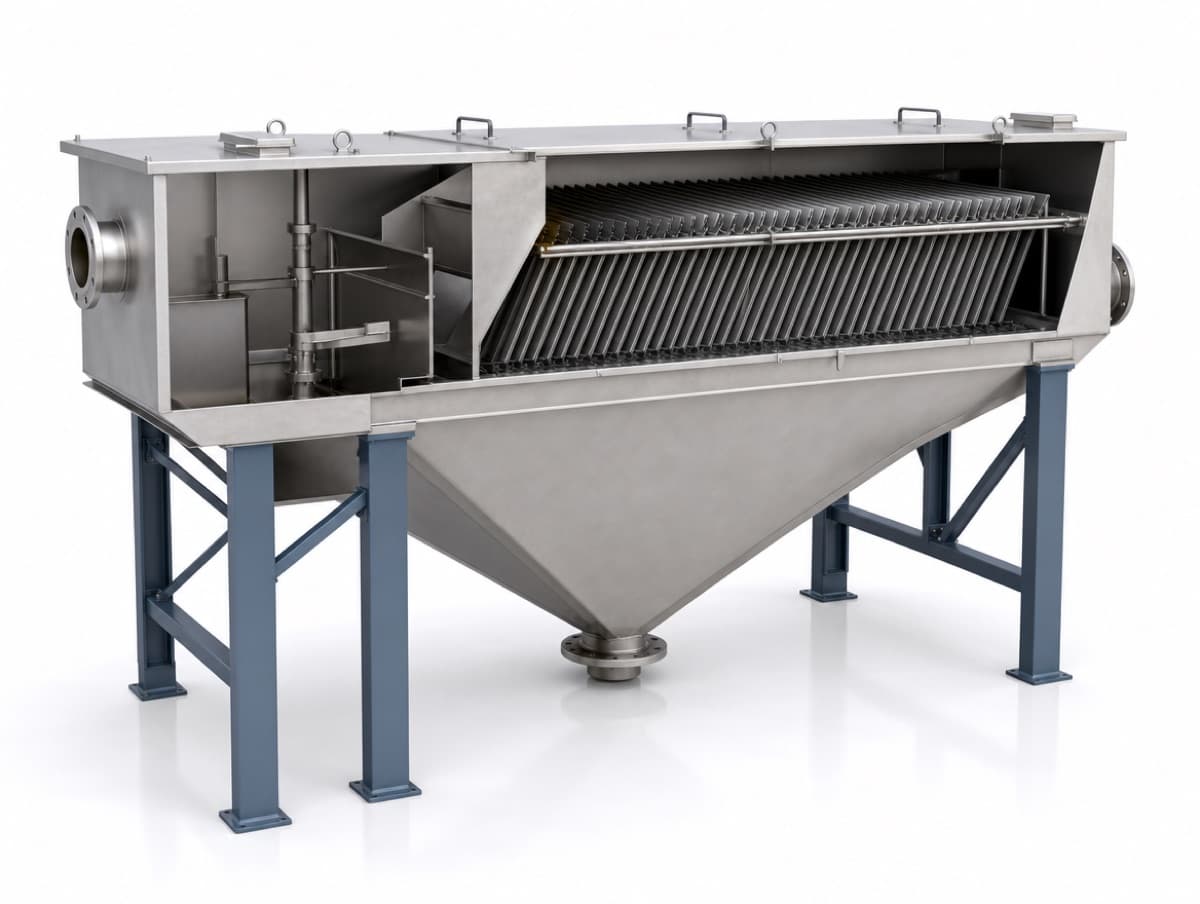
A lamella clarifier does what a conventional circular clarifier does, in about a tenth of the floor space. The trick is geometry. Instead of one large settling surface, the vessel stacks dozens of inclined plates, and each plate acts as its own shallow settling zone. Projected settling area multiplies while the tank stays compact, which is how a unit the size of a shipping container replaces a settling basin, cutting footprint by up to 90 percent.
How the plate pack works
Solids-laden water enters below the plate pack and rises between the plates. Particles settle onto the plate surfaces within a short vertical distance, slide down the incline into a collection hopper, and clarified water exits at the top through distribution orifices that keep flow even across the pack. There are no moving parts in the settling zone, so wear items are few and maintenance stays on the pumps and dosing systems where it belongs. The integrated sludge thickening hopper concentrates the underflow before it goes to dewatering, which shrinks the load on whatever press or centrifuge follows.
Where lamella clarifiers dominate
The applications where lamella clarifiers dominate are the ones where solids are the whole problem: mining and mineral processing water, construction and groundwater dewatering, metal finishing effluent after chemical precipitation, and industrial process water carrying grit or floc. Where the raw stream will not settle on its own, we add integrated flash-mix and flocculation stages ahead of the plate pack, so coagulant, polymer and settling happen in one skid. Vessel construction is 304 or 316 stainless or coated carbon steel, matched to the chemistry of your stream rather than defaulted.
Sizing is a solids problem
Sizing a lamella clarifier is a solids problem, not a flow problem. Two streams at the same flow rate can need very different plate areas depending on particle size, floc strength and solids loading, which is why we ask for a lab analysis or at least a jar test before quoting, and why the 110 monthly Canadian searches for this equipment so often come from engineers replacing an undersized unit bought on flow rate alone. Send your flow, your solids data and your discharge destination, and we return a sized configuration, budget price and delivery timeline for your site, anywhere in Canada. Every proposal is reviewed by a process engineer first, and pilot units can be arranged where treatability is genuinely uncertain. Plate packs are removable for inspection and washing without dismantling the vessel, and replacement packs remain available for the life of the unit, so recovery from an upset upstream is a cleaning day rather than a capital request.
Windsor's wastewater market is really two markets an hour apart. In the city of 230,000, auto assembly and parts plants generate oily emulsions, phosphate rinses and paint-shop effluent governed by Sewer Use By-law 168-2005, discharging toward the Detroit River. Down the highway in the Leamington-Kingsville greenhouse belt, North America's densest concentration of vegetable greenhouses produces nutrient-rich process water and irrigation leachate with entirely different rules and receiving waters. Auto plants plus Leamington-area greenhouse cluster — nutrient-rich process water; Windsor Sewer Use By-law 168-2005. That is the regulatory backdrop for lamella Clarifiers in Windsor: equipment gets sized against the local limits on the route to Detroit River, not against a national average.
Location
Windsor, Ontario
Population 230K
Receiving Water
Detroit River
Pricing
Sized & quoted per project
What's Included in Windsor
Sizing against Windsor's sewer-use and surcharge regime (auto plants plus Leamington-area greenhouse cluster — nutrient-rich process water; Windsor Sewer Use By-law 168-2005)
Support for direct-discharge projects requiring an Environmental Compliance Approval from Ontario's Ministry of the Environment, Conservation and Parks
Effluent characterization matched to Windsor's dominant dischargers: automotive, metal finishing, food & beverage, greenhouse agriculture
Discharge route review for systems releasing toward Detroit River
Lamella Clarifiers on the ground in Windsor
Windsor pairs auto-plant effluent under By-law 168-2005 with the Leamington greenhouse belt's nutrient-heavy leachate, two industrial wastewater disciplines an hour apart on the same Lake Erie watershed. In Windsor, the plants asking about lamella Clarifiers are mostly in automotive, metal finishing, food & beverage and greenhouse agriculture, and each of those sectors puts a different load on a treatment train. Auto plants plus Leamington-area greenhouse cluster — nutrient-rich process water; Windsor Sewer Use By-law 168-2005. Direct discharge toward Detroit River instead requires an Environmental Compliance Approval from Ontario's Ministry of the Environment, Conservation and Parks. In a city of Windsor's size the industrial dischargers are few enough that the utility knows each one by name, which cuts both ways at permit renewal. Projects in Windsor tend to be one-of-a-kind rather than repeat configurations, which is exactly the case where sizing from measured effluent data matters most.
FAQ
Frequently Asked Questions
Everything you need to know about our services.
Do you supply lamella Clarifiers in Windsor?
Yes. Industrial Wastewater Canada sizes and supplies lamella Clarifiers for plants across Windsor and the surrounding region. Most local demand comes from automotive, metal finishing, food & beverage, greenhouse agriculture. Send a quote request with your flow rate and effluent type and a sized proposal follows.
What discharge rules apply to industrial wastewater in Windsor?
Auto plants plus Leamington-area greenhouse cluster — nutrient-rich process water; Windsor Sewer Use By-law 168-2005. Paint shops and greenhouse leachate Automotive effluent is a mature discipline: ultrafiltration for oily emulsions, chemical treatment for phosphating lines, careful handling of paint-detackification water. The greenhouse side is younger and moving fast, with provincial scrutiny of nutrient discharges to Lake Erie tributaries pushing growers toward recirculation, denitrification and phosphorus capture. Plants discharging to the municipal sewer answer to that regime; anything released directly toward Detroit River needs an Environmental Compliance Approval from Ontario's Ministry of the Environment, Conservation and Parks. We size equipment against whichever limit governs your outfall.
How is lamella Clarifiers sized for a plant in Windsor?
From your numbers, not from the city's. We start with measured flow and effluent characterization, then check the result against Windsor's local limits. A processor in a city of 230K with automotive as the dominant sector rarely has the same loading profile as its neighbours, so treatability data drives the selection.
What does lamella Clarifiers cost in Windsor?
There is no list price; every system is sized and quoted per project. The economics are local, though. Feedwater at a greenhouse might carry 200 mg/L nitrate where a receiving stream target is a fraction of that. Windsor-area suppliers who can serve a transmission plant on Tuesday and a tomato operation on Wednesday match how this region actually works. Payback in Windsor is usually calculated against those surcharge and compliance costs, and the quote spells that comparison out.
Send the flow rate. Get the system.
Flow, contaminants, discharge limit. An engineer replies with a sized treatment train and a quote — no obligation.
In this city
Equipment available here.
Industrial Wastewater Treatment Systems→Oil Water Separators→Dissolved Air Flotation (DAF) Systems→Membrane Bioreactor (MBR) Systems→MBBR Systems (Moving Bed Biofilm Reactors)→Lamella Clarifiers→Sludge Dewatering Screw Presses→Dewatering Centrifuges→Industrial Reverse Osmosis Systems→Wastewater Evaporators & ZLD Systems→Belt Filter Presses→Coalescing Filters→Industrial Bag & Cartridge Filtration→Food & Beverage Processing→Dairy Processing→Breweries & Distilleries→Meat & Poultry Processing→Pulp & Paper→Pharmaceutical & Biotech→Textile & Dyeing→Mining & Mineral Processing→Oil & Gas / Produced Water→Metal Finishing & Plating→Chemical Manufacturing→Power, Boilers & Cooling Towers→
Nearby cities