Loading...
Dewatering Centrifuges in Sydney, Nova Scotia
Industrial Wastewater Canada sizes and supplies dewatering centrifuges for plants in Sydney, Nova Scotia. Local demand is driven by seafood processing, port logistics, fabrication, energy, discharging under Sydney's sewer-use rules toward Sydney Harbour. Quote requests with flow rate and effluent type get a sized proposal.
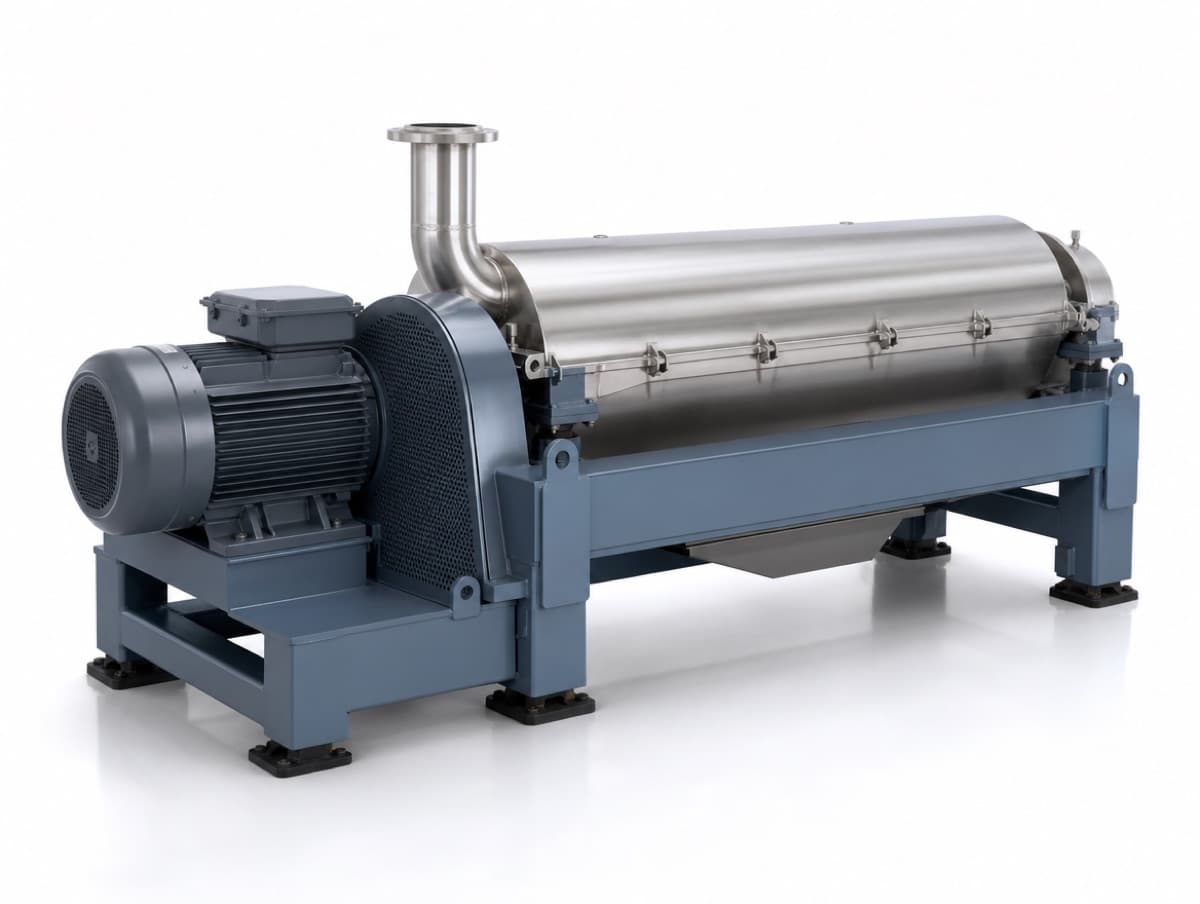
When cake dryness decides the economics, the decanter centrifuge is the machine to beat. Among continuous dewatering technologies it produces the driest cake, and every additional point of dry solids is a truck that never leaves your yard. For plants paying by the tonne to haul biosolids, tailings or oily sludge, that arithmetic usually settles the technology choice on its own.
Inside the decanter
Inside the machine, a bowl spinning at high speed multiplies gravity thousands of times, slinging solids against the bowl wall while a scroll conveyor, turning at a slightly different speed, ploughs them continuously toward the discharge end. Centrate exits the opposite end over adjustable weir plates. Because separation force comes from rotation rather than screen area, a decanter handles feeds that blind filters and belts: fine particles, oily sludges, slurries with variable solids content, streams that change character by the hour.
Who buys these machines
The duty environments tell you who buys these. Pulp and paper mills run them on primary and secondary sludge around the clock. Oil and gas operations use them on drilling mud, slop oil and produced-water solids. Municipal plants specify them where biosolids volumes are large enough that cake dryness dominates the operating budget. All three share the same requirements: continuous duty, tolerance for abrasive feed, and a machine that does its work inside a compact enclosed casing rather than an open hall, with no aerosols and no spray.
Wear, and the tungsten carbide answer
Wear is the honest cost of centrifugal dewatering, and the design answer is tungsten carbide. Our machines carry wear-protected tungsten carbide tiles on the scroll flights, the component that takes the abrasion, so rebuild intervals are measured in years of continuous service rather than months. Variable-speed scroll drives let an operator, or the control system, trade cake dryness against centrate clarity in real time as the feed changes, which is the practical difference between a machine that is tuned and a machine that is merely running.
Try before you commit
Commitment does not have to come first. Rental and pilot units are available, and for a difficult sludge the sensible path is often a two-week trial on your actual feed before anyone signs for a permanent installation. The 90 monthly Canadian searches for dewatering centrifuges are mostly engineers doing exactly that comparison. Send us your sludge type, feed solids and throughput, and a process engineer returns a sized configuration, budget price and delivery timeline for your site, anywhere in Canada. Installation support and commissioning are quoted per project, and vibration monitoring can be included in the scope so bearing wear announces itself on a trend line instead of on a night shift.
Sydney carries an environmental history no Canadian industrial city can match: the tar ponds, a century of coke-oven waste that became the country's most notorious contaminated site and then its most ambitious remediation, completed as Open Hearth Park in 2013. Today's economy, seafood processing, port logistics, fabrication and energy-sector hopes, operates in a community of 31,000 where discharge compliance is not an abstraction but a lived civic memory. After the tar ponds, everything is visible The remediation's legacy is scrutiny. Post-tar-ponds remediation legacy makes discharge compliance highly visible locally. That is the regulatory backdrop for dewatering Centrifuges in Sydney: equipment gets sized against the local limits on the route to Sydney Harbour, not against a national average.
Location
Sydney, Nova Scotia
Population 31K
Receiving Water
Sydney Harbour
Pricing
Sized & quoted per project
What's Included in Sydney
Sizing against Sydney's sewer-use and surcharge regime (post-tar-ponds remediation legacy makes discharge compliance highly visible locally)
Support for direct-discharge projects requiring an industrial approval under Nova Scotia's Environment Act
Effluent characterization matched to Sydney's dominant dischargers: seafood processing, port logistics, fabrication, energy
Discharge route review for systems releasing toward Sydney Harbour
Dewatering Centrifuges on the ground in Sydney
In post-tar-ponds Sydney, discharge compliance is civic memory: a community that fought decades for its harbour cleanup watches every industrial wastewater stream that enters it. In Sydney, the plants asking about dewatering Centrifuges are mostly in seafood processing, port logistics, fabrication and energy, and each of those sectors puts a different load on a treatment train. Post-tar-ponds remediation legacy makes discharge compliance highly visible locally. Direct discharge toward Sydney Harbour instead requires an industrial approval under Nova Scotia's Environment Act. Sydney's municipal plant has limited spare capacity, so a single overloaded industrial connection shows up quickly in its intake numbers. Projects in Sydney tend to be one-of-a-kind rather than repeat configurations, which is exactly the case where sizing from measured effluent data matters most.
FAQ
Frequently Asked Questions
Everything you need to know about our services.
Do you supply dewatering Centrifuges in Sydney?
Yes. Industrial Wastewater Canada sizes and supplies dewatering Centrifuges for plants across Sydney and the surrounding region. Most local demand comes from seafood processing, port logistics, fabrication, energy. Send a quote request with your flow rate and effluent type and a sized proposal follows.
What discharge rules apply to industrial wastewater in Sydney?
Post-tar-ponds remediation legacy makes discharge compliance highly visible locally. A community that spent decades fighting for a cleanup watches its harbour, and any operation discharging to Sydney's sewers or waters inherits that attention regardless of size. Practically, the market is Atlantic-standard: fish plants with salty, seasonal, high-BOD effluent needing screening and DAF; fabrication and port operations needing oil-water separation and washwater treatment. Plants discharging to the municipal sewer answer to that regime; anything released directly toward Sydney Harbour needs an industrial approval under Nova Scotia's Environment Act. We size equipment against whichever limit governs your outfall.
How is dewatering Centrifuges sized for a plant in Sydney?
From your numbers, not from the city's. We start with measured flow and effluent characterization, then check the result against Sydney's local limits. A processor in a city of 31K with seafood processing as the dominant sector rarely has the same loading profile as its neighbours, so treatability data drives the selection.
What does dewatering Centrifuges cost in Sydney?
There is no list price; every system is sized and quoted per project. The economics are local, though. The Cape Breton Regional Municipality administers sewer use, and its staff, like the public, know exactly why the rules exist. Suppliers who treat that history with respect rather than as a sales angle earn their place here. Payback in Sydney is usually calculated against those surcharge and compliance costs, and the quote spells that comparison out.
Send the flow rate. Get the system.
Flow, contaminants, discharge limit. An engineer replies with a sized treatment train and a quote — no obligation.
In this city
Equipment available here.
Industrial Wastewater Treatment Systems→Oil Water Separators→Dissolved Air Flotation (DAF) Systems→Membrane Bioreactor (MBR) Systems→MBBR Systems (Moving Bed Biofilm Reactors)→Lamella Clarifiers→Sludge Dewatering Screw Presses→Dewatering Centrifuges→Industrial Reverse Osmosis Systems→Wastewater Evaporators & ZLD Systems→Belt Filter Presses→Coalescing Filters→Industrial Bag & Cartridge Filtration→Food & Beverage Processing→Dairy Processing→Breweries & Distilleries→Meat & Poultry Processing→Pulp & Paper→Pharmaceutical & Biotech→Textile & Dyeing→Mining & Mineral Processing→Oil & Gas / Produced Water→Metal Finishing & Plating→Chemical Manufacturing→Power, Boilers & Cooling Towers→
Nearby cities