Loading...
Chemical Manufacturing in St. John's, Newfoundland and Labrador
Industrial Wastewater Canada sizes and supplies chemical manufacturing for plants in St. John's, Newfoundland and Labrador. Local demand is driven by offshore oil & gas, seafood processing, marine services, breweries, discharging under St. John's's sewer-use rules toward Atlantic Ocean. Quote requests with flow rate and effluent type get a sized proposal.
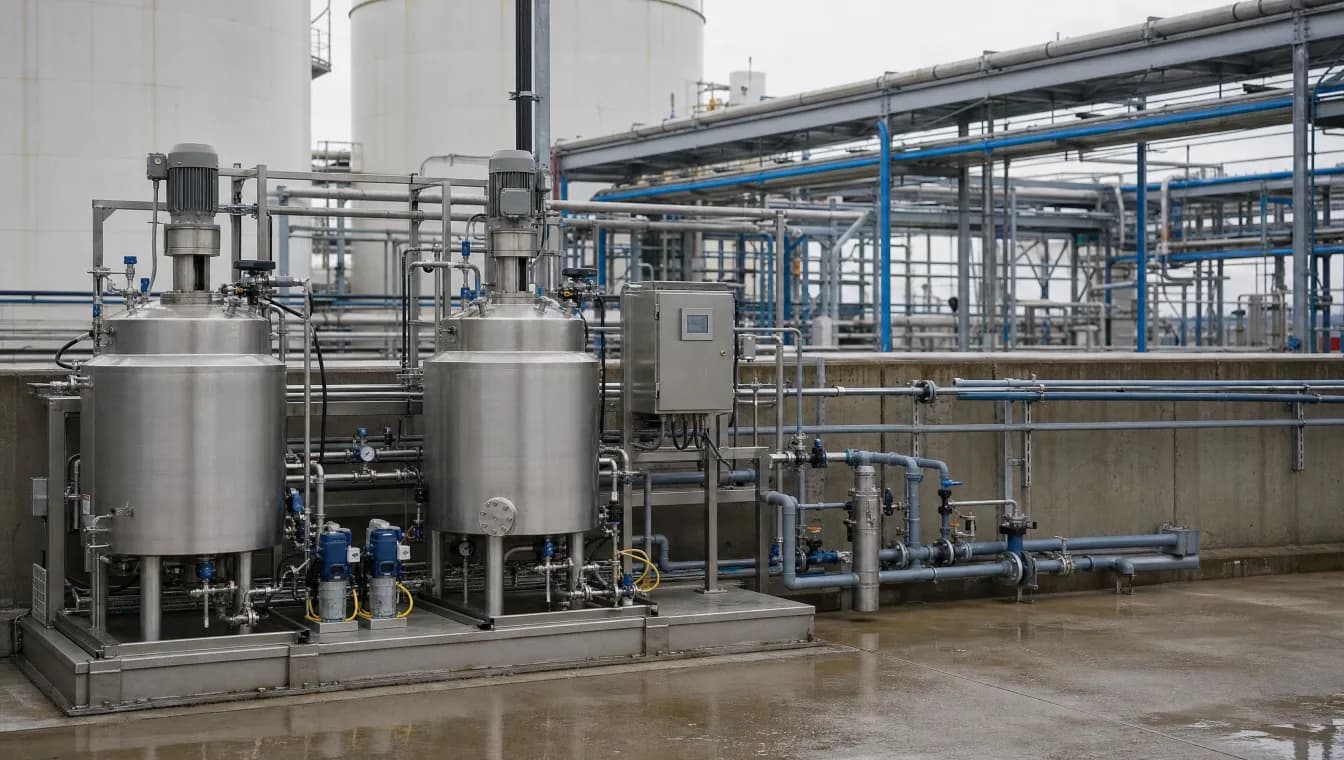
There is no such thing as typical chemical plant effluent, and any supplier who quotes chemical wastewater treatment equipment without asking what you make is guessing with your compliance record. A specialty chemicals site producing adhesives generates monomer-laden, high-COD washwater. A blender of cleaning products discharges surfactants that foam through every downstream tank. A resin plant fights phenols and formaldehyde. An agrochemical formulator handles active ingredients measured in parts per billion at the outfall. The common thread is not the contaminant. It is variability, and the discipline of characterizing before treating.
Characterization first
That characterization step is where chemical sector projects succeed or fail. We start from your product list, your batch records and a sampling campaign that covers changeovers, not just steady production, because the changeover wash is usually the worst water of the week. From there the treatability logic is straightforward: what fraction is biodegradable, what fraction needs physicochemical removal, and what needs to be kept out of the combined stream entirely and handled as concentrated waste.
The treatment building blocks
The treatment building blocks we supply follow that split. Equalization with pH control buffers batch swings and protects everything downstream. Coagulation, flocculation and dissolved air flotation or lamella clarification remove suspended and colloidal load. For the biodegradable fraction, MBBR systems tolerate the shock loads that batch chemistry produces better than conventional activated sludge, and anaerobic pretreatment earns its cost on high-strength streams. Recalcitrant COD calls for activated carbon or chemical oxidation, selected from treatability testing rather than a brochure. Where a site wants water reuse or faces tight dissolved-solids limits, industrial reverse osmosis closes the loop, with wastewater evaporators as the end point for concentrates that have nowhere else to go.
Provincial, municipal and federal layers
Canadian chemical facilities answer to provincial approvals, municipal bylaws, and federal requirements under CEPA for listed substances, and many also carry Responsible Care commitments that go beyond all three.
Your worst discharge day
Send us your product portfolio and a candid description of your worst discharge day. The proposal will be built for that day, not the average one. We also stock the unglamorous parts that keep these systems honest: dosing pumps, static mixers, industrial bag filter housings and instrumentation, because a chemical treatment plant is only as reliable as its weakest metering pump.
St. John's is the service capital of Canada's offshore oil industry, and its wastewater market reflects a city of 111,000 facing the North Atlantic. Supply bases handle bilge water, tank washings and produced-water logistics for the offshore platforms; fish plants process the inshore catch; breweries and marine-service yards round out the base. Offshore supply base — produced water, bilge and fish plant effluent; provincial Environmental Protection Act approvals. That is the regulatory backdrop for chemical Manufacturing in St. John's: equipment gets sized against the local limits on the route to Atlantic Ocean, not against a national average.
Location
St. John's, Newfoundland and Labrador
Population 111K
Receiving Water
Atlantic Ocean
Pricing
Sized & quoted per project
What's Included in St. John's
Sizing against St. John's's sewer-use and surcharge regime (offshore supply base — produced water, bilge and fish plant effluent; provincial Environmental Protection Act approvals)
Support for direct-discharge projects requiring a certificate of approval under Newfoundland and Labrador's Environmental Protection Act
Effluent characterization matched to St. John's's dominant dischargers: offshore oil & gas, seafood processing, marine services, breweries
Discharge route review for systems releasing toward Atlantic Ocean
Chemical Manufacturing on the ground in St. John's
St. John's pairs offshore oily-water logistics with seasonal fish-plant effluent, and its wastewater systems get chosen for salt-air durability and local repairability over refinement. In St. John's, the plants asking about chemical Manufacturing are mostly in offshore oil & gas, seafood processing, marine services and breweries, and each of those sectors puts a different load on a treatment train. Offshore supply base — produced water, bilge and fish plant effluent; provincial Environmental Protection Act approvals. Direct discharge toward Atlantic Ocean instead requires a certificate of approval under Newfoundland and Labrador's Environmental Protection Act. St. John's's municipal plant has limited spare capacity, so a single overloaded industrial connection shows up quickly in its intake numbers. Projects in St. John's tend to be one-of-a-kind rather than repeat configurations, which is exactly the case where sizing from measured effluent data matters most. John's favour mechanical simplicity and corrosion resistance over refinement, because salt air and supply-chain distance punish delicate designs.
FAQ
Frequently Asked Questions
Everything you need to know about our services.
Do you supply chemical Manufacturing in St. John's?
Yes. Industrial Wastewater Canada sizes and supplies chemical Manufacturing for plants across St. John's and the surrounding region. Most local demand comes from offshore oil & gas, seafood processing, marine services, breweries. Send a quote request with your flow rate and effluent type and a sized proposal follows.
What discharge rules apply to industrial wastewater in St. John's?
Offshore supply base — produced water, bilge and fish plant effluent; provincial Environmental Protection Act approvals. Discharges run under provincial Environmental Protection Act approvals, with the Atlantic itself as the ultimate receiving water. Offshore logistics meet fish-plant seasons The offshore segment needs oily-water expertise: separation, polishing and certified handling of streams whose disposal is tracked from platform to final treatment. Plants discharging to the municipal sewer answer to that regime; anything released directly toward Atlantic Ocean needs a certificate of approval under Newfoundland and Labrador's Environmental Protection Act. We size equipment against whichever limit governs your outfall.
How is chemical Manufacturing sized for a plant in St. John's?
From your numbers, not from the city's. We start with measured flow and effluent characterization, then check the result against St. John's's local limits. A processor in a city of 111K with offshore oil & gas as the dominant sector rarely has the same loading profile as its neighbours, so treatability data drives the selection.
What does chemical Manufacturing cost in St. John's?
There is no list price; every system is sized and quoted per project. The economics are local, though. Fish plants bring the classic Atlantic profile, high-BOD, saline, seasonal effluent that hammers infrastructure during the crab and cod runs. What unites them is remoteness economics: equipment here must be maintainable with local trades and stocked spares, because a specialist flight from Ontario adds days and thousands to any repair. Systems chosen for St. Payback in St. John's is usually calculated against those surcharge and compliance costs, and the quote spells that comparison out.
Send the flow rate. Get the system.
Flow, contaminants, discharge limit. An engineer replies with a sized treatment train and a quote — no obligation.
In this city
Equipment available here.
Industrial Wastewater Treatment Systems→Oil Water Separators→Dissolved Air Flotation (DAF) Systems→Membrane Bioreactor (MBR) Systems→MBBR Systems (Moving Bed Biofilm Reactors)→Lamella Clarifiers→Sludge Dewatering Screw Presses→Dewatering Centrifuges→Industrial Reverse Osmosis Systems→Wastewater Evaporators & ZLD Systems→Belt Filter Presses→Coalescing Filters→Industrial Bag & Cartridge Filtration→Food & Beverage Processing→Dairy Processing→Breweries & Distilleries→Meat & Poultry Processing→Pulp & Paper→Pharmaceutical & Biotech→Textile & Dyeing→Mining & Mineral Processing→Oil & Gas / Produced Water→Metal Finishing & Plating→Chemical Manufacturing→Power, Boilers & Cooling Towers→
Nearby cities
Also serving these cities.
All wastewater treatment service areas in Newfoundland & Labrador