Loading...
Oil & Gas / Produced Water in Sherbrooke, Quebec
Industrial Wastewater Canada sizes and supplies oil & gas / produced water for plants in Sherbrooke, Quebec. Local demand is driven by machinery, rubber & plastics, food processing, textiles, discharging under Sherbrooke's sewer-use rules toward Rivière Saint-François. Quote requests with flow rate and effluent type get a sized proposal.
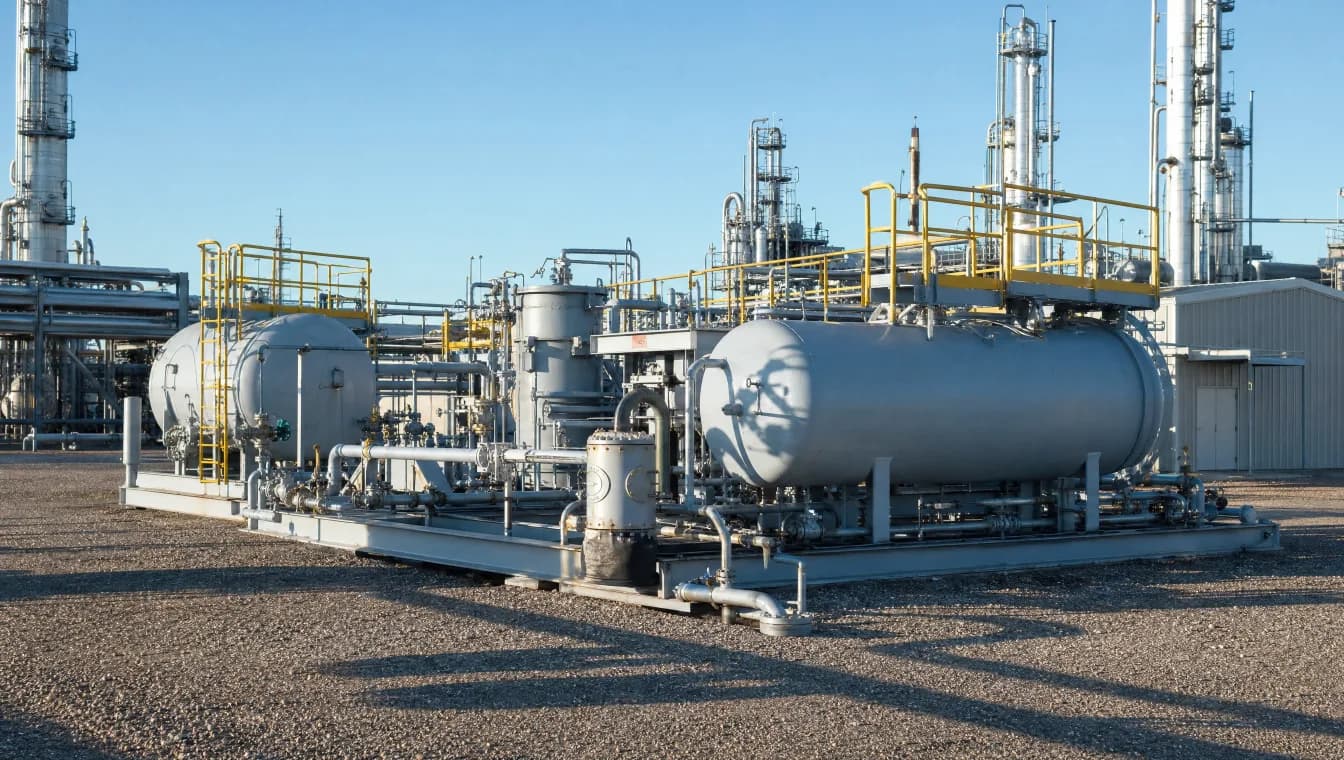
Oil and water separate on their own, given time. The entire discipline of oil and gas wastewater treatment exists because nobody in the industry has that time, and because the last few percent of oil refuses to leave without help. Free oil rises and skims easily. Dispersed droplets need coalescing plates or gas flotation. Emulsified oil, stabilized by production chemicals and shear from pumps, needs chemistry to break before any mechanical device can touch it. Knowing which fraction dominates your stream decides the equipment, which is why we ask for an oil-in-water analysis before we quote anything.
Applications across the value chain
The applications span the value chain. Upstream, produced water from Alberta and Saskatchewan wells carries oil, solids and dissolved salts, and is treated for reinjection, disposal, or reuse in waterfloods, where oil carryover fouls injection formations. Midstream terminals and truck washouts generate slop oil and tank bottoms. Downstream, refineries run API separators as the first line, followed by dissolved gas or air flotation ahead of biological treatment. Gas plants add their own stream: amine and glycol wastes that behave nothing like produced water and should never be mixed with it.
Separators built to API 421
Our equipment for this sector includes API oil water separator packages built to the API 421 gravity-separation design method, corrugated and inclined plate coalescing separators for tighter footprints, induced and dissolved gas flotation units, skimmer systems, and coalescing filter vessels for final polishing where discharge or reinjection specs demand single-digit oil concentrations. For remote batteries and early-production facilities the package arrives skid-mounted and winterized.
Limits differ by regulator
Alberta Energy Regulator directives, Saskatchewan disposal rules and federal offshore regulations each define oil-in-water limits differently, so we design against your specific approval rather than a generic number.
Where your water goes next
Send us the analysis, the flow range and the destination of the water, whether that is disposal well, waterflood or surface discharge. The proposal that comes back will name the separation stages, the expected outlet quality at each, and the turndown behaviour, because oilfield flows never stay at design point for long. A practical note on solids: produced sand and fines shorten the life of every separation stage, so where the well history shows sand production we put hydrocyclones or filtration ahead of the separator rather than letting the API vessel become a settling basin.
Sherbrooke anchors the Estrie manufacturing economy: machinery builders, rubber and plastics processors, food plants and a surviving textile sector spread through a city of 173,000 on the Rivière Saint-François. Discharges follow Quebec's MELCCFP framework, and the city's own sewer rules govern connections to the municipal plant. What colours the market is the university presence, Université de Sherbrooke's engineering faculty feeds the region a steady supply of talent and a taste for trying newer treatment approaches. Estrie manufacturing base with university-driven cleantech adoption. That is the regulatory backdrop for oil & Gas / Produced Water in Sherbrooke: equipment gets sized against the local limits on the route to Rivière Saint-François, not against a national average.
Location
Sherbrooke, Quebec
Population 173K
Receiving Water
Rivière Saint-François
Pricing
Sized & quoted per project
What's Included in Sherbrooke
Sizing against Sherbrooke's sewer-use and surcharge regime (estrie manufacturing base with university-driven cleantech adoption)
Support for direct-discharge projects requiring a ministerial authorization under section 22 of Quebec's Environment Quality Act
Effluent characterization matched to Sherbrooke's dominant dischargers: machinery, rubber & plastics, food processing, textiles
Discharge route review for systems releasing toward Rivière Saint-François
Oil & Gas / Produced Water on the ground in Sherbrooke
Sherbrooke's university-fed manufacturing base pilots newer industrial wastewater technologies, electrocoagulation, MBRs, earlier than comparable cities, with the trial often co-supervised from a campus lab. In Sherbrooke, the plants asking about oil & Gas / Produced Water are mostly in machinery, rubber & plastics, food processing and textiles, and each of those sectors puts a different load on a treatment train. Estrie manufacturing base with university-driven cleantech adoption. Direct discharge toward Rivière Saint-François instead requires a ministerial authorization under section 22 of Quebec's Environment Quality Act. In a city of Sherbrooke's size the industrial dischargers are few enough that the utility knows each one by name, which cuts both ways at permit renewal. Projects in Sherbrooke tend to be one-of-a-kind rather than repeat configurations, which is exactly the case where sizing from measured effluent data matters most.
FAQ
Frequently Asked Questions
Everything you need to know about our services.
Do you supply oil & Gas / Produced Water in Sherbrooke?
Yes. Industrial Wastewater Canada sizes and supplies oil & Gas / Produced Water for plants across Sherbrooke and the surrounding region. Most local demand comes from machinery, rubber & plastics, food processing, textiles. Send a quote request with your flow rate and effluent type and a sized proposal follows.
What discharge rules apply to industrial wastewater in Sherbrooke?
Estrie manufacturing base with university-driven cleantech adoption. A mid-size market that adopts early Sherbrooke plants punch above their size in cleantech adoption. A rubber processor here is more likely than its Ontario counterpart to pilot electrocoagulation or a membrane bioreactor, partly because a professor's lab will co-supervise the trial. Plants discharging to the municipal sewer answer to that regime; anything released directly toward Rivière Saint-François needs a ministerial authorization under section 22 of Quebec's Environment Quality Act. We size equipment against whichever limit governs your outfall.
How is oil & Gas / Produced Water sized for a plant in Sherbrooke?
From your numbers, not from the city's. We start with measured flow and effluent characterization, then check the result against Sherbrooke's local limits. A processor in a city of 173K with machinery as the dominant sector rarely has the same loading profile as its neighbours, so treatability data drives the selection.
What does oil & Gas / Produced Water cost in Sherbrooke?
There is no list price; every system is sized and quoted per project. The economics are local, though. The industrial streams themselves are varied: latex and additive-laden rinses from rubber lines, oily machinery wastewater, food-plant BOD in the 1,500 to 3,000 mg/L range. All of it lands in a francophone regulatory process where the attestation file, the pilot report and the operator training work best written in French from the start. Payback in Sherbrooke is usually calculated against those surcharge and compliance costs, and the quote spells that comparison out.
Send the flow rate. Get the system.
Flow, contaminants, discharge limit. An engineer replies with a sized treatment train and a quote — no obligation.
In this city
Equipment available here.
Industrial Wastewater Treatment Systems→Oil Water Separators→Dissolved Air Flotation (DAF) Systems→Membrane Bioreactor (MBR) Systems→MBBR Systems (Moving Bed Biofilm Reactors)→Lamella Clarifiers→Sludge Dewatering Screw Presses→Dewatering Centrifuges→Industrial Reverse Osmosis Systems→Wastewater Evaporators & ZLD Systems→Belt Filter Presses→Coalescing Filters→Industrial Bag & Cartridge Filtration→Food & Beverage Processing→Dairy Processing→Breweries & Distilleries→Meat & Poultry Processing→Pulp & Paper→Pharmaceutical & Biotech→Textile & Dyeing→Mining & Mineral Processing→Oil & Gas / Produced Water→Metal Finishing & Plating→Chemical Manufacturing→Power, Boilers & Cooling Towers→
Nearby cities