Loading...
Sludge Dewatering Screw Presses in Ottawa, Ontario
Industrial Wastewater Canada sizes and supplies sludge dewatering screw presses for plants in Ottawa, Ontario. Local demand is driven by high-tech, food processing, federal facilities, biotech, discharging under Ottawa's sewer-use rules toward Ottawa River. Quote requests with flow rate and effluent type get a sized proposal.
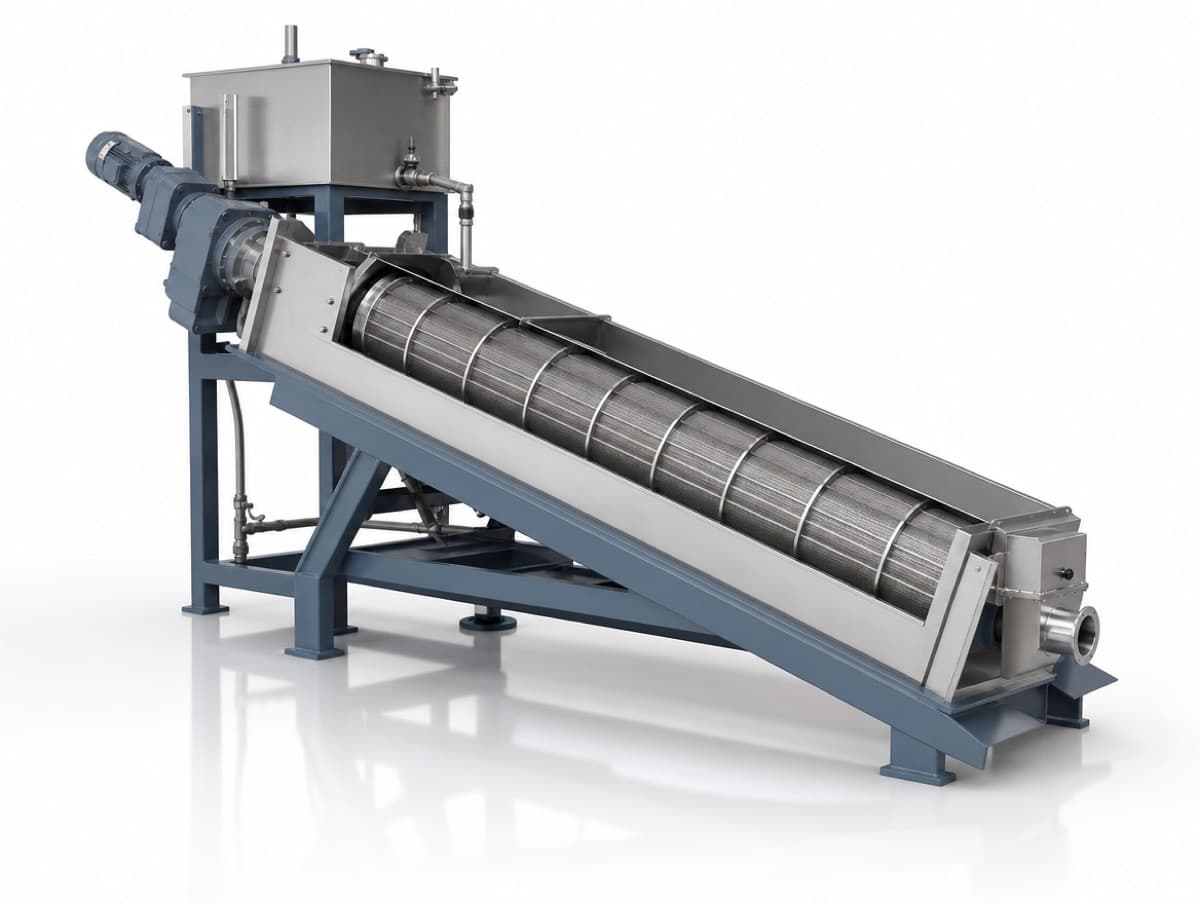
A sludge dewatering screw press turns at one to two revolutions per minute. That single number explains most of why plants choose it. Slow rotation means low wear, low energy draw, almost no noise, and a machine that runs 24/7 unattended while producing a stackable cake at 18 to 30 percent dry solids from municipal and industrial biosolids.
A patient mechanism
The mechanism is patient rather than violent. A slowly turning screw conveys conditioned sludge through a cylindrical screen basket while the flight pitch tightens and the shaft diameter grows, squeezing free water out through the screen as the sludge travels. Filtrate drains continuously, cake discharges against an adjustable pressure cone, and the whole process happens inside a fully enclosed body, so there are no aerosols and no odour escaping into the building. For operators, that enclosure is often the deciding argument after years with an open belt press: no spray, no washdown shift, and washwater consumption that is a small fraction of what a belt machine drinks.
Polymer dosing that tracks the sludge
Polymer conditioning still matters, and our packages integrate automatic polymer dosing that tracks feed rate, so the chemistry follows the sludge instead of being set once and forgotten. Turndown is wide; the same machine handles the Monday surge and the Sunday trickle without operator intervention, which is exactly what a small municipal plant or a food processor without a dedicated dewatering operator needs. Maintenance is measured in years rather than months because at these speeds there is very little to wear out.
Where the alternatives fit
The alternatives each have their place, and we sell those too. A centrifuge beats a screw press on cake dryness when every point of dry solids counts against hauling fees. A belt press wins on very high throughput. The screw press wins on total cost of ownership for small and mid-sized plants: lowest energy per tonne, least operator attention, quietest installation and simplest cleaning. The 140 monthly Canadian searches for this machine come disproportionately from plants replacing exactly those older technologies.
Sizing inputs
Sizing is driven by sludge type, feed solids concentration and throughput, so send us your sludge source, your current volumes and a recent analysis if you have one. We return a sized configuration, budget price and delivery timeline for your facility, anywhere in Canada, and every proposal crosses a process engineer's desk before it crosses yours. Pilot and rental arrangements can be made where the sludge is unusual enough to warrant proof first. Screen baskets and screw flights are supplied as replacement parts with known lead times, and the enclosed body opens for inspection without special tooling, which keeps the maintenance you rarely need simple when it finally comes due.
Ottawa's wastewater profile is unusual for a city of more than a million: alongside conventional food processors sits the largest concentration of federal facilities, research institutions and laboratories in the country, each generating small but chemically awkward waste streams. Sewer Use By-law 2003-514 governs what reaches the Ottawa River via the city's treatment plant, and it treats lab solvents, photographic chemistry and biotech media with the same rigour as a factory outfall. Small flows, complicated chemistry The typical Ottawa project is not a 1,000 m³/day food plant. Sewer Use By-law 2003-514; large institutional and lab wastewater segment. That is the regulatory backdrop for sludge Dewatering Screw Presses in Ottawa: equipment gets sized against the local limits on the route to Ottawa River, not against a national average.
Location
Ottawa, Ontario
Population 1,017K
Receiving Water
Ottawa River
Pricing
Sized & quoted per project
What's Included in Ottawa
Sizing against Ottawa's sewer-use and surcharge regime (sewer Use By-law 2003-514; large institutional and lab wastewater segment)
Support for direct-discharge projects requiring an Environmental Compliance Approval from Ontario's Ministry of the Environment, Conservation and Parks
Effluent characterization matched to Ottawa's dominant dischargers: high-tech, food processing, federal facilities, biotech
Discharge route review for systems releasing toward Ottawa River
Sludge Dewatering Screw Presses on the ground in Ottawa
Ottawa's industrial wastewater market is dominated by federal labs and biotech facilities discharging small, chemically awkward streams under Sewer Use By-law 2003-514, work that rewards instrumentation over sheer tank volume. In Ottawa, the plants asking about sludge Dewatering Screw Presses are mostly in high-tech, food processing, federal facilities and biotech, and each of those sectors puts a different load on a treatment train. Sewer Use By-law 2003-514; large institutional and lab wastewater segment. Direct discharge toward Ottawa River instead requires an Environmental Compliance Approval from Ontario's Ministry of the Environment, Conservation and Parks. A metro of Ottawa's size runs enough industrial flow that the municipal plant polices its intake closely, and surcharge invoices arrive on schedule. Projects in Ottawa tend to be one-of-a-kind rather than repeat configurations, which is exactly the case where sizing from measured effluent data matters most.
FAQ
Frequently Asked Questions
Everything you need to know about our services.
Do you supply sludge Dewatering Screw Presses in Ottawa?
Yes. Industrial Wastewater Canada sizes and supplies sludge Dewatering Screw Presses for plants across Ottawa and the surrounding region. Most local demand comes from high-tech, food processing, federal facilities, biotech. Send a quote request with your flow rate and effluent type and a sized proposal follows.
What discharge rules apply to industrial wastewater in Ottawa?
Sewer Use By-law 2003-514; large institutional and lab wastewater segment. It is a 5 to 50 m³/day stream from a vaccine facility, a federal research campus or a microelectronics fab, where the challenge is characterization and neutralization rather than sheer volume. That favours compact, well-instrumented systems: pH control with real redundancy, effluent holding for batch certification before release, and logging the by-law inspector can audit. Plants discharging to the municipal sewer answer to that regime; anything released directly toward Ottawa River needs an Environmental Compliance Approval from Ontario's Ministry of the Environment, Conservation and Parks. We size equipment against whichever limit governs your outfall.
How is sludge Dewatering Screw Presses sized for a plant in Ottawa?
From your numbers, not from the city's. We start with measured flow and effluent characterization, then check the result against Ottawa's local limits. A processor in a city of 1,017K with high-tech as the dominant sector rarely has the same loading profile as its neighbours, so treatability data drives the selection.
What does sludge Dewatering Screw Presses cost in Ottawa?
There is no list price; every system is sized and quoted per project. The economics are local, though. Food and beverage plants along the city's east end still need classic BOD reduction, and we serve both ends of that spectrum. Payback in Ottawa is usually calculated against those surcharge and compliance costs, and the quote spells that comparison out.
Send the flow rate. Get the system.
Flow, contaminants, discharge limit. An engineer replies with a sized treatment train and a quote — no obligation.
In this city
Equipment available here.
Industrial Wastewater Treatment Systems→Oil Water Separators→Dissolved Air Flotation (DAF) Systems→Membrane Bioreactor (MBR) Systems→MBBR Systems (Moving Bed Biofilm Reactors)→Lamella Clarifiers→Sludge Dewatering Screw Presses→Dewatering Centrifuges→Industrial Reverse Osmosis Systems→Wastewater Evaporators & ZLD Systems→Belt Filter Presses→Coalescing Filters→Industrial Bag & Cartridge Filtration→Food & Beverage Processing→Dairy Processing→Breweries & Distilleries→Meat & Poultry Processing→Pulp & Paper→Pharmaceutical & Biotech→Textile & Dyeing→Mining & Mineral Processing→Oil & Gas / Produced Water→Metal Finishing & Plating→Chemical Manufacturing→Power, Boilers & Cooling Towers→
Nearby cities