Loading...
Coalescing Filters in Corner Brook, Newfoundland and Labrador
Industrial Wastewater Canada sizes and supplies coalescing filters for plants in Corner Brook, Newfoundland and Labrador. Local demand is driven by pulp & paper, seafood processing, forestry, port services, discharging under Corner Brook's sewer-use rules toward Humber Arm. Quote requests with flow rate and effluent type get a sized proposal.
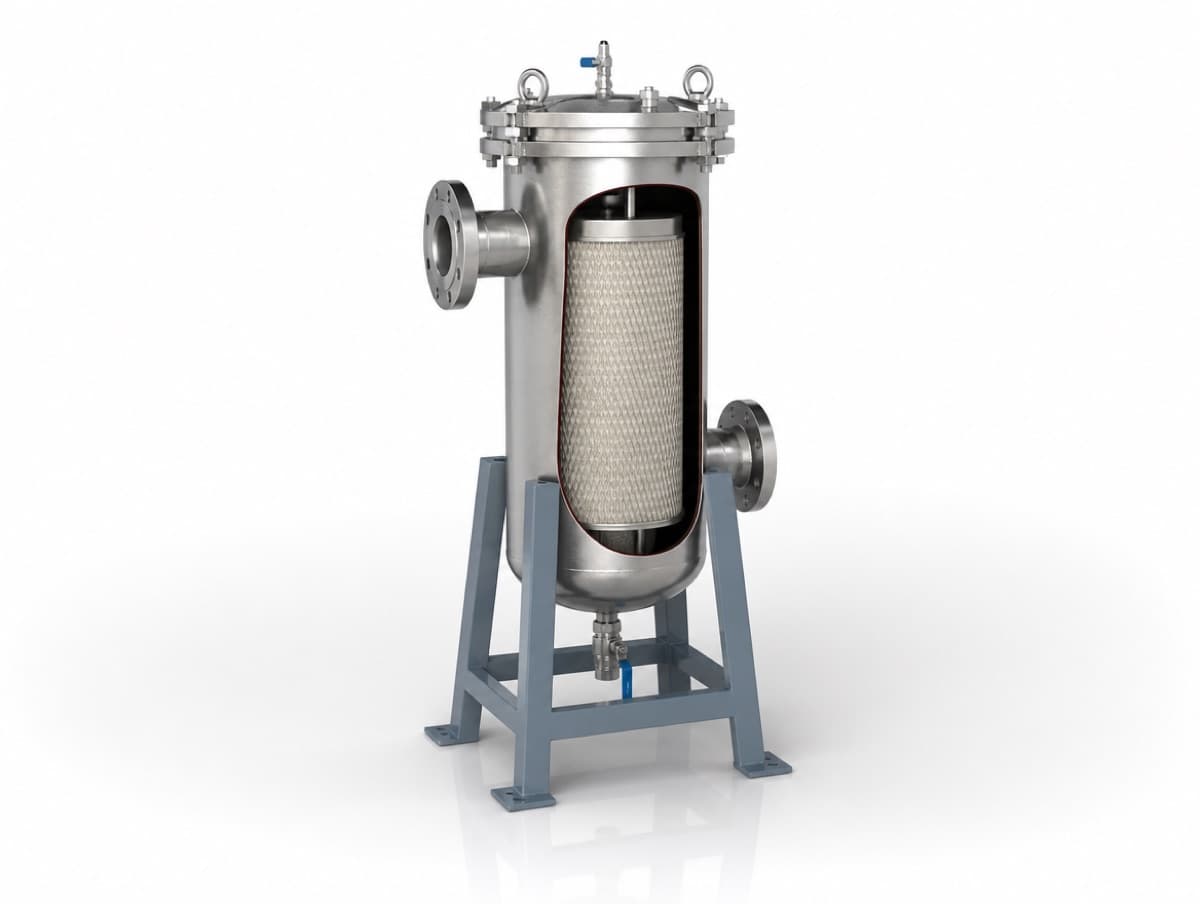
Free oil rises out of water on its own if you give it a quiet tank and a little time. Emulsified oil does not. Droplets of 20 microns and below stay dispersed indefinitely, sail straight through a gravity separator, and show up in your effluent sample as an oil and grease exceedance you cannot explain. The coalescing filter exists for exactly this gap.
Collision and capture
The mechanism is collision and capture. Wastewater passes through oleophilic media or inclined plate packs, surfaces that oil wets preferentially. Fine droplets collide with the media, stick, and merge with the droplets already there, growing until buoyancy takes over and carries them to the surface for skimming. A compact vessel can hold effluent oil below 10 to 15 mg/L on free and dispersed oil, performance a plain gravity tank cannot reach at any residence time that fits inside a building.
Where coalescers earn their place
Where these units earn their place: downstream of machine shops and compressor condensate systems, on wash bay and fuel handling drainage, and as a polishing stage after an API separator, capturing the fine fraction the big basin lets through. We supply both liquid-liquid configurations for oily water and gas-liquid configurations that strip sub-micron aerosols from compressed air and gas streams, in stainless or carbon steel vessels matched to the service.
Two installation details that matter
Two housekeeping details separate a good installation from a frustrating one. First, media type: plate-pack and permanent-media coalescers are not consumables; the packs are removed, washed and returned, typically serving for the life of the vessel. Cartridge-style elements do load up with solids and are changed on a differential-pressure schedule, typically once or twice a year in industrial service, and our vessels carry differential-pressure indicators so the change-out is scheduled rather than discovered. Second, upstream solids: a simple strainer or settling stage ahead of the coalescer extends media life dramatically, and we design for easy pack removal so cleaning stays a maintenance task instead of a shutdown. We also cross-reference OEM cartridges directly, so replacement elements for an existing housing are a part number away.
What coalescers cannot do
One honest limit: coalescers do not remove chemically emulsified or dissolved oil. Surfactant-stabilized emulsions need chemical treatment or flotation, and we will say so before quoting. Send your flow rate, an analysis and your discharge limit, and a process engineer returns a sized configuration, budget price and delivery timeline, anywhere in Canada. Spare packs and cartridges are stocked against your housing model, and change-out procedures are documented at commissioning so the differential-pressure alarm leads to a scheduled swap, not a scramble.
Corner Brook is a one-mill town in the truest sense: the Kruger paper operation on the Humber Arm has anchored the west-coast Newfoundland economy for a century, and its water use dwarfs everything else in this city of 19,000. Seafood processors, forestry contractors and port services complete an industrial base that discharges toward the Humber Arm, a deep fjord-like inlet opening to the Gulf of St. Lawrence. Kruger paper mill anchors the west-coast NL industrial base. That is the regulatory backdrop for coalescing Filters in Corner Brook: equipment gets sized against the local limits on the route to Humber Arm, not against a national average.
Location
Corner Brook, Newfoundland and Labrador
Population 19K
Receiving Water
Humber Arm
Pricing
Sized & quoted per project
What's Included in Corner Brook
Sizing against Corner Brook's sewer-use and surcharge regime (kruger paper mill anchors the west-coast NL industrial base)
Support for direct-discharge projects requiring a certificate of approval under Newfoundland and Labrador's Environmental Protection Act
Effluent characterization matched to Corner Brook's dominant dischargers: pulp & paper, seafood processing, forestry, port services
Discharge route review for systems releasing toward Humber Arm
Coalescing Filters on the ground in Corner Brook
Corner Brook's century-old Kruger mill uses more water than the rest of the city combined, and every wastewater upgrade there is a publicly watched regional event on a salmon-river inlet. In Corner Brook, the plants asking about coalescing Filters are mostly in pulp & paper, seafood processing, forestry and port services, and each of those sectors puts a different load on a treatment train. Kruger paper mill anchors the west-coast NL industrial base. Direct discharge toward Humber Arm instead requires a certificate of approval under Newfoundland and Labrador's Environmental Protection Act. Corner Brook's municipal plant has limited spare capacity, so a single overloaded industrial connection shows up quickly in its intake numbers. Projects in Corner Brook tend to be one-of-a-kind rather than repeat configurations, which is exactly the case where sizing from measured effluent data matters most.
FAQ
Frequently Asked Questions
Everything you need to know about our services.
Do you supply coalescing Filters in Corner Brook?
Yes. Industrial Wastewater Canada sizes and supplies coalescing Filters for plants across Corner Brook and the surrounding region. Most local demand comes from pulp & paper, seafood processing, forestry, port services. Send a quote request with your flow rate and effluent type and a sized proposal follows.
What discharge rules apply to industrial wastewater in Corner Brook?
Kruger paper mill anchors the west-coast NL industrial base. The mill sets the scale, the Arm sets the standard Paper-machine effluent at mill scale, fibre, dissolved organics, process chemistry, runs through treatment infrastructure whose upgrades are engineering projects of regional significance, tracked publicly because the mill's fortunes are the region's fortunes. The Humber Arm's salmon rivers and fishery keep receiving-water quality a community concern rather than a technical one. Plants discharging to the municipal sewer answer to that regime; anything released directly toward Humber Arm needs a certificate of approval under Newfoundland and Labrador's Environmental Protection Act. We size equipment against whichever limit governs your outfall.
How is coalescing Filters sized for a plant in Corner Brook?
From your numbers, not from the city's. We start with measured flow and effluent characterization, then check the result against Corner Brook's local limits. A processor in a city of 19K with pulp & paper as the dominant sector rarely has the same loading profile as its neighbours, so treatability data drives the selection.
What does coalescing Filters cost in Corner Brook?
There is no list price; every system is sized and quoted per project. The economics are local, though. Around the mill, fish plants bring seasonal high-strength loads to a municipal system with limited industrial capacity, making pretreatment less optional than in larger centres. Remoteness completes the design brief: equipment serviceable by local trades, spares on the island, and suppliers who answer the phone in February. Payback in Corner Brook is usually calculated against those surcharge and compliance costs, and the quote spells that comparison out.
Send the flow rate. Get the system.
Flow, contaminants, discharge limit. An engineer replies with a sized treatment train and a quote — no obligation.
In this city
Equipment available here.
Industrial Wastewater Treatment Systems→Oil Water Separators→Dissolved Air Flotation (DAF) Systems→Membrane Bioreactor (MBR) Systems→MBBR Systems (Moving Bed Biofilm Reactors)→Lamella Clarifiers→Sludge Dewatering Screw Presses→Dewatering Centrifuges→Industrial Reverse Osmosis Systems→Wastewater Evaporators & ZLD Systems→Belt Filter Presses→Coalescing Filters→Industrial Bag & Cartridge Filtration→Food & Beverage Processing→Dairy Processing→Breweries & Distilleries→Meat & Poultry Processing→Pulp & Paper→Pharmaceutical & Biotech→Textile & Dyeing→Mining & Mineral Processing→Oil & Gas / Produced Water→Metal Finishing & Plating→Chemical Manufacturing→Power, Boilers & Cooling Towers→
Nearby cities
Also serving these cities.
All wastewater treatment service areas in Newfoundland & Labrador